

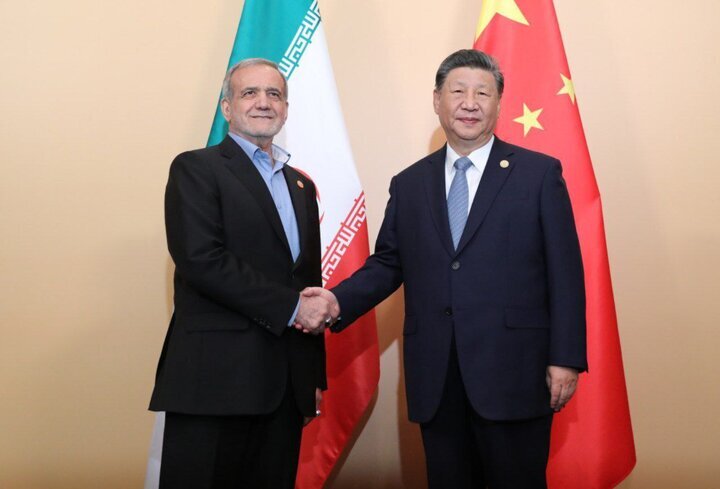
SHAOXING, ZHEJIANG- Wars often redefine international relationships. The recent conflict between Iran and the United States may prove to be one of those moments. As military confrontation gives way to diplomacy, Tehran is sending a clear signal: rebuilding and strengthening relations with China has become one of its highest foreign policy priorities
The clearest indication came from reports that Iranian Parliament Speaker Mohammad Bagher Ghalibaf—who also serves as Iran’s Special Representative for China Affairs—is expected to visit Beijing. His recent speeches in Tehran leave little doubt about the direction of Iran’s diplomacy. Iran is no longer looking only for stronger economic cooperation with China. It wants a broader strategic partnership, one that includes political coordination, investment, technology, infrastructure and regional security.
Yet Ghalibaf’s remarks also reveal an uncomfortable reality. Five years after China and Iran signed their 25-Year Comprehensive Cooperation Agreement, the partnership has yet to reach the level that either side originally envisioned
The reasons are not difficult to identify. International sanctions have complicated China’s commercial engagement with Iran, while years of domestic political and economic uncertainty have discouraged large-scale investment. At the same time, Beijing has pursued a balanced Middle East policy, strengthening ties not only with Iran but also with Saudi Arabia, the United Arab Emirates and other Persian Gulf states. Such a strategy inevitably limits how far and how fast China is prepared to deepen cooperation with Tehran.
From Iran’s perspective, however, the picture looks rather different. Many Iranians believe Beijing has been excessively cautious in implementing the comprehensive cooperation agreement and believe Beijing has been overly cautious in developing relations with Iran and too willing to yield to pressure from the United States. Some also believe that China’s position on the three islands in the Persian Gulf has failed to reflect what Tehran regards as one of its core national interests.
These different interpretations expose a more fundamental problem. The greatest obstacle to deeper China–Iran cooperation is not the absence of shared interests. It is the shortage of strategic trust
This matters now more than ever. West Asia is undergoing one of its most significant geopolitical transformations in decades. Regional powers are pursuing greater strategic autonomy, expanding their diplomatic options and reducing excessive dependence on any single great power.
In this changing environment, China and Iran have every reason to work more closely together. But shared interests alone cannot sustain a long-term strategic partnership. That requires confidence in each other’s intentions
Building such confidence will not be easy. One challenge lies in how each country understands its own place in the international system
Following what Iranian leaders regard as a successful defence of the country during the recent conflict, many in Tehran believe Iran’s international standing has risen substantially. They increasingly see their country not merely as a regional power but as an influential actor whose voice should carry greater weight in shaping regional and international affairs
Meanwhile, Beijing increasingly sees China as a superpower on a par with the United States. From this perspective, although Iran is an important regional partner, the two countries naturally occupy different positions within the global hierarchy. Such differences in strategic self-perception can easily produce mismatched expectations, making mutual trust more difficult to build
None of this, however, diminishes the strong complementarity between the two countries
Iran possesses abundant energy resources, a strategic geographical location and enormous development potential. Even to ensure the continuity of its political system, Tehran will need to pursue necessary reforms. Such reforms are likely to make Iran a stronger and more prosperous country. As regional tensions gradually ease and sanctions are expected to become less restrictive, Iran is likely to attract growing international investment.
Even if European and American companies eventually return to the Iranian market, China will continue to enjoy important advantages. Chinese companies have accumulated valuable experience in Iran over many years, while Chinese products have become increasingly competitive in both quality and affordability. China has also made internationally recognised advances in high-technology sectors, further enhancing its attractiveness as a long-term economic partner for Iran.
Meanwhile, Iran itself is unlikely to abandon its policy of diversified diplomacy. Tehran has consistently sought to avoid excessive dependence on any single external power, and that principle will almost certainly remain central to its foreign policy after the war. China therefore does not need to become Iran’s exclusive partner to remain one of its most important strategic partners
Ultimately, China and Iran are connected by converging interests. Yet if the two countries genuinely hope to transform their relationship into a mature strategic partnership, economic cooperation alone will not be enough. Greater strategic trust must become the foundation of future cooperation
Against this backdrop, Ghalibaf’s expected visit to China is about much more than diplomacy. It offers both governments an opportunity to address long-standing misunderstandings and reinforce political confidence at a time when the Middle East is being reshaped by profound geopolitical change
Strategic partnerships are built on common interests. Enduring partnerships are built on trust. China and Iran have already established the first. Their next challenge is to achieve the second
Hongda Fan is the director of the China–Middle East Center at Shaoxing University, and a visiting scholar at the Middle East Institute of National University of Singapore
