

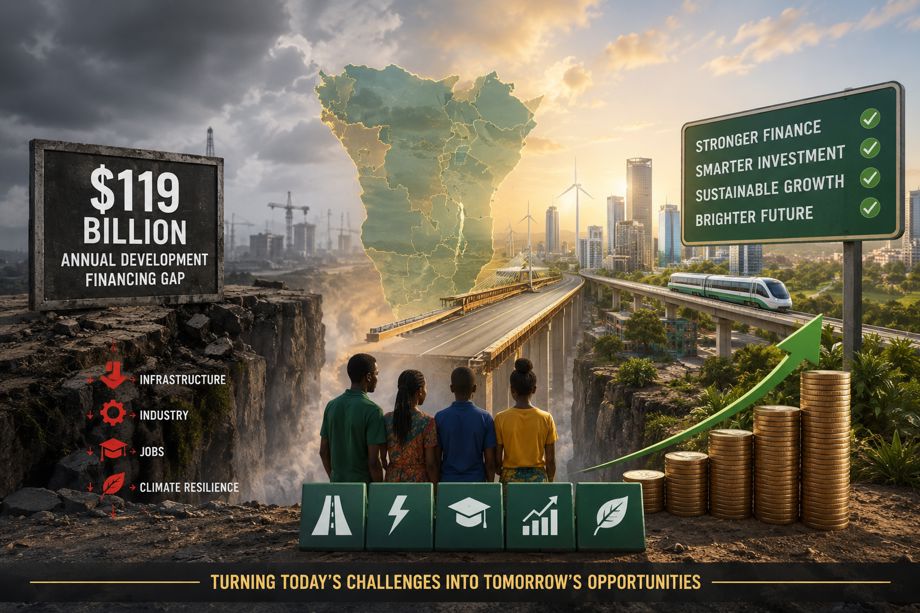
East Africa remains the continent’s fastest-growing region, but the African Development Bank estimates that it faces an annual development financing gap of about US$119 billion. The central challenge identified in the Bank’s 2026 regional and Kenya reports is no longer growth alone, but whether governments can convert that momentum, domestic savings and private capital into infrastructure, productive industries and jobs.
East Africa’s economic expansion accelerated sharply in 2025, reinforcing its position as Africa’s fastest-growing region. According to the African Development Bank’s East Africa Economic Outlook 2026, regional growth rose from 4.3 percent in 2024 to an estimated 6.6 percent in 2025, supported by resilient household consumption, stronger public and private investment, improved agricultural production and continued services-sector expansion.
The AfDB report identifies Ethiopia, Rwanda, Tanzania and Kenya among the economies recording some of the region’s strongest performances, but it also cautions that growth remains uneven and vulnerable to domestic and external shocks. Regional expansion is projected to moderate to 5.9 percent in 2026 as geopolitical tensions, higher energy and fertiliser prices and supply-chain disruptions weigh on economic activity.
The distinction between rapid growth and genuine economic transformation is crucial. The regional outlook says expansion remains heavily dependent on services, modest industrial growth and climate-sensitive agriculture. Eight of the region’s 13 economies recorded growth below 5 percent in 2025, illustrating how the regional average can obscure weaker performance in smaller and more fragile states.
This means East Africa can remain the continent’s strongest growth performer without creating enough productive employment, manufacturing capacity or export diversification. The region’s policy challenge is therefore not simply to preserve headline GDP growth, but to ensure that growth produces stronger domestic industries, more resilient public finances and broader economic opportunities.
The AfDB expects East Africa to remain the continent’s fastest-growing region over the medium term. However, the Bank also identifies geopolitical fragmentation, climate shocks, tighter financial conditions and disruptions to trade and supply chains as major downside risks, particularly for fuel-importing countries such as Kenya, Ethiopia, Rwanda and Tanzania.
The $119 Billion Hole Behind the Headline
The most consequential number in the regional outlook is not the 6.6 percent growth rate. It is the estimated US$119 billion that East Africa lacks each year to meet its development and climate-related investment requirements.
The East Africa Economic Outlook 2026 links this financing gap to infrastructure shortages, limited energy access, low industrialisation, high youth unemployment and rising climate vulnerability. It estimates that gross capital formation, the share of economic output invested in assets such as infrastructure, machinery and productive facilities, averaged about 18.2 percent of regional GDP in 2024. That compares with 33.4 percent in middle-income economies.
The investment deficit helps explain why strong GDP growth has not produced transformation at the same pace. Transport networks, energy systems, irrigation, digital connectivity and industrial facilities require large volumes of patient, long-term capital. When investment remains below the level needed to expand productive capacity, consumption and services can continue driving growth while structural bottlenecks persist.
The AfDB identifies three interconnected financing constraints: limited domestic recaused by weak public financial management and illicit financial flows. Tax revenues remain below 17 percent of GDP in many countries, while private-sector credit is below 35 percent of GDP in much of the region. Capital markets, pension systems and insurance sectors also remain too shallow to provide sufficient long-term finance
The fiscal environment makes the problem harder. According to the regional report, East Africa’s average fiscal deficit widened from 3.3 percent of GDP in 2024 to an estimated 3.8 percent in 2025 and is projected to reach 4.2 percent in 2026. Rising debt-service costs, infrastructure needs and external shocks are limiting the room governments have to sustain development and social spending.
The region faces an increasingly difficult equation. Governments need to invest more, but many cannot safely rely on additional borrowing. External capital is becoming more expensive and volatile, while dependence on foreign-currency finance increases exposure to exchange-rate shocks.
The AfDB’s proposed direction is to mobilise more finance from within the region, through broader and more efficient tax systems, deeper capital markets, pension and insurance assets, diaspora savings and private investment, while improving how public re
Kenya Shows Why Capital Is Not Reaching Transformation
The AfDB’s Kenya Country Focus Report 2026 provides a national example of the wider regional problem. Kenya has a sophisticated financial sector, high levels of digital financial inclusion and an expanding pool of domestic savings. Yet the report argues that its central challenge is not access to finance alone, but the ability to channel capital towards long-term productive investment.
Kenya’s economy grew by an estimated 5 percent in 2025, up from 4.7 percent in 2024, according to the country report. Services accounted for 53.1 percent of GDP and contributed three percentage points to growth, supported by information technology, financial services, mobile-money activity and digital financial intermediation.
However, fiscal pressures remain severe. The Kenya report estimates public debt at 69.9 percent of GDP in 2025, above the country’s internal debt anchor, while interest payments absorbed about 34 percent of government revenue. That combination constrains fiscal space and reduces the re
The scale of the financing requirement is substantial. The Kenya Country Focus Report 2026 estimates annual development financing needs at US$14.2 billion, equivalent to 13 percent of GDP, and an associated financing gap of US$12.5 billion by 2030. Roads account for 55 percent of the identified need, education 22 percent and energy 20 percent. The report also notes that recurrent expenditure stood at about 17 percent of GDP in 2025, compared with development expenditure of only 3.5 percent.
The diagnosis goes beyond a shortage of money. The AfDB says weaknesses in project preparation, public-investment efficiency and long-term financing channels prevent Kenya from converting its financial rement-ready projects means capital may exist without credible vehicles through which it can be deployed
Kenya’s institutional savings illustrate the problem. The regional outlook says the country’s pension assets increased from KSh1.84 trillion in 2023 to KSh2.23 trillion in December 2024. Yet pension portfolios remain heavily concentrated in government securities, while exposure to corporate bonds, private equity and infrastructure-type instruments remains limited.
The concentration protects retirement savings through relatively liquid and predictable assets, but it also means less patient capital reaches infrastructure, manufacturing, logistics and renewable energy. The Kenya report links this pattern to prudential restrictions, limited investment-grade infrastructure vehicles, concerns about project governance and weak feasibility preparation.
The Real Race Is to Rebuild the Financing System
The AfDB’s roadmap is not centred on one new fund or financing mechanism. It calls for a broader redesign of how East Africa raises, allocates and governs capital. The East Africa Economic Outlook 2026 recommends stronger tax administration, wider digitalisation, better management of state-owned enterprises and tighter controls against illicit financial flows. It also calls for improved public-private partnership frameworks, stronger project-preparation capacity, blended-finance instruments and greater use of pension, sovereign, diaspora and regional investment pools.
These reforms involve real trade-offs. Governments may need to broaden their tax bases, but aggressive formalisation could place additional pressure on small firms and informal workers. The regional report itself stresses that revenue reforms should be gradual and credible, supported by transparency and visible improvements in public services. It notes that public willingness to accept higher taxation depends partly on whether citizens trust governments to spend the additional revenue effectively.
Private finance can support infrastructure, but it cannot substitute for sound public institutions. Public-private partnerships require transparent contracts, credible demand forecasts and effective management of fiscal risks. Pension assets can support long-term investment, but retirement savings cannot be directed into poorly prepared projects simply because governments need capital.
Regional integration offers another route. The AfDB argues that fragmented national financial markets limit liquidity and prevent domestic savings from reaching cross-border infrastructure and productive investment. Harmonised bond frameworks and linked securities markets could expand the investor base, although the regional outlook notes that Kenya’s deeper market still dominates those of Uganda, Tanzania, Rwanda and Burundi.
The Bank’s larger warning is that East Africa’s financial architecture is not yet keeping pace with its economic ambitions. Shallow markets, high borrowing costs, limited private-sector finance and the close relationship between banks and sovereign borrowing continue to obstruct the efficient allocation of domestic savings.

