

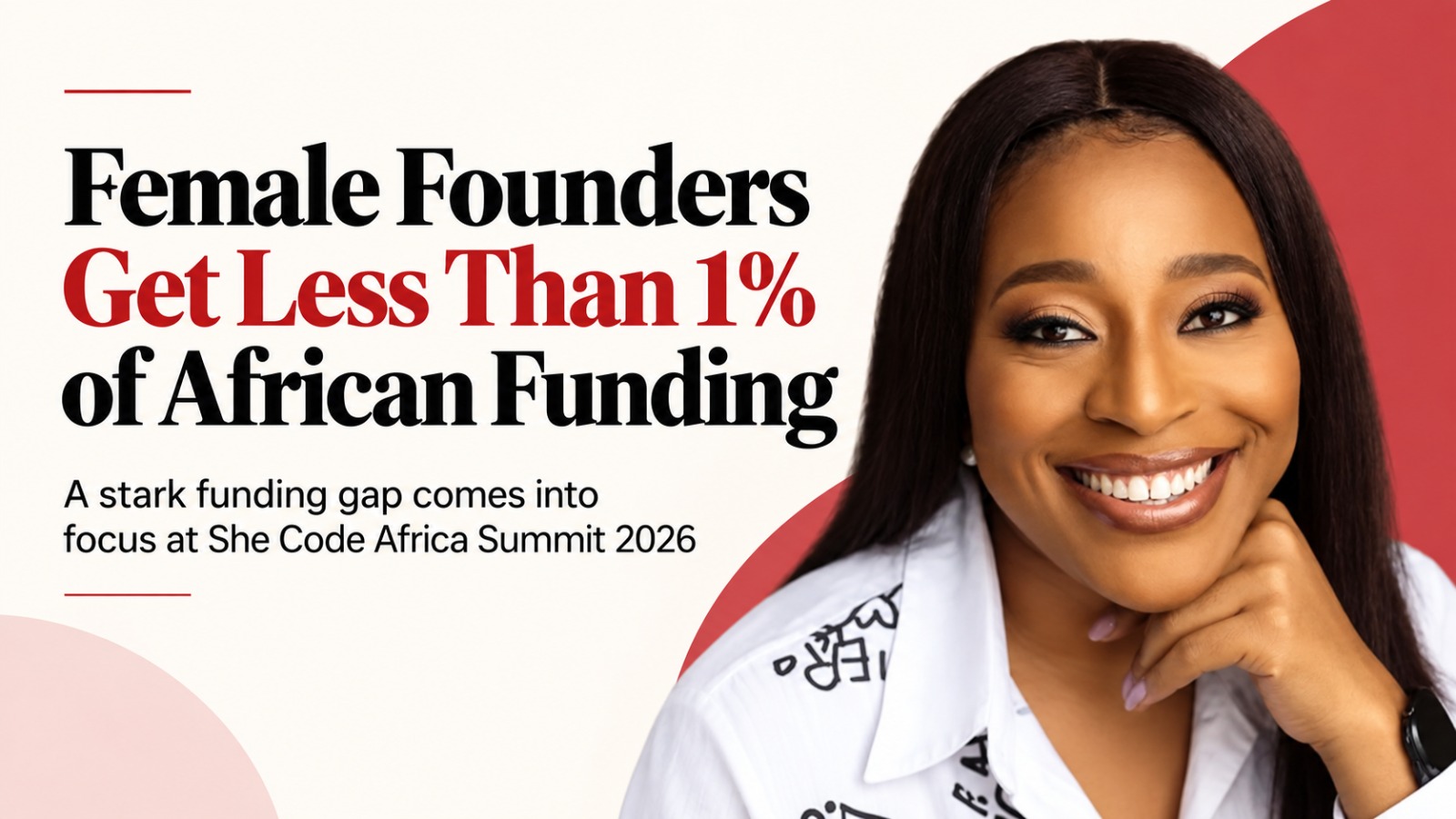
Women-led startups remain on the margins of Africa’s funding landscape, with female solo founders and all-women founding teams receiving less than 1 per cent of tracked capital across African markets, according to figures highlighted at the She Code Africa Summit 2026.
The contrast is sharp. Male solo founders and all-male founding teams accounted for 91 per cent of the tracked funding, while mixed-gender founding teams received 8 per cent. The figures, drawn from Africa: The Big Deal reports, were cited by B4B Partners Managing Partner Napa Onwusahduring a discussion on women’s participation in technology and investment.
The conversation took place as She Code Africa marked its 10th anniversary, but the funding numbers shifted attention from how many women are entering technology to what happens when they try to build, lead and finance companies.
Onwusah argued that putting more women inside investment firms would not, on its own, be enough to narrow the gap. She called for more women to become capital allocators, placing them in positions where investment decisions are actually made.
Women enter STEM, but numbers thin out at the top
The problem extends beyond fundraising.
Onwusah said women account for almost half of STEM graduates, yet represent only 23 to 30 per cent of technology roles. Their share falls further higher up the ladder, to nearly 12 per cent of technology leadership positions and 10 per cent of technology startup chief executives.
Her argument was that participation is only the beginning. Women also need to build companies, develop products, finance ventures and support other women moving through the ecosystem.
She pointed to technical depth, product thinking, commercial understanding and strategic judgment as areas that aspiring technology founders should strengthen.
That focus on what happens after someone decides to become a founder became clearer in another session at the summit, where Shuttlers co-founder and CEO Damilola Olokesusi spoke about the realities of building a business before institutional capital arrives.
Shuttlers spent four years building before seeking outside investment
Olokesusi said Shuttlers spent its first four years building its transportation business without external investment, relying instead on grants and revenue from customers.
Her early approach was unusually hands-on. She said she joined buses as a conductor to understand the transportation business and experience its operational challenges first-hand.
The company eventually reached a stage where bootstrapping could no longer support the scale it wanted. That was when it turned to external capital to develop its technology and expand its customer base.
For Olokesusi, fundraising begins with knowing what kind of company a founder is trying to build. She cautioned that venture capital is not necessarily the right option for every business and advised entrepreneurs to understand their operations, develop relationships with investors and clearly communicate both their value proposition and growth potential.
That distinction matters in a funding debate that can easily become reduced to one question: how can more women raise venture capital?
The speakers at the summit presented a broader question. What kind of capital does a particular business actually need?
Equity is not the only route
Damilola Teidi-Ayoola, Principal, Platform and Networks at Ventures Platform Fund, said founders looking for investment need a firm grasp of their business, industry, customers and financial performance.
She also stressed the importance of matching a company with the appropriate type of financing. Depending on the business, debt or revenue-based financing may make more sense than giving up equity.
At the same time, she called on investors and organisations supporting entrepreneurs to examine biases affecting female founders. Even programmes open to both men and women, she said, receive significantly fewer applications from women.
Esther Otusanya of Endeavor Nigeria added another layer to what investors consider when deciding whether a company can scale. Beyond the headline idea, investors assess factors including cost structure, the founder’s ability to work with others and the strength of the management team.
Founders, she said, also need to show exactly what new capital would accomplish, whether that means entering new markets, increasing revenue or developing additional revenue streams.
She Code Africa says its work has reached 65,000 women and girls
For She Code Africa founder Ada Nduka, the summit also offered a chance to look back at how the organisation itself has changed.
Nduka said the initiative began in 2016 as a storytelling effort focused on making women in technology more visible. It later evolved into a more structured organisation offering learning opportunities, scholarships and other forms of support after recognising that visibility alone was not enough without access to re
She said the organisation has impacted 65,000 women and girls and argued that its progress should ultimately be judged by opportunities created and lives changed.
Nduka called for employers, educators, investors, policymakers and other organisations to work together on more inclusive workplaces, accessible technical education and greater opportunities for businesses led by women.
Her message for the organisation’s next decade was also a shift in ambition: women should not only seek places at existing decision-making tables, but take part in designing those tables and shaping the future of technology in Africa.
The less-than-1-per-cent funding figure gives that ambition a difficult backdrop. The discussion at the summit, however, went beyond simply identifying the gap. It focused on who controls capital, how founders prepare for investment, which forms of financing suit different businesses and what needs to change if more women are to move from participating in Africa’s technology economy to building and funding companies within it.

