

Christopher Nolan’s The Odyssey begins its journey through the ancient world at Ait Benhaddou, the fortified settlement near Ouarzazate in southern Morocco.
The Unesco World Heritage Site helps form the director’s vision of Troy in the film. Its appearance continues a long tradition of protected locations across the Arab world being transformed into ancient kingdoms, biblical cities, hidden temples and distant planets.
From Petra’s role in Indiana Jonesand the Last Crusade (1989) to Wadi Rum’s appearances in The Martian(2015) and Dune (2021), these sites have helped shape some of cinema’s most recognisable worlds.
Ait Benhaddou, Morocco
When Nolan needed Troy, he chose a location whose screen history was already tied to empires, battles and vanished civilisations.
Ait Benhaddou, once positioned along the caravan route between the Sahara and Marrakesh, has earthen buildings grouped within defensive walls reinforced by towers. The settlement can suggest both a thriving city and the remains of a lost one.
That adaptability has made it one of Morocco’s most recognisable filming locations. In Ridley Scott’s Gladiator(2000), the surrounding area became part of the Roman world through which Maximus is taken after his capture. In The Mummy(1999), it contributed to the film’s imagined Egypt, while The Last Temptation of Christ (1988) used Morocco to evoke biblical landscapes.
In The Odyssey, the fortified ksar’s architecture becomes part of the city Odysseus leaves behind before beginning his journey home, placing Nolan’s Troy within a landscape that has spent decades serving as cinema’s shorthand for antiquity.
Petra, Jordan
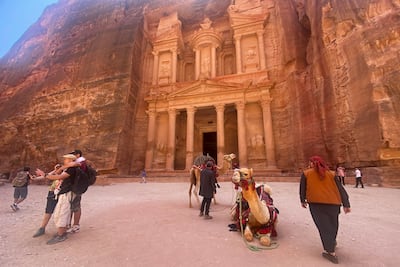
The narrow gorge leading into Petra provided one of the most memorable reveals in the Indiana Jones series.
Near the end of The Last Crusade, Indiana Jones, his father and their companions travel through the Siq before emerging in front of Al Khazneh, the elaborately carved monument commonly known as the Treasury.
Its facade becomes the entrance to the temple containing the holy grail. The chambers were created elsewhere, but the approach and exterior were filmed at Petra.
The sequence follows the characters through the confined passage before the Treasury suddenly fills the frame, requiring little alteration to become the destination of the film’s final search.
Petra was added to the World Heritage List in 1985. The former Nabataean caravan city is partly built and partly carved into sandstone, with tombs, temples and passages surrounded by mountains and gorges.
Unlike locations disguised as fictional places, the Treasury remained unmistakably Petra. The film borrowed the monument’s mystery without erasing its identity, turning it into a Hollywood landmark.
Wadi Rum, Jordan
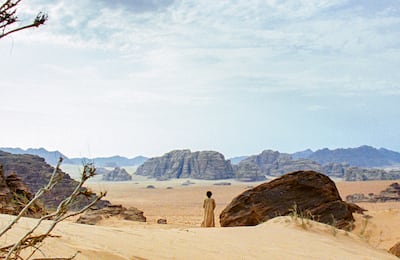
Wadi Rum has perhaps played more worlds than any other protected landscape in the Arab region.
Its sandstone cliffs, natural arches and open desert became closely associated with international cinema through David Lean’s Lawrence of Arabia. The 1962 film used Jordan’s landscape for a story rooted in the region, establishing the scale later productions adopted for varying purposes.
Wadi Rum represented Mars in The Martian, an alien moon in Prometheus(2012) and the planet Jedha in Rogue One: A Star Wars Story(2016). Denis Villeneuve also filmed there for Dune, using the rock formations and expanses as part of the fictional planet Arrakis.
Wadi Rum’s appeal is not simply its emptiness. The cliffs, canyons and shifting colours provide distinctive geographical features, allowing filmmakers to create a coherent world rather than an anonymous stretch of sand.
Unesco inscribed Wadi Rum on its World Heritage List as a mixed natural and cultural site in 2011. It contains thousands of inscriptions, petroglyphs and archaeological traces recording a long history of human presence.
The Jordanian film Theeb (2014) uses the landscape differently. Set during the First World War, Naji Abu Nowar’s drama presents the desert not as a substitute for another planet, but as a lived environment understood by its Bedouin characters.
Giza Pyramid complex, Egypt
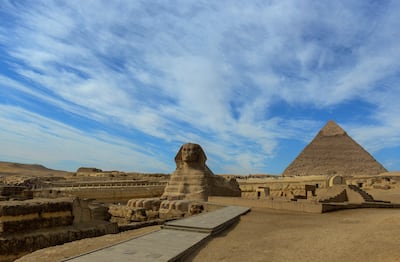
The pyramids are so widely recognised that filmmakers rarely attempt to disguise them as somewhere else.
Instead, productions use the meanings audiences already attach to them: ancient power, mystery and a civilisation whose scale still provokes wonder. The complex has appeared in films including Cleopatra(1963), The Spy Who Loved Me(1977)and Jumper(2008).
In the Bond film, Giza provides the setting for a tense sequence during the sound-and-light show, with the pyramids and Great Sphinx looming over the action. Jumper, meanwhile, uses the site as one of several global landmarks its characters can reach instantaneously.
The complex also appeared in Michael Bay’s Transformers: Revenge of the Fallen(2009), where it was folded into a science-fiction mythology involving an ancient machine concealed in Egypt.
Giza forms part of the Unesco property known as Memphis and its Necropolis, which stretches from the pyramid fields at Giza to Dahshur. Inscribed in 1979, the site charts the development of royal tomb construction in ancient Egypt.
Medina of Sousse, Tunisia
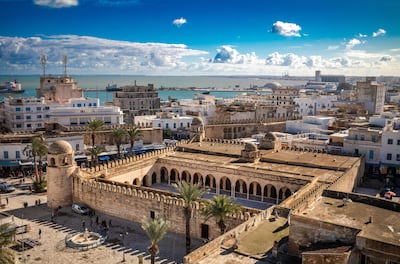
In Monty Python’s Life of Brian, the filmmakers needed a version of Roman-era Jerusalem that could support both historical spectacle and absurdist comedy.
The 1979 production was filmed around Sousse, Monastir and Carthage, using Tunisia’s walls, courtyards, fortifications and ruins to build the world surrounding Brian, the unfortunate man repeatedly mistaken for the messiah.
The Medina of Sousse contributed its defensive architecture and enclosed urban spaces. Its kasbah, ramparts and historic buildings offered the density of an old city without requiring every street to be constructed from scratch.
Unesco added the medina to the World Heritage List in 1988. Its ribat, Great Mosque, kasbah and walls formed part of the defensive system of an early Islamic coastal town.
The architecture did not precisely match Roman Palestine, but it provided age, texture and spatial coherence. The film’s irreverence works partly because the world around its characters feels so solid.
Carthage, Tunisia
Life of Brian also drew on Carthage, one of the Mediterranean’s most historically layered archaeological sites.
Founded by the Phoenicians, Carthage became the centre of a power that rivalled Rome before it was destroyed and rebuilt as a Roman city. Remains from several periods are now spread through the modern Tunis area.
Its ruins and classical structures suited a production set under Roman rule without requiring extensive reconstruction.
Carthage is less immediately recognisable in the film than the Treasury in Indiana Jones or the pyramids in Transformers. Rather than centring on one landmark, the production draws its atmosphere from the wider archaeological environment.
