

The proliferation of “galamsey”—illicit gold mining and smuggling—has increasingly attracted criminal networks that rely on coercion and co-option to undermine security, the rule of law, and legitimate businesses.
The path of the Offin River severely altered by galamsey in the Ashanti Region (Photo: Edem Srem).
Illegal gold mining in Ghana has evolved from a localized law enforcement challenge into a growing governance and security concern with national and regional implications. Following years of steady expansion, artisanal and small-scale gold mining now generates roughly $11 billion in foreign exchange, compared to $9 billion for large-scale miners. An estimated 70–80 percent of artisanal miners operate without a license. This supports a sprawling illicit economy involving hundreds of thousands of miners, transnational financiers, foreign operators, gold smugglers, equipment suppliers, and criminal intermediaries.
Galamsey (literally “gather them and sell”) is the local Ghanaian term to describe illegal, small-scale, and unregulated gold mining, which typically occurs along riverbeds. Working in sites for which they do not have legal access, these miners use toxic chemicals such as mercury to extract gold through amalgamation. The chemicals released into the rivers subsequently endanger drinking water, fisheries, cocoa production, and other economic activities nearby.
Successive Ghanaian governments have deployed military and police task forces to combat illegal mining in Africa’s leading and the world’s sixth largest gold producer. Yet, these recurring operations have failed to establish durable control over many affected areas.
The security implications extend well beyond illegal extraction itself. Organized criminal groups increasingly protect galamsey operations through violence and intimidation to control access to land and revenue. Confrontations linked to illegal mining have killed more than 50 security personnel and over 120 civilians in recent years. Authorities have seized large numbers of illegal firearms from mining sites, underscoring the growing security challenges the government faces in controlling territory, regulating strategic resources, and enforcing the rule of law in affected regions.
Local illegal mining networks have also become intertwined with cross-border gold smuggling routes, illicit financial flows, and foreign actors. This includes the large-scale influx of Chinese operators, capital, and equipment that accelerated the sector’s mechanization over the past two decades. These dynamics have transformed galamsey from a largely informal livelihood activity into a parallel political economy that increasingly operates beyond effective government oversight.
Weakly governed mining sectors leave Ghana vulnerable to exploitation by violent extremist organizations, as has happened elsewhere in West Africa. In neighboring Burkina Faso and Mali, for example, militant Islamist groups have inserted themselves within artisanal mining economies to generate revenue, expand local influence, and finance their violent insurgencies.
At a Glance: Ghana’s Galamsey Crisis
- 700,000–800,000 estimated illegal miners operating nationwide
- Water treatment plants periodically shut down due to contamination
- $2.3 billion in estimated annual revenue losses
- 120 of Ghana’s 261administrative districts impacted
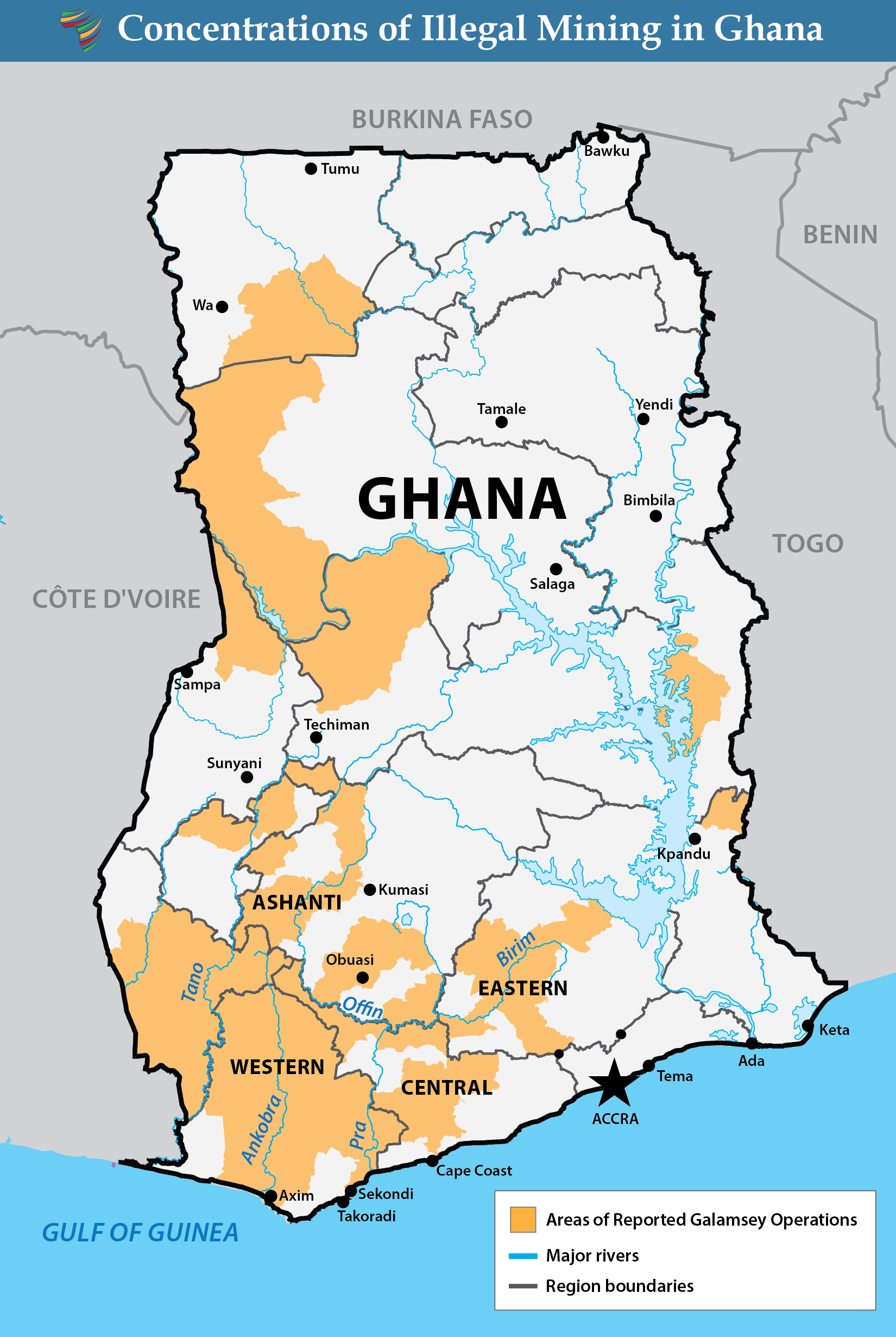
- Pra, Ankobra, Offin, Tano, Birim, Densuriver systems most directly impacted,concentrated in south central Ghana
From Informal Livelihood to a Parallel Political Economy
Artisanal gold mining has long supplemented rural livelihoods in Ghana. For decades, small-scale miners panned river sediments or worked shallow pits using rudimentary tools, operating largely at the margins of the formal economy. While often unregulated, these activities were generally localized, labor-intensive, and limited in scale.
This began to change in the early 2000s as three reinforcing dynamics took hold:
- Rising global gold prices
- The influx of foreign capital and machinery
- Persistent weaknesses in regulation and enforcement
Excavators, dredges, and mechanized processing equipment—often financed by external investors—dramatically expanded extraction capacity, allowing mining activity to spread rapidly into forest reserves, agricultural land, and major river systems.
As production increased, so too did the complexity of the networks supporting it. Illegal mining operations developed into interconnected systems of financing, transportation, gold aggregation, and informal refining. Despite legal restrictions on foreign participation in Ghana’s small-scale mining sector, foreign operators—particularly Chinese financiers and equipment suppliers—became integrated into these illicit supply chains through local partnerships and financing arrangements.
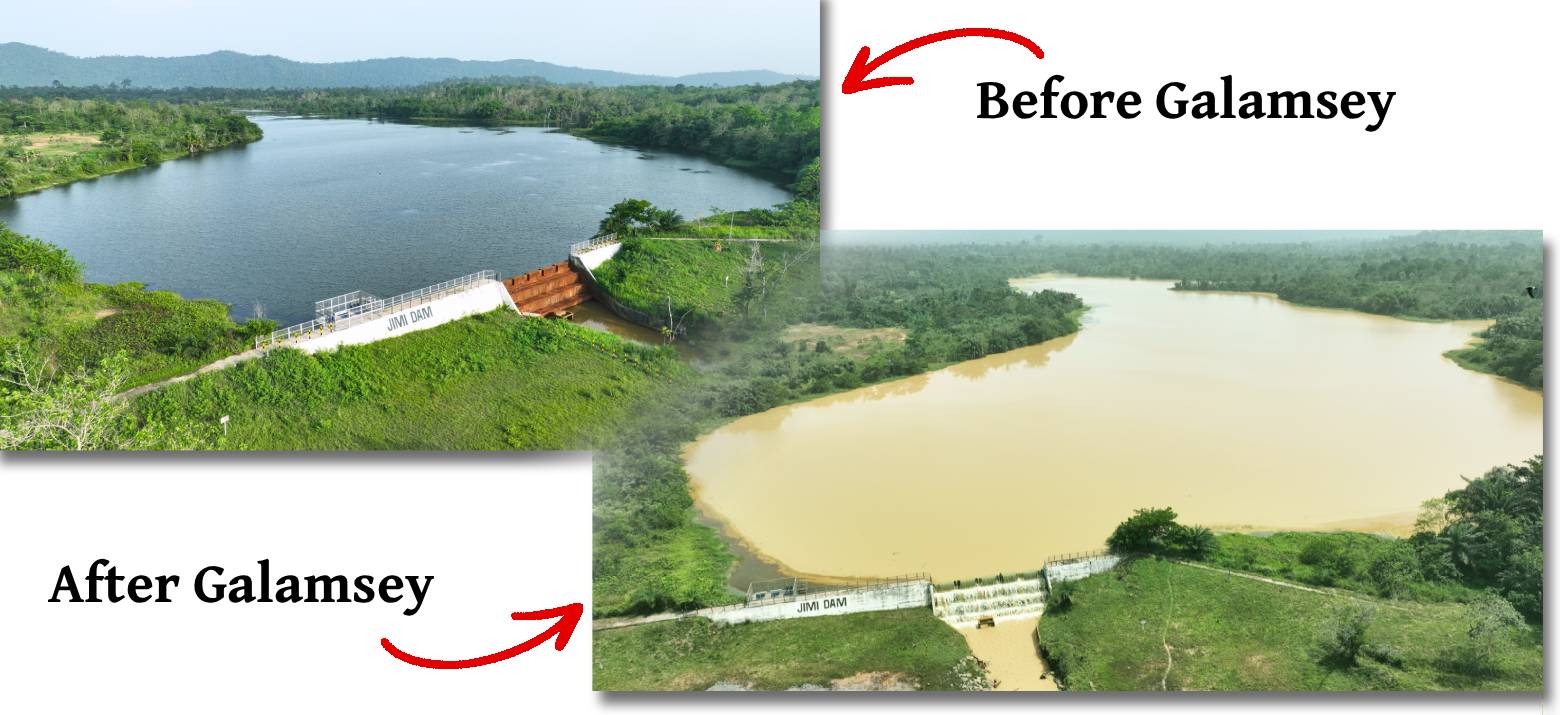
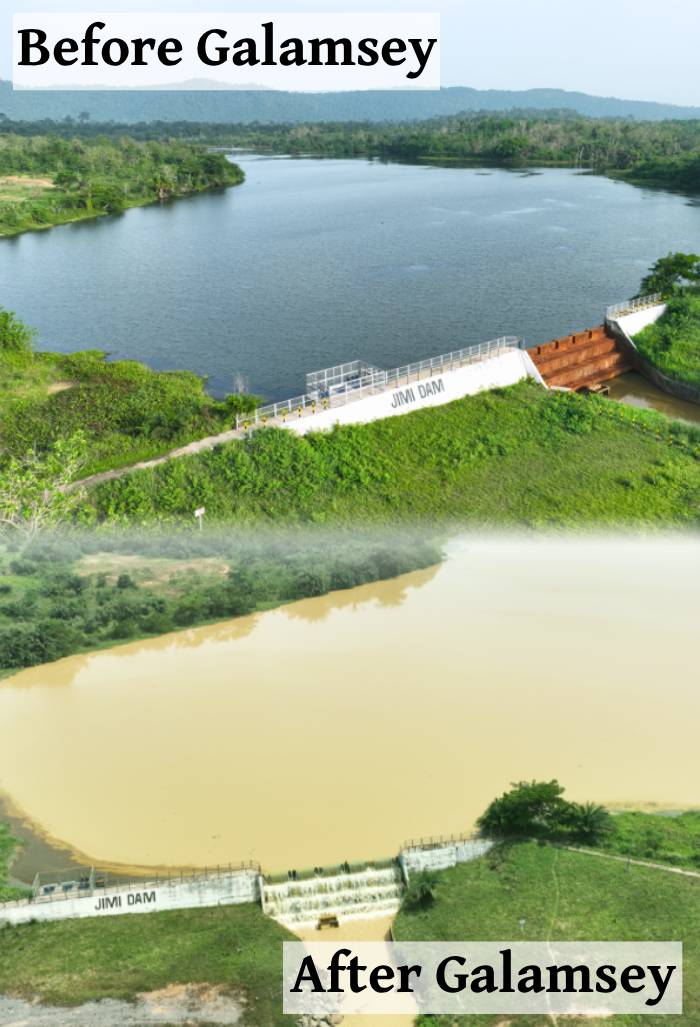
The Jimi Dan along the Jimi River in the Ashanti Region before (April 2023) and after (November 2024) upstream galamsey operations. (Photo: Edem Srem)
This foreign role is enabled by local “bush buyers” purchasing gold directly from miners—often through anonymous cash transactions with little or no documentation—before selling to intermediaries operating in regional trading hubs such as Kumasi. At these early stages of the gold trade, illegally mined gold is frequently blended with legallyement mechanisms
Satellite imagery and aerial monitoring illustrate the scope of this transformation, showing heavy machinery stripping hillsides and dredging riverbeds on a near-continuous basis. Estimates suggest that some 50,000 illegal Chinese miners are now operating in Ghana, supported by wider networks of financiers, equipment suppliers, transporters, intermediaries, and informal refiners.
Geographically, illegal mining is concentrated in forested and riverine areas of the Ashanti, Western, Eastern, and Central Regions of south-central Ghana. These areas of concentrated mining overlap with cocoa-growing areas, water catchments, and protected reserves, magnifying the national consequences of what might otherwise appear to be localized economic activity.
(Click for printable PDF version.)
In many affected communities, illegal mining has become deeply embedded in local economies, generating employment, cash flow, and political influence while simultaneously weakening regulatory oversight and formal enforcement authority. As the parallel illicit economy around galamsey expands, it poses not only a growing national security threat driven by organized criminal activity but also erodes other sectors of Ghana’s economy.
How Galamsey Undermines National Security
Galamsey intersects directly with core functions of government: the enforcement of law, the regulation of economic activity, the provision of public services, and the maintenance of security. Illegal extraction persists despite repeated police and military operations, underlying the importance of examining how illicit extraction networks reshape local authority, distort enforcement, and generate crime.
Crime, Coercion, and Illicit Networks
The growth of galamsey has been increasingly sponsored by criminal networks that coordinate financing, machinery, labor, transport, gold aggregation, and informal refining. Operating through layers of intermediaries and informal transactions, these networks complicate oversight and weaken traceability. Control over downstream aggregation, transport, and market access is often more consequential than activity at the mine site itself, enabling gold extracted through unlicensed or otherwise illegal mining operations to be laundered into legitimate supply chains.
Armed actors use firearms, machetes, and intimidation to secure mining sites, deter rivals, resist enforcement efforts, and regulate access to mining areas.
As these networks have expanded, violence and coercion have become increasingly important for protecting operations and regulating access to mining areas. Journalists investigating illegal mining activities have faced beatings, threats, and forced deletion of footage, while local communities and rival groups are often intimidated from interfering with operations. In some areas, galamsey continues near police posts or despite repeated enforcement operations, reinforcing perceptions that illicit actors can operate with relative impunity.
Many illegal mining sites now function as spaces where economic activity is regulated less through formal law than through informal coercive arrangements. Armed actors use firearms, machetes, and intimidation to secure mining sites, deter rivals, resist enforcement efforts, and regulate access to mining areas. These groups are typically composed of local youth, private security elements, and criminal actors organized around individual mining financiers rather than identifiable criminal organizations. The scale of weaponization has become increasingly apparent. Estimates suggest that security forces seize roughly 1,500 illegal firearms annually from galamsey sites in the Ashanti and Western Regions alone. These dynamics increasingly normalize the use of force as a means of economic regulation, weakening confidence in formal security institutions to enforce the law consistently and protect legal economic enterprises.
The persistence of armed protection around illicit economic activity creates localized security and governance vulnerabilities. Weapons acquired to guard mining operations have also been linked to armed robbery and other criminal activity in affected districts.
Governance Stress and State Authority
The persistence of galamsey reflects not only enforcement gaps but also distorted governance incentives surrounding the gold sector. These conditions have contributed to the growth of patronage networks, discretionary licensing practices, and uneven enforcement. This reduces the credibility of government institutions and creates strong pressures to tolerate or selectively regulate operations tied to local income and revenue generation. Public confidence has been further undermined by regular allegations of political interference and weak accountability, including reports that hundreds of excavators seized during anti-galamsey operations later disappeared without explanation.
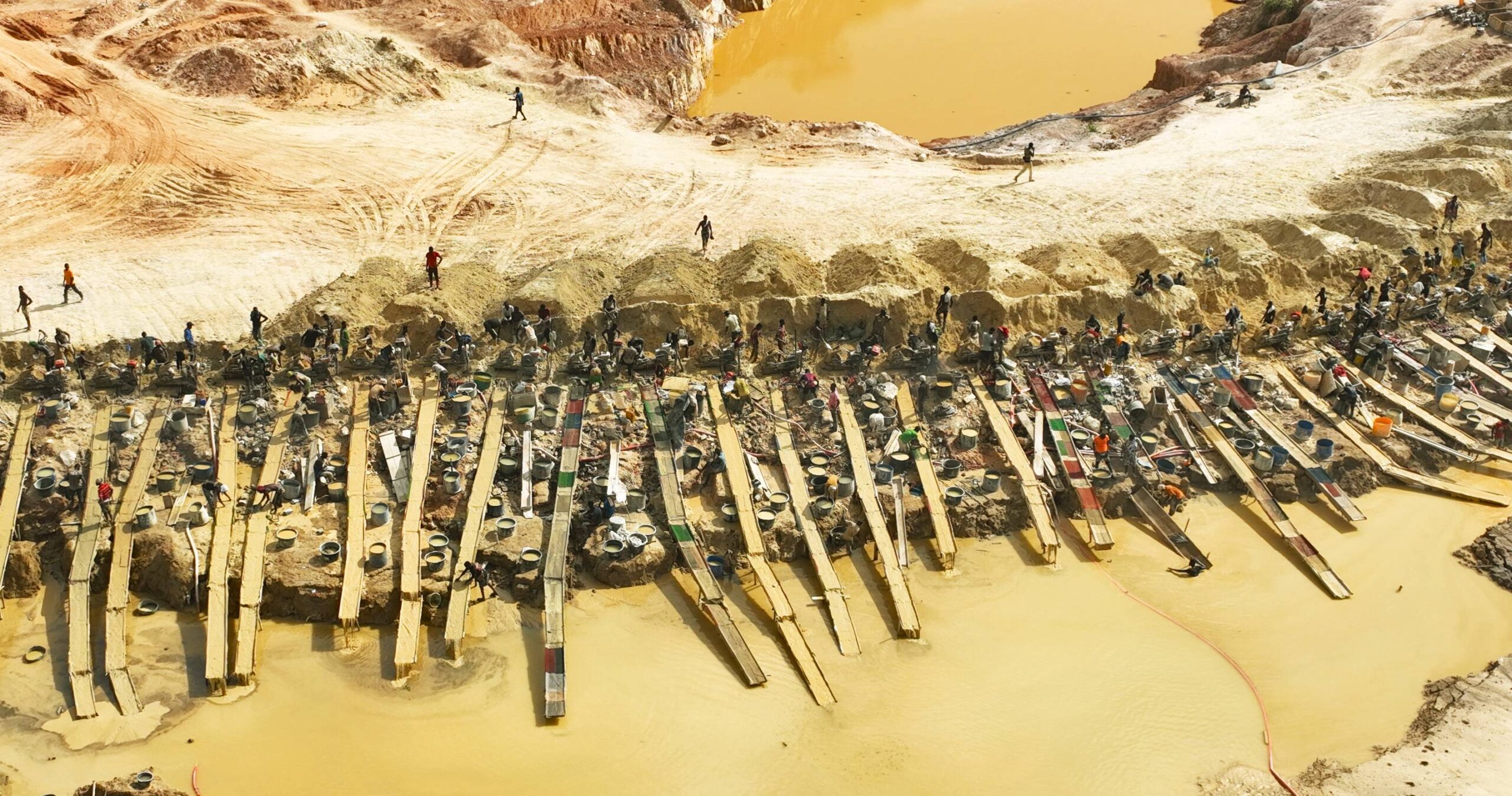
A line of galamsey miners washing gold at a site in Wassa Dadieso, Western Region. (Photo: Edem Srem).
These dynamics also complicate relations between communities and security actors. Where livelihoods depend heavily on mining activity, enforcement operations may be viewed not simply as anti-criminal interventions, but as threats to local survival. This creates opportunities for criminal sponsors of galamsey to portray themselves as economic protectors while framing government regulation as predatory. This can open the door to wider instability.
How Illegal Mining Threatens Water Security
Galamsey has become a major excavation along riverbanks, and the widespread use of mercury and other chemicals have heavily polluted major waterways, including the Pra, Offin, Ankobra, and Birim Rivers. In some areas, contamination levels have surged far beyond treatment capacity, forcing periodic shutdowns of water treatment facilities and sharply increasing processing costs
Protesters in Accra demand government action on illegal gold mining and the release of activist, October 3, 2024. (Photo:
These disruptions extend beyond environmental degradation. As contamination intensifies, strain on water provision increasingly affects urban and peri-urban populations, including key commercial and administrative centers.
The operational implications are increasingly significant. Disruptions to water treatment and distribution systems heighten pressure on local authorities, increase the risk of localized unrest, and complicate service provision in already stressed communities. In mining regions, contaminated wateratory illness, skin disease, and heavy metal poisoning
Strategic Economic Vulnerabilities
Unregulated and illegal mining imposes significant economic costs on the Ghanaian government through lost tax revenue, gold smuggling, environmental remediation burdens, and the expansion of illicit financial flows. Estimates suggest Ghana loses billions of dollars annually through off-the-books gold exports and the associated revenue loss, constraining rees, and security operations
The effects extend beyond the mining sector.
The effects extend beyond the mining sector itself. Galamsey activity increasingly overlaps with strategically important agricultural and ecological zones, including cocoa-growing areas, forest reserves, and critical water catchments. The Forestry Commission has reported illegal mining activity in dozens of forest reserves, while cocoa-producing districts have experienced significant losses of productive land. For context, cocoa contributes roughly 10 percent to the Ghanaian economy. The resulting decline in agricultural output also threatens food production, livelihoods, and export earnings in communities already facing economic pressure. Nearly three-fourths of Ghana’s rural population relies on agriculture for their livelihoods.
The rapid circulation of mining-related income can also distort local economies by incentivizing short-term extraction over longer-term agricultural or commercial investment.
Gold smuggling routes operating through neighboring countries and international trading hubs undermine export oversight and facilitate broader illicit financial activity. In northern border regions, Ghanaian security officials must confront the possibility that weakly regulated mining hubs and smuggling corridors could become vulnerable to exploitation by organized criminal or extremist actors operating across the border in Burkina Faso.
Toward a More Effective Security Response
Galamsey has evolved into a security and governance problem rooted in illicit economic networks, weak regulatory enforcement, and growing pressures on strategically important sectors and infrastructure. Previous responses have struggled not because the problem is intractable, but because interventions have often focused on visible mining activity while leaving the political and economic systems that sustain illicit extraction largely intact.
Previous responses have often focused on visible mining activity while leaving the political and economic systems that sustain illicit extraction largely intact.
Past enforcement efforts have relied heavily on periodic crackdowns at mining sites, often targeting miners while leaving financiers, equipment suppliers, transportation networks, and gold aggregation networks comparatively insulated from disruption. Because galamsey increasingly functions through organized and layered networks, more effective responses will require intelligence-led operations focused on the actors who finance and coordinate illegal mining. Targeting these upstream nodes would raise operational risks for illicit actors more effectively than repeated site-level raids. This includes targeting financiers, equipment suppliers, gold buyers, transporters, and export intermediaries through financial investigations, licensing oversight, customs enforcement, and anti-money laundering measures. This would also reduce the number of direct confrontations between security forces and mining-dependent communities.
The influx of Chinese operators, capital, and mechanized equipment has transformed galamsey from a largely local enforcement challenge into one with important transnational criminal dimensions. Enforcing restrictions on foreign participation in Ghana’s small-scale mining sector, strengthening scrutiny of heavy equipment imports and illicit gold exports, and working with customs, financial intelligence units, and international partners to disrupt cross-border smuggling and money laundering are vital to making it more difficult for organized criminal networks to sustain illegal mining operations.
Patronage networks linked to galamsey, discretionary licensing systems, and uneven application of regulations have weakened confidence in government and reinforced perceptions of selective enforcement. Reversing this will require strengthening the independence and protection of oversight mechanisms. This includes more transparent licensing and concession tracking systems, clarifying agency mandates, and reducing political interference in licensing and enforcement processes.
Enforcement alone cannot resolve an illicit mining economy that has become deeply embedded in many local communities. To further strengthen efforts to counter galamsey, initiatives will also be needed in the following areas:
- Expand access to formalized small-scale mining. Simplifying licensing procedures and improving monitoring and export certification systems can help reduce incentives for illegal operations while ensuring government oversight of the sector.
- Protect strategic economic sectors.Sustained investments in land reclamation, environmental rehabilitation, and alternative livelihood opportunities in heavily mined districts can help rejuvenate cocoa production, water infrastructure, and agricultural land.
- Mitigate the vulnerability to exploitation by regional extremist actors.Ghanaian authorities must strengthen financial intelligence, border coordination, and regional information-sharing mechanisms to proactively guard against destabilizing efforts by these external extremist groups.
These measures point to the need for sustained political commitment rather than episodic intervention. Galamsey will not be resolved through enforcement alone, nor through environmental policy in isolation. It requires a coordinated strategy that recognizes illicit mining as a challenge affecting governance, economic resilience, and internal security—one whose resolution is increasingly tied to the government’s ability to maintain public trust, effective oversight, and long-term stability.
Edem Sremis an award-winning Ghanaian journalist and documentary filmmaker as well as executive director of the production company 5fifty Documentaries.
Additional Resources
- Marcena Hunter and Gideon Ofosu-Peasah, “Violent Extremist Threats to Northern Ghana’s Gold Sector,”Research Report,Global Initiative against Transnational Organized Crime, December 2025.
- Paul Nantulya, “China’s Critical Minerals Strategy in Africa,”Spotlight, Africa Center for Strategic Studies, December 9, 2025.
- Alexander Abdelilah, “In Ghana, the Environment and Journalists Are the First Casualties of the Illegal Gold Rush,”Investigative Report,Forbidden Stories, October 24, 2025.
- Gabriel Botchwey and Gordon Crawford, “Small-scale Mining, Environmental Destruction and Democracy Capture: The Government of Ghana’s Failed ‘war on galamsey,’”Democratization, 32, no. 8 (2025).
- Catherine Lena Kelly, “Trends in Transnational Organized Crime in Africa and Innovations in Coordinated Responses,”Africa Amani Journal, 10, no. 3 (2024).
- Denis Mahonghol, “The Regional Security Imperative to Protect the Congo Basin,”Africa Security Brief44, Africa Center for Strategic Studies, November 2024.
- Ndubuisi Christian Ani, “Illegal mining digs up multiple problems in Ghana,”ENACT Observer, ENACT, October 31, 2024.
More on: Environment and Security
