

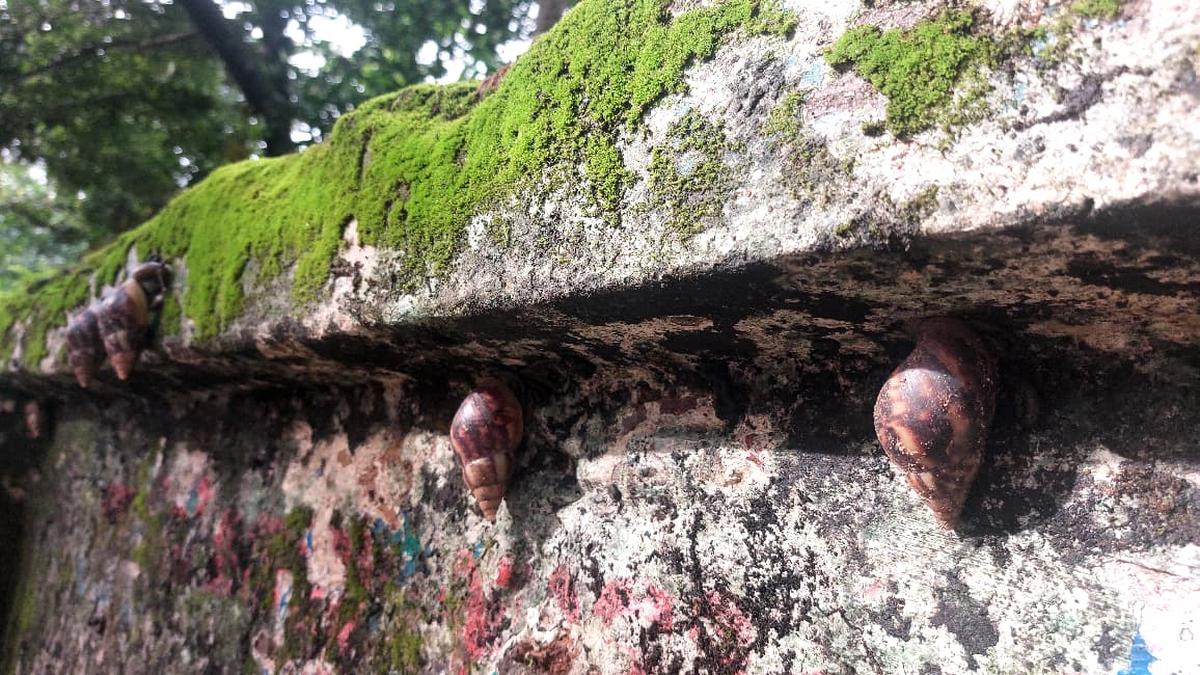
The invasive giant African snail (Lissachatina fulica) is spreading rapidly across Tirunavaya panchayat and has now entered school campuses. Children and teachers are struggling as the snails crawl over playgrounds, walls and classrooms
Teachers say the snails have become a daily nuisance. Students are told not to touch them, while schools struggle to keep campuses clean. Health experts warn that children are at risk because the snails can carry the rat lungworm parasite (Angiostrongylus cantonensis), which can cause eosinophilic meningitis in humans. The snail’s mucus may also trigger allergic reactions
Keerthy Vijayan, who led a Kerala Forest Research Institute (KFRI) study with researchers from the University of Nottingham, the Natural History Museum in London and the Environmental Agency in the UAE, said children needed extra protection, especially in schools
“Tirunavaya has faced this infestation for years. Children on school campuses are more likely to come into contact with the snails and their mucus, and they are least aware of the health risks,” she said
Dr. Vijayan added that doctors at two major hospitals in Kochi have reported a surprising number of eosinophilic meningitis cases, mostly in children under 10
“It is alarming in schools,” she said. “Teachers, along with parents, should prevent snails from entering classrooms and bathrooms. Mesh screens can help block their entry.”
Residents have been using salt and tobacco-copper sulphate mixtures to kill the snails. Health workers also advise wearing gloves while handling them
Salman Karimpanakkal, a teacher and environmental activist, said civic authorities should launch a coordinated drive to control the infestation before it worsens
Native to East Africa, the giant African snail is listed by the International Union for Conservation of Nature (IUCN) among the world’s 100 worst invasive species
Studies say it was introduced to India in 1847, reached Madras in the early 1900s, and was first reported in Kerala in the 1950s at Elapully, Palakkad. Major spread waves followed in the 1970s and again in 2005
Beyond damaging crops, the snail can carry disease-causing organisms, including the rat lungworm that causes meningitis and bacteria linked to septicemia and peritonitis

