

Published 1 February 2012Updated 26 July 2025
What is our heritage?
Heritage is what we have inherited from the past
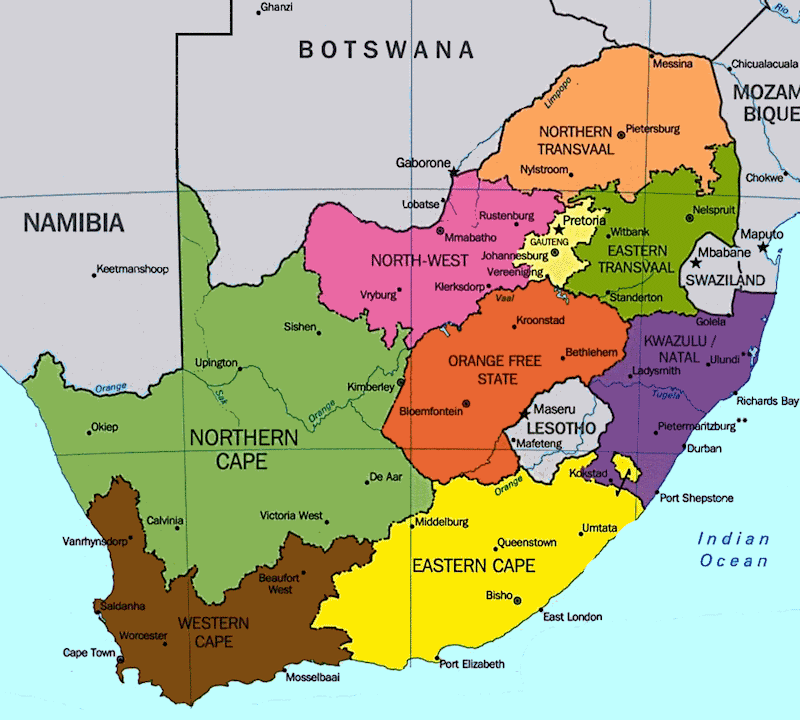
Each of South Africa’s nine provinces is rich in diverse heritage that belongs to all South Africans. Heritage can be tangible or intangible. Tangible heritage includes things we can see and touch, like a place, ornament, building, fossil or artwork. Intangible heritage includes things such as our family heritage, religion, praise poetry, music, songs, dance and festivals, or even in naming a place after a significant person. The heritage trail in this section of your Grade 5 history takes us to places in different parts of South Africa and looks at some of the things of significance that we have inherited from the past.
Gauteng
Gauteng means “place of gold” in Sesotho, and it was built on the wealth of gold found deep underground. Forty percent of the world’s gold reserves are found in the land under Johannesburg
Capital City: Johannesburg
Mine-dumps and headgear are symbols of Johannesburg’s rich past. Gleaming skyscrapers contrast with Indian bazaars and African medicine shops, and the streets throng with fruit sellers and street vendors. An exciting blend of ethnic and western art and cultural activities is reflected in theatres and open-air arenas throughout the city
North West Province
North West is known as the Platinum Province because of the wealth of the metal it has underground. It has a number of major tourist attractions, including the internationally famous Sun City, the Pilanesberg National Park, the Madikwe Game Reserve and the Rustenburg Nature Reserve
Capital City: Mahikeng
Mahikeng (previously Mafeking, then Mafikeng) is best known for the famous siege during the South African War, which ended in a decisive victory for the British and made a hero of Robert Baden-Powell, founder of the Boy Scouts. The siege was movingly recorded by South African intellectual, journalist and activist Sol T Plaatje in his Boer War Diary: An African at Mafeking
The Free State
The Free State lies in the heart of South Africa, between the Vaal River in the north and the Orange River in the south. The area is characterised by flat, rolling grasslands and crop fields, rising to lovely sandstone mountains in the northeast
Capital City: Bloemfontein
Bloemfontein is an important centre of education and administration in South Africa. The city is home to the Supreme Court of Appeal, the University of the Free State and the Central University of Technology
Limpopo
Limpopo is a region of contrasts, from true bushveld country to majestic mountains, ancient indigenous forests, unspoilt wilderness and patchworks of farmland. Limpopo is rich in natural beauty, culture and wildlife and has a thriving tourism industry, including the Kruger National Park
Capital City: Polokwane
Polokwane means “place of safety”. The city provides access to various nature and wildlife viewing opportunities for tourists, such as the Polokwane Game Reserve. The city is also home to an extensive art gallery and archaeological sites with remains of iron and copper smelting installations, as well as rock paintings from around 1000 BCE
Mpumalanga
Mpumalanga – “the place where the sun rises” – is a province with spectacular scenic beauty and an abundance of wildlife
Capital City: Nelspruit
Nelspruit is also known as Mbombela. The city and the surrounding area contain San art
Kwa-Zulu-Natal
The garden province of South Africa, KwaZulu-Natal is one of the country’s most popular tourist destinations. Its western part is marked by the dramatic Drakensberg mountain range, with several peaks well over 3 000 metres. The range has been awarded Unesco World Heritage status for its dramatic natural beauty and the wealth of San Bushman rock art found in its caves – the richest concentration on the continent of Africa
Capital City: Pietermaritzburg
The city is home to many schools and universities and some tourist attractions include The Natal Museum, Tatham Art Gallery, City Hall and SANBI Botanical Gardens
Eastern Cape
The Eastern Cape, lying on the south-eastern coast, is a region of great natural beauty, from the picturesque Karoo desert to the rugged cliffs, rough seas and dense green bush of the stretch known as the Wild Coast
Capital City: Bisho
Bisho is the Xhosa word for buffalo, which is also the name of the river that runs through this town
Western Cape
This province is one of the country’s most beautiful, attracting the lion’s share of foreign tourists. It is a region of majestic mountains, colourful patchworks of farmland set in lovely valleys, long beaches and, further inland, the wide-open landscape of the semi-desert Karoo
Capital City: Cape Town
Apart from being the home of South Africa’s iconic Table Mountain, the area has a long and colourful history. Robben Island, in Table Bay, near Cape Town, was used for centuries as a prison and is now an essential stop for visitors to the region. It was on this island, that Nelson Mandela spent the bulk of his 27 years in prison
Northern Cape
The Northern Cape is the largest province in South Africa. Its mighty Orange River feeds the agriculture and diamond industries in the area
Capital City: Kimberley
Home of the Big Hole, Kimberley has considerable historical significance due to its diamond mining past and the siege during the Second Boer War
| Province | Heritage | Type of heritage |
|---|---|---|
| Gauteng | Cradle of Humankind | Site of significance |
| North West | The stone-walled town ofKaditshwene | Heritage in architecture |
| Free State | Rivers, dams and towns | Heritage in names of places |
| Limpopo | Golden objects at Mapungubwe | Heritage in objects |
| Mpumalanga | The Makhanjwa Mountains – the oldest in the world | Mountains and ancestors |
| Kwa-Zulu-Natal | San rock art in the Drakensberg | Heritage in Art |
| Eastern Cape | Healing properties of aloe | Indigenous medicine |
| Western Cape | The Castle | Heritage in changing identities |
| Northern Cape | Francis Baard | Heritage in people’s achievements |
Heritage can be divided into two major categories: Natural heritage and Cultural heritage
Natural Heritage Sites
Natural heritage is a country’s natural environment, including the local plant life and wildlife. The beauty of a natural heritage site can attract tourists to a country. South Africa has many natural heritage sites, including:
The uKhahlamba Drakensberg Park The Cape Floral Kingdom The Greater St Lucia Wetlands National Park
Cultural Heritage Sites
Cultural heritage refers to things that a group of people or a country believe to be very important and valuable to them because they are a part of their history and identity. Cultural heritage reflects who you are as a group or as a country. Cultural heritage is passed down from generation to generation. Cultural heritage can be tangible, such as artefacts like pots or types of weapons, jewellery, books, paintings, documents, instruments or places such as graves, archaeological sites, museums, monuments, and buildings.
Cultural heritage can also be intangible, in the form of music, dances, cultural practices, religions, festivals, ceremonies, traditions, customs and ways of doing things in a society. This heritage is what we have inherited from our ancestors and learned from previous generations
ActivityThink of some examples of cultural heritage you express in your daily life. Think of some tangible and intangible examples and write them down in your book
World Heritage Sites
A world heritage site is a place that has been officially recognised by the United Nations as having special value to all human beings. The United Nations Organisation (UNO) is a global organisation that each country in the world belongs to. It is responsible for promoting world peace and protecting things of global importance. The United Nations Educational, Scientific and Cultural Organization (UNESCO) is responsible for naming world heritage sites. There are 936 world heritage sites in total, eight of which are located in South Africa.
- Cradle of Humankind.
- Mapungubwe Cultural Landscape.
- Richtersveld Cultural and Botanical Landscape.
- Robben Island.
- Cape Floral Region Protected Areas.
- iSimangaliso Wetland Park.
- Vredefort Dome.
- uKhahlamba / Drakensberg Park
The Cradle of Humankind
Who are we? Where did we come from? What does it mean to be human?
Humans have always been intrigued by these mysteries, but the discoveries made at the Cradle of Humankind have given us some insight into the answers to these important questions, and therefore, in 1999 the area was declared a World Heritage Site. The Cradle of Humankind is a large area about 50km north of Johannesburg, where many fossil sites are located. The most famous is the Sterkfontein Caves. The discoveries of fossilised bones of early humans have given us incredible clues about what early humans were like and where we come from.
In 1936, Dr Robert Broom found the bones of an early hominid (a human-like being) in The Sterkfontein Caves. A decade later, he made the famous discovery of Mrs Ples – a 2.3-million-year-old Australopithecus fossil. The discovery proved that the first humans came from Africa. Since then, many more hominid fossils have been found in the area (some over 3.5 million years old), as well as animal fossils and over 9000 stone tools
Other famous fossils include “Little Foot”, a discovery which began with uncovering four tiny foot bones, and led to the discovery of the most complete early hominid skeleton. It is believed that Little Foot was a child who died when he fell down a hole into the caves while running from a predator. More recently, in 2013, a group of cavers discovered a large number of fossils, which belong to a species of hominid scientists call Homo Naledi. What fascinated some scientists is that is appears as if the bones may have been placed in the cave on purpose by the Homo Naledi, who may have wished to bury their dead in one place – quite a remarkable practice for such ancient hominids!
Golden Objects at Mapungubwe
On 8 April 1933, The Illustrated London News reported a remarkable discovery: a grave of unknown origin, containing lots of gold objects, found on top of a natural rock stronghold in a wild region. This site, Mapungubwe Hill, is on the farm Greefswald where the borders between South Africa, Zimbabwe and Botswana meet. Since the site was discovered, in 1933, research and news reports have told the story of Mapungubwe, a flourishing Iron Age trading centre on the Limpopo River, ruled by an African king almost a thousand years ago.
The heritage of Frances Baard’s achievements
Heritage is not only about places and objects from the past. It can also be about celebrating people and the good things they have done for others or for a good cause. In 2001, a municipal district in the Northern Cape was renamed to commemorate the brave actions of a woman named Frances Baard, who did a lot to fight for the rights of others. Frances Baard, or ‘Mabaard’, to those who knew her well, was an anti-apartheid activist who fought to defend human rights by protesting against the unfairness of apartheid. She was a trade unionist, who stood up for the rights of workers, and she was also an organiser of the ANC’s Women’s League. Her actions included participation in the Defiance Campaign in 1952, a peaceful protest where black people were encouraged to simply defy the apartheid laws, by breaking curfews, refusing to carry a pass book or deliberately using facilities reserved for whites only. She also helped to write the Freedom Charter in1955 and was one of the leaders of the women’s march on the union buildings in 1956.
Heritage in names of rivers, dams and town in the Free State
The Free State is a province with many different people and languages. This mix of cultures in reflected in the names of its river, dams and towns. These names are another form of heritage as they help to preserve memories of the past
The Gariep River
Gariep is the Nama name for the Orange River. The name Gariep is being used more and frequently, because many people have realised the importance and value in keeping the Nama language alive to preserve the culture
Heritage in names of rivers, dams and town in the Free State
The Free State is a province with many different people and languages. This mix of cultures in reflected in the names of its river, dams and towns. These names are another form of heritage as they help to preserve memories of the past
The Gariep River
Gariep is the Nama name for the Orange River. The name Gariep is being used more and frequently, because many people have realised the importance and value in keeping the Nama language alive to preserve the culture
Sol Plaatje Dam
Sol Plaatje was born in the Free State, in 1876, and he grew up to become a highly influential and famous black journalist and writer who spoke out against racial discrimination
Hobhouse
Hobhouse is a small farming town in the Free State, named after Emily Hobhouse, a British woman who did much to help people in the South African War. The British used concentration camps to imprison enemy civilians to prevent them from helping enemy soldiers. The conditions in these camps were terribly inhumane. Emily Hobhouse investigated the camps and reported her shocking finding to the British public and campaigned to put a stop to the human rights abuses
Other examples
After the end of apartheid, regions in the Free State were also renamed in the different languages of the people living in the Free State. An example is Lejweleputswa, which is a Basotho word meaning Grey Rock. This replaced the name ‘Free State Goldfields’
The Castle as an example of heritage in buildings
The Castle of Good Hope in Cape Town is the oldest building in South Africa. It was built by Soldiers, sailors and slaves, over 30 years, using local stone as well as stone blocks imported from Holland
In 1652, Jan van Riebeek arrived at the Cape. He had been sent by the Dutch East India Company to set up a halfway station where trading ships could stop to get fresh food, water and supplies half way through their journey between Europe and India. In 1666, the settlers living at the halfway station decided to build the fort for protection. Over the years, the castle’s identity and purpose has been reinvented many times. After it was no longer used as a fort, it became the centre of community life and administration in the Cape. Today it is mainly a museum that shows the lives of the early settlers in Cape Town.
Indigenous medicine and the healing properties of the aloe
The Eastern Cape is home to unique type of heritage in the form of an indigenous tradition. This tradition is the use of the aloe plant for its medicinal properties. An aloe is type of succulent plant that grows in the Eastern Cape, and the people living there have used it for centuries to treat various health problems. The soothing quality of the aloe is used to treat many skin problems, including burns, skin infections, wounds, acne, allergic reactions and insect bites. It is also used to sooth heartburn and the juice is believed to help digestion. Many pharmaceutical companies have also embraced the indigenous knowledge of the aloe’s healing properties and it is used as in ingredient in countless pills, lotions, sprays, ointments, creams and jellies.
The stone-walled town of Kaditshwene
This ancient Tswana city was home to a population of approximately twenty thousand people of the Bahurutshe tribe in the early 1800s. The Bahurutshe were a tribe of wealthy cattle farmers and traders who traded iron and copper, which they were skilled in producing. Archaeologists have discovered numerous well-preserved smelting furnaces in the area which show that the people were skilled in smelting metals and creating items for trade. The town was highly advanced and was skilfully laid-out and built using well-constructed stone walls which still stand today.
Architecture in the town
The architecture in the town is fascinating. The town consisted of separate walled off enclosures containing large circular stone houses, with high walls and space for families to keep animals and store grain
The Makonjwa – the oldest mountains in the world
These mountains are a geological marvel and world heritage site because, at around 3.6 billion years old, they are the oldest and best preserved rocks in the world. These ancient green rocks are a valuable record of the earth’s history and can tell us much about how and when the earth was formed. The mountains are located near Barberton, in Mpumalanga. As well as holding prehistoric significance, these mountains also hold cultural significance and represent a rich history involving Africans and settlers. For the Swazi people, these mountains are considered sacred as it is believed that there is powerful connection between the rocks and the ancestors. The rocks themselves are believed to allow communication with the ancestors and even have healing powers. There are also many stories about early prospectors looking for gold in the mountains, and today some of the oldest gold is mined from these mountains.
The San Rock Art in the Drakensberg
The San were the first people to live in South Africa, over 20000 years ago. These hunter-gathers used their extensive knowledge of plants and animals to survive. The San were nomadic wanderers who lived off the land and moved with the changing seasons and movements of the antelope herds. They therefore left no trace of buildings or houses or roads, but they did tell their story through the medium of art which they painted on the surfaces of rack faces and cave walls. San rock paintings can be found all over Southern Africa but some of the best examples are found in the Drakensberg. This world heritage site contains over 20 000 examples of rock art in over 500 caves. There is something mysterious and magical about this ancient art that tells the fascinating story of people, animals, shamans, and ancient rituals and the spirit world. The paintings depict epic hunts, battles and trance dances where shamans would visit the spirit world. These sites hold deep spiritual significance for people even thousands of years later.
Classroom
History Classroom Grade Five
Grade 5
We have a rich and diverse heritage that belongs to all South Africans today. In this topic we take a heritage trail through the provinces of South Africa highlighting the rich and diverse heritage that belongs to all South Africans. We learn about each province and what importance it hold for us

