

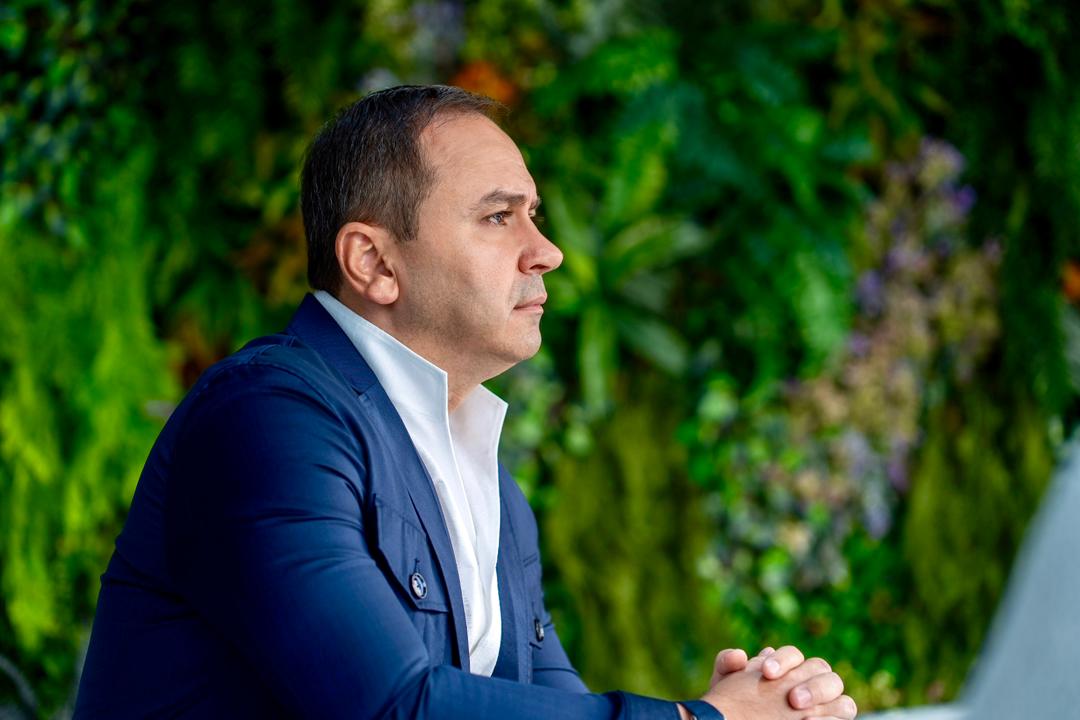
*The Ivorian group he founded in the worst year available for founding one now delivers infrastructure in seven countries. The road from Abidjan to Lagos, he argues, was never waiting on money.
There is a particular register in which African infrastructure gets discussed in Washington in springtime. It is the register of instruments and pipelines and blended finance, of men in good suits describing a continent in basis points, and it fills the corridors of the IMF and World Bank Spring Meetings every April.
Hassan Dakhlallah was there last year, at the head of a delegation. Between two of those meetings, he took out his phone and looked at mud.
The photographs had come from a road site in Benin. Work had stopped. It had been raining. Somewhere inside a building where the future of the continent was being modelled, the founder and chairman of a €737-million construction group stood studying a stalled excavator, the way a surgeon looks at a scan. Then he put the phone away and went back in.
The Beninese dailyMatin Libre reported the scene under a headline that has followed him since: the African boss the IMF listens to. What the scene actually explains is why they listen. In a week given over to what Africa intends, one man in the building was thinking about what Africa was, at that hour, physically doing. And whether it would be finished on the day he had promised it would be.
“There are no shortcuts,” he has said. “You do not build a continent through communication, but through real assets, transmitted skills, and standards held over time.”
The African Development Bank puts the continent’s infrastructure requirement at roughly $130 billion a year. Construction accounts for eight to ten per cent of GDP across West Africa’s principal economies. The African Continental Free Trade Area advances on paper. Corridors are drawn, costed and redrawn, and the trucks go on queueing at the borders.
The road from Abidjan to Lagos is the oldest of these ambitions. It crosses five countries. It carries the heaviest concentration of trade and human movement anywhere in the region. It has been a stated priority for longer than most of the officials now working on it have been alive, and it is not finished.
The reason is not, mostly, money. Corridors get financed. Corridors get launched, with ribbon and anthem and a communiqué. What corridors have never had enough of is the narrow, unglamorous figure who converts a signed agreement into a surface a lorry can drive on.
For most of the post-independence period that figure came from outside the continent. Foreign contractors delivered, maintained, and set the calendar. Costs rose. Dates moved. And the calendar, far more than the finance, is where sovereignty quietly leaked away, because a state that cannot say when a road will open has subcontracted a piece of itself.
Dakhlallah has spent fifteen years making a narrower argument than his admirers tend to notice. “We are moving from a time when we debated priorities,” he told the Ivorian dailyFraternité Matin, “to a time when we measure capacities.”
The Wrong Year to Start a Construction Company
He began in 2011. Sit with the year for a moment.
Côte d’Ivoire had been cut in two. It had come through two civil conflicts and a post-electoral crisis. The economy was on the floor and capital was leaving. He was in his early forties.
He founded a construction company.
Le Figaro, reconstructing the decision years later, traced it to a refusal of what might be called absentee infrastructure: projects conceived a long way from the ground they are meant to serve, executed by people who will not be there when the surface fails. The alternative he chose was expensive, slow and structural. Own the chain. Depend on nobody. He set it out in his own account of the founding in language he has not really altered since.
“I build roads,” he told the paper, “but my true objective is to trace the path of Africa’s future.”
The firm started as a single Abidjan contractor. He bought it outright in 2015 and renamed it PORTEO in 2020. There are now around twenty subsidiaries across five divisions.
Buy the Plant, Not the Cement
SoPORTEO makes its own concrete, through a subsidiary called Technic Béton. It rolls its own steel, at B. Steel. It produces its own asphalt and its own aggregates. It trains its own engineers and funds scholarships for others. It runs more than two hundred local SMEs inside its supply chain. Its fleet has grown past three thousand machines and trucks, none of them rented or shared, because for fifteen years the profit went into equipment instead of out to shareholders.
Consider what that buys. Days before the 2023 Africa Cup of Nations, an instruction reached Abidjan: the Ebimpé Olympic Stadium needed a VIP heliport, and heads of state would be arriving by air. The brief came in the middle of December. On 4 January there was a heliport. You cannot rent one in three weeks. You can pour one, if the concrete is already yours.
And on many public-private projects, the group finances the works itself and is paid only on delivery.
That last sentence deserves a second reading from anyone who follows Nigerian road policy. It describes, in a single clause, the model this country has spent years trying to legislate into existence, in which private firms build federal roads and recover the cost afterwards. The scheme is not the hard part.
The hard part is that almost nobody can carry it. To fund a highway and wait to be paid, a contractor needs a balance sheet, an owned fleet and its own material production, or the cost of capital eats the road before the road exists.
There is a name for the trade Dakhlallah made. Aliko Dangote’s insight was that you do not import the cement; you build the plant, and price stops being a market condition and becomes a decision you take.
Dakhlallah pushed the same logic one step further upstream, into the act of building itself. He did not want to buy concrete. He wanted a concrete company. The reason a ministry can be handed a date by PORTEO and believe it is that somewhere behind that date, for a decade and a half, a man declined a dividend.
He has a phrase for this, and it is the most precise thing he has said about his own business. “Productive sovereignty is not decreed,” he told Fraternité Matin. “It is built patiently, by giving yourself the means not to depend, on every single site, on an outside chain.”
What Fifteen Years Bought
The figures, dated, by his own count: €737 million of revenue in 2025. Twelve thousand employees of twenty-three nationalities, up from around four thousand two hundred two years earlier. Seven countries. More than three thousand kilometres of road delivered.
In Gabon, PORTEO is paving some 300 kilometres of the Transgabonaise for 140 billion FCFA, or €213 million, the longest road contract ever entrusted to a single company in that country, a projectForbes Afrique framed as the making of a sovereign Gabon. It will employ around fifteen hundred people locally and pull sixty local firms into its supply chain. In Côte d’Ivoire the group built the Grand-Bassam to Assinie dual carriageway, the Aboisso bridge, and two sovereign data centres.
The group holds ISO triple certification, which is not a plaque on a wall but a three-year cycle of audits with the standing power to take it back. The African Development Bank named him Builder of the Year in 2024. Côte d’Ivoire has given him its National Excellence Award three times, in 2018, 2022 and 2024. The International Africa Development Forum in Casablanca gave him its gold trophy for South to South cooperation.
Jeune Afrique, placing PORTEO at 342 in its 2024 ranking of Africa’s top 500 companies, put the ascent down to speed of execution and to the unfashionable decision to buy the machines rather than rent them.
He is severe about what growth does to a standard, in the manner of a man who has watched other companies get big.
“The real credibility of a group rests on its ability to maintain, from one territory to another, the same discipline,” he has said. “Growing does not mean accepting a gradual lowering of standards.”
What He Wants West Africa to Understand
The ambition is not modest. He intends to triple revenue by 2030 and to be operating in ten to fifteen countries, across most of ECOWAS and into East Africa.RTI has reported the plan; the group’s Senegalese chief executive, Papa Amadou Sarr, formerly an executive director of the French Development Agency, was recruited in 2025 to run it.
But when Dakhlallah is asked what the region actually lacks, he does not talk about capital, and he does not talk about scale. He talks about the rain in Benin.
“West Africa has never lacked plans. What we have lacked is people who ensure the roads open the day they said it would. A promise kept is the only sovereignty a trader can drive on.” he says.
It is an argument he has made in Abidjan, at the Africa CEO Forum, and in Washington at the U.S. Chamber of Commerce, and it does not change with the room. Ghana is the immediate test.
Discussions are underway around a road tied to the government’s Big Push, and Ghana’s argument with itself about the Big Push is not really an argument about money. It is an argument about whether anybody can build it on time.

Sixty Years, From Rhetoric to Rebar
Kwame Nkrumah argued that political independence without industrial capacity amounted to a flag and an anthem. He was right, and he was early, and the capacity did not come.
It is a strange thing to watch that sentence finally being written, not in a speech but in steel, by a group whose chief executive is Senegalese, whose Gabonese operations are run by an Ivorian, and whose payroll spans twenty-three nationalities. Data that would once have been hosted in Frankfurt now sits in Libreville.
A road becomes a corridor. A corridor becomes trade. Trade becomes industry, and industry is the only thing that has ever turned a free-trade agreement from a document into an economy. Sovereignty, on this reading, is not a position a country adopts. It is a supply chain it owns.
“Africa should be judged on what it builds,” Dakhlallah has said, “rather than on what it announces.”
Caleb Nnamani writes from Lagos
