

African History
How Nelson Mandela Used Rugby as a Symbol of South African Unity
In a nation bitterly divided by apartheid, Mandela used the game to foster shared national pride
Farrell Evans
Ross Kinnaird – PA Images via Getty ImagesPublished: July 29, 2021Last Updated: January 31, 2025
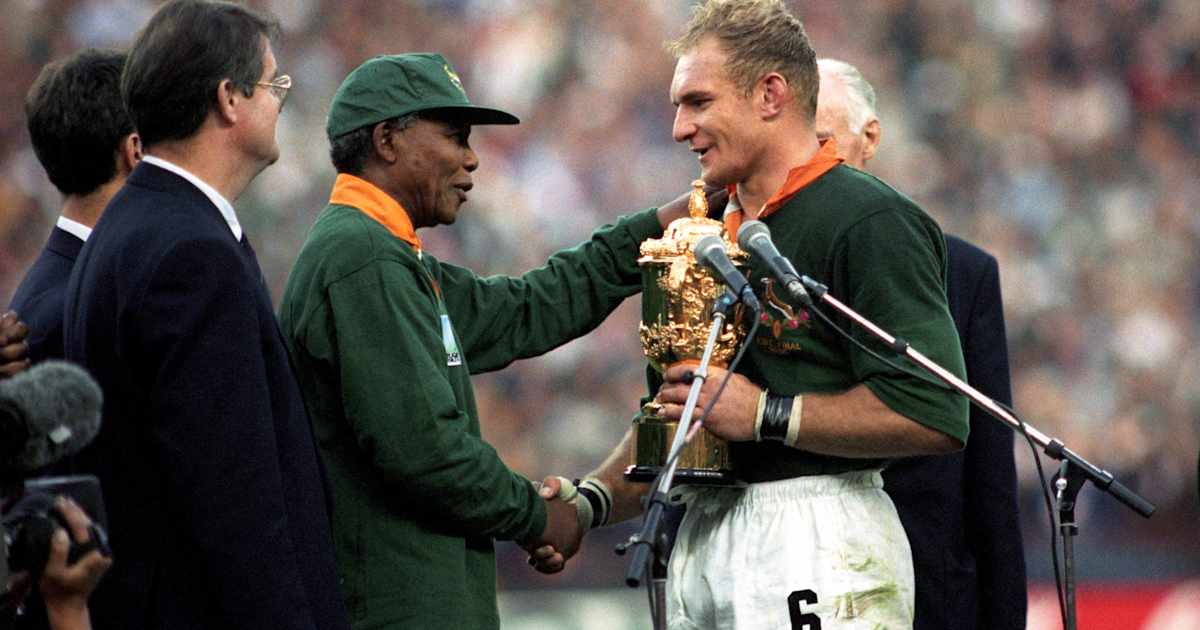
On June 24, 1995, at Johannesburg’s Ellis Park Stadium, South Africa won the Rugby World Cup 15-12 over its arch-rival New Zealand. The match stands as a hugely symbolic moment in South African history. It marked the nation’s first major sporting event since the end of its segregationist apartheid regime in 1991. And in a masterful act of statecraft conducted squarely in the international spotlight, President Nelson Mandela orchestrated a show of unity in one of the world’s most bitterly divided nations, using the slogan “One Team, One Country.”
The reality of the moment proved far more complicated than image-making
Apartheid’s gross human rights violations had long made South Africa an international pariah. In 1973, a UN resolution declared apartheid a “crime against humanity.” From 1964 to 1992, the country was banned from the Olympic Games, while its rugby team was kept out of the sport’s first two World Cups in ’87 and ’91. To Black South Africans, the historically white team—along with their green and gold colors and their Springbok mascot—had come to symbolize the nation’s oppressive minority white rule.
President Mandela saw rugby as a way to help lessen divisions between Black and white South Africans and foster a shared national pride. The sport had been a unifying force before, among the nation’s competing colonial forces. A 1906 Springbok tour of the British Isles proudly featured players from both sides in the bitter Boer War (1899-1902) between English and Afrikaners, including one player who had been imprisoned in a British concentration camp. To heal the wounds this time, Mandela—who had himself been jailed for 27 years for challenging the white minority-led apartheid system—had to first acknowledge and address the widespread pain and division apartheid had wrought.
The Historic Connection Between Rugby and Apartheid
While racial segregation had been long practiced in South Africa, the official system of apartheid emerged in 1948, after the political ascendance of the Afrikaner National Party. Afrikaners, descendants of Dutch, German and French settlers who saw themselves as a chosen people, worked to shape a government that favored the white minority
Under apartheid, the Black majority population was moved to segregated townships in conditions of brutal poverty, excluded from any role in national politics and denied jobs beyond those involving unskilled labor. In 1953, the Reservation of Separate Amenities Act passed, officially segregating all public areas in South Africa—including the rugby pitch
The Afrikaner National Party had deep ties to the rugby team, which had fielded an all-white roster for its first 90 years. The party embraced the team’s success as its own, and players sometimes used the team as a springboard into party positions
“The National Party envisioned the Springbok symbol [a native antelope] as a representation of the values and characteristics of the Afrikaner people,” wrote Simon Pinsky in an essay published in South African History Online. “In their minds, allowing Black players to don the sacred jersey was a step toward the erosion of these values. The Springbok had come to symbolize more than rugby excellence to the hard-line Afrikaner—it had come to symbolize racial superiority.”
Truth, Reconciliation and Rugby
In 1995, five years after walking out of prison and one year after being elected the nation’s first Black president, Mandela formed the Truth and Reconciliation Commission to investigate apartheid-related crimes. The hope of the commission was that full disclosure of the truth about the era’s atrocities would lead to healing in the racially divided nation
Black South Africans wanted to destroy any symbols of the apartheid regime. High on the list: the Springbok, which had been the rugby team’s mascot—and the sport’s emblem of apartheid’s National Party—since 1906. After the first free elections in 1994, all South African national teams had adopted a protea, the country’s national flower, as their emblem—except the rugby team. In a country where rugby was the great national pastime, the Springbok emblem with its green and gold colors wasn’t something many white South Africans were willing to give up.
Mandela Pursues a Larger Goal

South African President Nelson Mandela showing his support for the historically white Springboks rugby squad at the _1995 Rugby Union World Cup _final between South Africa and New Zealand in Johannesburg
Photo by Ross Kinnaird/EMPICS via Getty Images
South African President Nelson Mandela showing his support for the historically white Springboks rugby squad at the _1995 Rugby Union World Cup _final between South Africa and New Zealand in Johannesburg
Photo by Ross Kinnaird/EMPICS via Getty Images
Understanding this resistance to change, Mandela sought a conciliatory strategy that would allow Afrikaners to keep their treasured emblem as a means to an end: bringing the nation together
“As far back as the 1960s, Mandela began studying Afrikaans, the language of the white South Africans who created apartheid,” wrote Richard Stengel in Time magazine on Mandela’s 90th birthday in 2008. “His comrades in the ANC [African National Congress] teased him about it, but he wanted to understand the Afrikaner’s worldview; he knew that one day he would be fighting them or negotiating with them, and either way, his destiny was tied to theirs.” In his 1994 inaugural speech, he voiced his vision of a “rainbow nation at peace with itself.”
So at the beginning of his first term, he invited Francois Pienaar, the team’s captain, to meet with him to discuss how the Springboks could help broker peace between the Black and white populations. Pienaar had grown up in an Afrikaner community, where Mandela’s name was associated with “terrorist” and “bad man.” To a Black crowd, Mandela said, “I ask you to stand by [these boys] because they are our kind.”
Black Groups Criticize Mandela
Mandela’s conciliatory gestures to a harshly racist apartheid regime didn’t sit well with Black South Africans still dealing with that regime’s legacy of oppression and violence. In the 1976 Soweto uprisings alone, police had killed hundreds of Black citizens and injured thousands
After his 1994 election, Mandela came under fire from militant Black groups who believed his ruling party, the African National Congress, was too conciliatory to the former apartheid regime. One of his most vocal critics was his estranged wife, Winnie Mandela, who believed he focused more on appeasing whites than on ensuring rights for Black South Africans. While Mandela and the ANC listened to these critics, they continued to focus on reassuring the white minority that it wanted to build a strong working relationship. His appeals to Black South Africans were often framed through the lens of what their support could mean for his larger aims for the country.
“We have adopted these young men as our boys, as our own children, as our own stars,” he said during a visit to the Springbok training camp shortly before the start of the World Cup. “The country is fully behind them. I have never been so proud of our boys as I am now and I hope that that pride we all share.”
The 1995 Rugby World Cup Finals

South Africa’s Joel Stransky (white shorts) drops the winning goal against New Zealand in the 1995 Rugby Union World Cup finals
Ross Kinnaird/EMPICS via Getty Images
South Africa’s Joel Stransky (white shorts) drops the winning goal against New Zealand in the 1995 Rugby Union World Cup finals
Ross Kinnaird/EMPICS via Getty Images
Before the start of the 1995 World Cup Finals against New Zealand, a mostly white audience of 63,000 at Ellis Park sang along as the Springboks led a new national anthem. It combined words from the “Die Stem” (the apartheid-era anthem, which had been subject to earlier protest) and “Nkosi Sikelel’ iAfrika,” an old pan-African liberation hymn from the anti-apartheid movement. When Mandela appeared in the stadium wearing the Springbok green, the mostly Afrikaner crowd shouted, “Nelson, Nelson, Nelson!”
The game showcased Mandela’s work in the weeks leading up to the matches, setting the stage for a historic—and largely symbolic—show of national unity across the races for the whole world to see. In the match, the two teams finished regulation time tied 9-9 in a spirited match of archrivals. With seven minutes left in extra time, the South African team won with a drop goal by Joel Stransky to secure a 15-12 victory
“The whole of South Africa erupted in celebration, Blacks as joyful as the whites,” wrote Martin Meredith in his biography, Mandela. “Never before had Blacks had cause to show such pride in the efforts of their white countrymen. It was a moment of national fusion that Mandela had done much to inspire.”
A Moment of Symbolic Unity, With a Complicated Legacy
“When the final whistle blew, this country changed forever,” said team captain Pienaar years later, when Mandela died. While this may have been a gross overstatement to most Black South Africans who continued to suffer at the bottom rung of society in the post-apartheid world, it reflected a deft effort by Mandela to use rugby to heal the nation’s wounds
To many Black South Africans, the Springboks continue to represent a brutal apartheid regime. The team had just one Black player in the 1995 matches and had only six in 2019 when it won the World Cup over England with its first Black captain, Siya Kolisi. “Just as Mandela’s gesture in 1995 was hailed as a metaphor for racial reconciliation in the nation, so rugby’s failure to transform is seen as a metaphor for disillusionment among Black people who gained political but not economic freedom,” wrote journalist David Smith in a 2015 Guardian column.
Still, Mandela’s efforts to use rugby to bring together a new nation struggling to heal its old wounds became one of his signal achievements as president of South Africa—and a sign of what could be done for good through the power of sport. In 2000 at the Laureus World Sports Awards, Mandela said, “Sports has the power to change the world. Sport can create hope, where once there was only despair.”
Related
African History
2 videos
African History
The Harsh Reality of Life Under Apartheid in South Africa
For decades, the country’s Black majority was controlled by racist laws enshrining white supremacy

African History
Key Steps That Led to End of Apartheid
A combination of internal and international resistance to apartheid helped dismantle the white supremacist regime

African History
How Timbuktu Flourished During the Golden Age of Islam
During the 15th and 16th centuries, Timbuktu, located in Mali, served as a major intellectual hub of Islamic civilization
See More
About the author
Farrell Evans
Farrell Evans is an award-winning journalist who writes about sports and history
Fact Check
We strive for accuracy and fairness. But if you see something that doesn’t look right, click here to contact us! HISTORY reviews and updates its content regularly to ensure it is complete and accurate
Citation Information
Article Title
How Nelson Mandela Used Rugby as a Symbol of South African Unity
Author
Farrell Evans
Website Name
History
URL
https://www.history.com/articles/nelson-mandela-1995-rugby-world-cup-south-african-unity
Date Accessed
June 24, 2026
Publisher
A&E Television Networks
Last Updated
January 31, 2025
Original Published Date
July 29, 2021
Advertisement
Advertisement
Advertisement
 HISTORY EducationHISTORY Vault™HISTORY AppsHISTORY en Español®Military HISTORY®Newsletter Sign UpShare Your OpinionsFAQ / Contact Us
Advertise with UsA+E Factual Studios™A+E Studios®Employment OpportunitiesAccessibility SupportTV Parental Guidelines


Advertise with UsA+E Factual Studios™A+E Studios®Employment OpportunitiesAccessibility SupportTV Parental Guidelines
© 2026, A&E Television Networks, LLC. All Rights Reserved.
Terms of UsePrivacy PolicyCopyright PolicyCookie NoticeAd Choices
