

Digital economy
How will Africa make use of AI?
31.03.2026

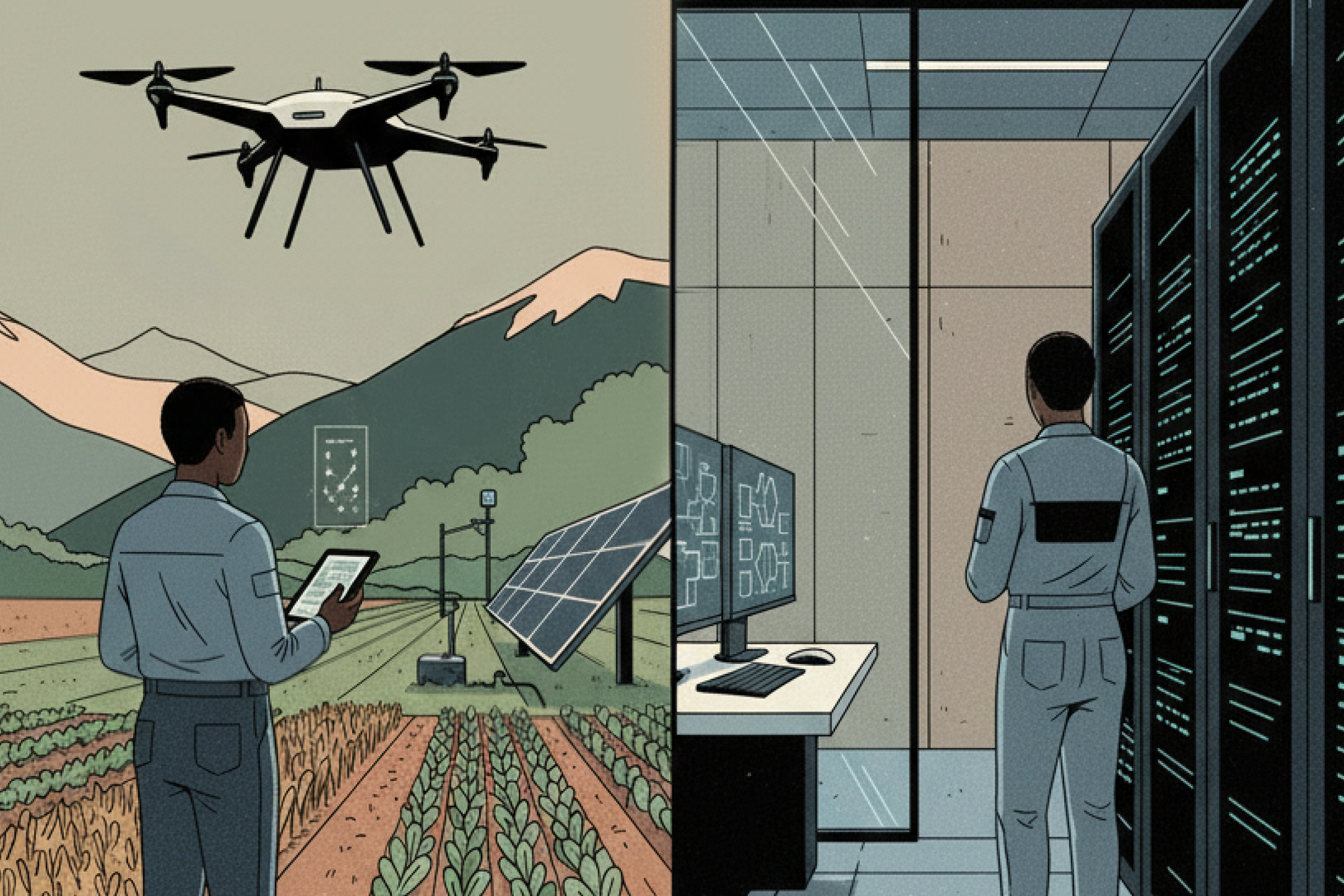
D+C, AI generated
Should Africa Invest more in exportable applications or data centers?
The hour of AI is striking under unusually compressed conditions. Global investment in AI now runs into trillions of dollars, yet early evidence suggests that returns are highly concentrated in a narrow set of firms and geographies. Many projects never reach commercial sustainability is widening
Having lived through earlier technology cycles, including the dot-com era, one lesson stands out: hype does not fail all at once. It fractures. Valuable ideas survive the crack; capital-intensive illusions do not.
For Africa, the debate is often framed as whether the continent should “build AI.” But the real question is whether it will own intelligence or merely host consumption. Two competing visions now shape Africa’s AI future – and they differ not only in cost and timelines but also in terms of who benefits from it, how risks are managed and whether dependencies or leverage result from it.
One emphasises infrastructure replication: building data centres, sovereign clouds and domestic compute capacity to mirror advanced economies. The other prioritises skipping some of the traditional stages of development in a process known as “leapfrogging” and moving straight to developing specialised, context-aware AI systems that solve real-world problems and can travel globally with modest infrastructure.
Vision one: infrastructure replication
Across Africa, governments and institutions are advancing plans to invest in national AI infrastructure: domestic data centres, sovereign cloud platforms and ambitions to develop local large-scale models. Such infrastructure-first strategies are appealing to policymakers because they promise data sovereignty in a world where information is strategic, reduce dependence on foreign platforms and signal geopolitical seriousness.
Technology and ethics
This logic echoes earlier development eras: just as industrialisation required power plants and transport networks, AI competitiveness is assumed to require ownership of foundational infrastructure. In capital-scarce environments, such visible investments also provide proof that the state is acting decisively
This vision has political logic, but it is also structurally flawed. AI infrastructure is capital-intensive and technologically volatile. Data centres require not only billions in upfront investment but reliable electricity, cooling, water and long-term operational capacity. Hardware and model structures depreciate rapidly; what appears strategic today can become obsolete within years
More fundamentally, infrastructure replication places African states in direct competition with global hyperscalers, which are difficult to match. Moreover, public capital tied to fixed assets is capital unavailable for market creation, education or application deployment. Investing heavily in infrastructural foundations may turn out as a strategic misalignment if value migrates toward applications, data rights and specialised AI.
Vision two: application leapfrogging
A different vision has emerged from observing how this AI value is increasingly created. Instead of prioritising scale and infrastructure ownership, this approach emphasises specialisation, speed and exportability. The global AI economy is moving away from the assumption that bigger models are always better. Value is increasingly generated by smaller, fine-tuned systems: domain-specific language models, decision engines and hybrid AI tools that integrate data, rules and human oversight. These systems are cheaper to train, faster to deploy and easier to adapt across markets.
The cost differential is striking. Big models require tens or hundreds of millions of dollars in compute. In contrast, a Mauritius-based AI team recently trained and benchmarked a model for under a dollar per run on standard commodity cloud infrastructure, demonstrating how capital-light iteration is becoming possible outside Silicon Valley’s compute arms race. While narrower than big models, their ability to iterate rapidly and deploy on modest infrastructure makes them particularly suited to emerging markets.
Africa’s complexity demands AI systems that reason under constraint: fragmented logistics, informal economies, multilingual societies and uneven infrastructure. Solutions built for these conditions are often particularly robust. Crucially, they are exportable to other emerging markets facing similar realities across the Global South
African-founded AI firms already demonstrate this logic. Some export decision-optimisation systems for logistics and manufacturing; others produce climate intelligence derived from sparse data environments; still others build language technologies for under-resourced languages. These firms are not exporting hardware or raw data. They are exporting intelligence – models, Application Programming Interfaces (APIs) and decision tools that embed African problem-solving expertise.
Application leapfrogging also aligns more closely with development priorities. Specialised AI systems can be delivered through mobile devices and low-bandwidth channels, operating in local languages and supporting users with limited literacy. Small language models dramatically lower the infrastructure threshold for participation. They do not require constant connectivity to hyperscale data centres and thus foster inclusion by design.
Economic
Limited capital forces African governments to make a choice. They should consider that, from the standpoint of capital allocation, AI strategies that require years of infrastructure build-out before producing deployable applications entail significant disadvantages. What’s at stake is the question whether scarce capital compounds or is locked into assets that yield uncertain, delayed returns
Artificial Intelligence
In my work as an AI investor across regions, one rule has proven consistent: if a system cannot reach real users within 12 months and demonstrate transferability across markets within 18, it does not count as part of an export industry. It counts as a pilot project. Behind this insight lies a market mechanism: capital tends to flow toward models that demonstrate their usability and scalability early on, rather than toward those that require a lengthy infrastructure build-out before they can be validated.
The logic applies not only to investors but also to public institutions. In lower-margin, infrastructure-constrained environments, durable advantage comes from specialisation, fast iteration and exportable problem-solving. Consequently, AI strategies should be judged not by ambition alone, but by how quickly they generate real-world feedback and economic proof. In capital-constrained economies, AI strategies that require billion-dollar bets before value is proven are thus not so much a strategy, but a risk.
What is already working
African-founded AI firms already illustrate the feasibility of application-led strategies. InstaDeep, founded in Tunisia, built decision-optimisation systems deployed globally before being acquired for $ 682 million by a major biotech firm. Amini AI produces climate intelligence by combining sparse local data with satellite inputs. Lelapa AI develops language technologies for underresourced African languages. DataProphet, originating in South Africa, applies AI to manufacturing optimisation for international clients.
These examples illustrate a structural shift: Africa’s competitive advantage in AI lies not in owning infrastructure but in exporting intelligence. These firms achieved global commercial success without owning a data centre. They also send an important signal to capital markets: globally competitive outcomes can be achieved even with modest capital bases when solutions are closely tailored to real-world constraints. They share common traits: modest infrastructure, deep domain expertise and exportable intelligence.
If application leapfrogging is to succeed, it must be paired with deliberate governance. Three immediate actions would accelerate Africa’s application-led AI strategy:
First, African governments and development finance institutions should prioritise investing in and deploying AI applications rather than funding AI infrastructure. Second, they should establish Pan-African data standards that enable innovation while preventing extraction. The African Union’s data governance initiative provides a foundation, but it needs acceleration and enforcement mechanisms. Third, African AI initiatives should be judged not only on local impact but on exportability to Global South markets.
Avoiding neocolonial structures
No matter which path African governments and the local AI industry choose to take – no African child should have to work in mines extracting raw materials used for the chips and batteries of major AI corporations. No African worker should be mining those rare earth elements, without which technological progress would be impossible, under utterly precarious conditions. And no resident of the Democratic Republic of the Congo or elsewhere should suffer from the massive environmental pollution caused by raw material extraction.
Technology
At the same time, we must prevent Africa from becoming a data colony. In today’s AI economy, the added value primarily benefits those companies that control platforms, capital, and intellectual property – and most of them are based outside Africa. Thus, the data of African AI users flows outward, while revenue and decision-making power remain in the hands of others. Moreover, systems trained predominantly on Western datasets often misinterpret African languages, social norms, and behaviours.
This exploitation must end. Africa must shape its own AI development to the greatest extent possible. A major obstacle here is the lack of basic infrastructure: reliable power supply, internet connection and modern devices are prerequisites that are still very unevenly distributed across the continent. Poorly designed measures even risk deepening digital divides by benefiting urban elites while rendering others digitally invisible.
All of these disadvantages do not argue against the use of AI per se, but certainly against the capital-heavy, opaque and extractive models that dominate the current AI economy. African governments and AI institutions should make sure they play their part in shaping a new AI era
Roger B. Jantio is an AI investor and strategic advisor. He is the founder and CEO of Sterling Merchant Finance Ltd and affiliated investment funds and a graduate of Harvard Business School. rjantio@sterlingus.com
Most viewed articles
- Load More

