

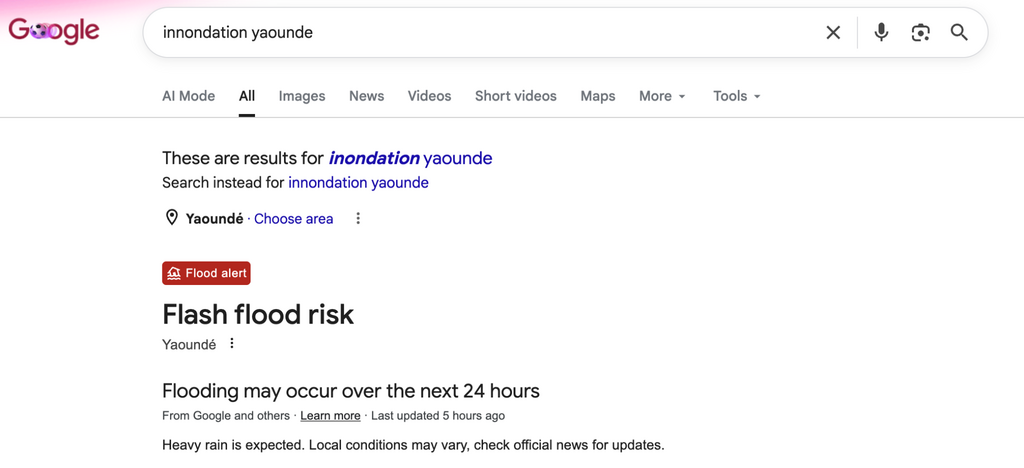
Last Month, it rained again in Yaoundé. Rain, which was once seen as a blessing has now been a crippling cause of anxiety in my country. The images I saw online after the rains, gave that story more colour. Streets swallowed by water. Homes completely submerged. People swimming their way through. Floods. Again. A trauma I know all too well.
@amouria237#vu#like#camerountiktok🇨🇲♬ son original – amouria mk❤️
From Yaounde to Douala, Same nightmare, June 2026
Let me tell you my story
Twelve years ago, I happily moved to Yaoundé to pursue my studies in journalism at the Advanced School of Mass Communication and realize my childhood dream of becoming a journalist. Like many other students, I rented a room in a neighborhood close to the university. Everything was going smoothly until March 8th, 2014, a date I will hardly ever forget. I still remember how the day started. Men in our mini student residence cooked for the women as their way of celebrating us on International Women’s Day. I enjoyed the moment, the meal and went back to my room to rest. While I was sleeping, it started raining, and I fell asleep to the sound.
Rude awakening
When I woke up and put my foot on the ground I felt something cold.I looked down and saw water. I rubbed my eyes twice to make sure I was not dreaming. This time, I saw the water more clearly. It was everywhere. I ran outside to check whether I was the only one experiencing this, but unfortunately, I couldn’t even reach the entrance because the entire courtyard was flooded. I managed to check on some neighbors and realised they had already organized themselves and everyone was trying their best to remove water from their rooms.
Tears, feet in water
This was just too much for me. Why was I going through this when all I had come to Yaoundé for was to pursue my dream of becoming a journalist? It took me some time to recover from this experience. I informed my family and, thankfully, they were there for me, both physically and emotionally. Financially, however, it was difficult for them to afford another room in a different area so that I could avoid going through this again.
Within the year, I experienced flooding more than once. I lost a lot: school materials, clothes, and other belongings. More importantly,my mental health was impacted. Talking about floods is one thing, experiencing them is something completely different. I found it a terrifying experience.
If you live in an area where flooding follows every heavy rain, the sound of rain will never be the lullaby it may once have been to you. Instead, whenever you see the sky darkening and announcing rain, you lose your peace of mind. When we talk about extreme weather events, it is not because we want to make noise as an NGO. It is because behind every flood there is a family experiencing loss. There is a mother crying. There is a child whose life may be at risk. There are countless people suffering from diseases they could have avoided. Flooding is not just about having water in your house after a heavy rain. It brings loss, fear, uncertainty, and emotional distress.
These words come from my heart, and I hope the hearts of others, affected by floods or not. When we speak about climate change and extreme weather events, we are not talking about abstract concepts or distant statistics. We are talking about families losing everything they own, children missing school, mothers struggling to protect their loved ones, and communities carrying emotional scars long after the waters have receded.
Floods leave scars that can affect your mental health long after the water has disappeared – because we know they will come again. I am fortunate that my work as a storyteller at Greenpeace Africa gives me the opportunity to raise this issue at a broader level, but more families (data says 450,000 people were affected in 2024 and more than 56,000 homes destroyed across my country) are going through more difficult circumstances due to flooding but do not have the right platform to tell their own stories.
Please help me spread the message so that polluters can stop their destructive practices and start paying for the loss and damages they are causing. Across Africa, climate change is making heavy rainfall events more frequent and more intense. Combined with rapid urbanisation and inadequate drainage systems, this increases the likelihood of devastating floods in cities such as Douala and Yaoundé. While communities bear the consequences, many of the emissions driving these changes originate from major polluters far beyond their borders. Innocent communities should not bear the cost of a crisis they did not create. Those most responsible must be held accountable. Enough is enough.

