

The pitch arrives the way most opportunities do in West Africa‘s digital economy: through a WhatsApp message, a Facebook post, a friend of a friend. There is a job waiting overseas, the recruiter says. Good pay. Travel. A future. All that is needed is a registration fee, conveniently paid through mobile money.
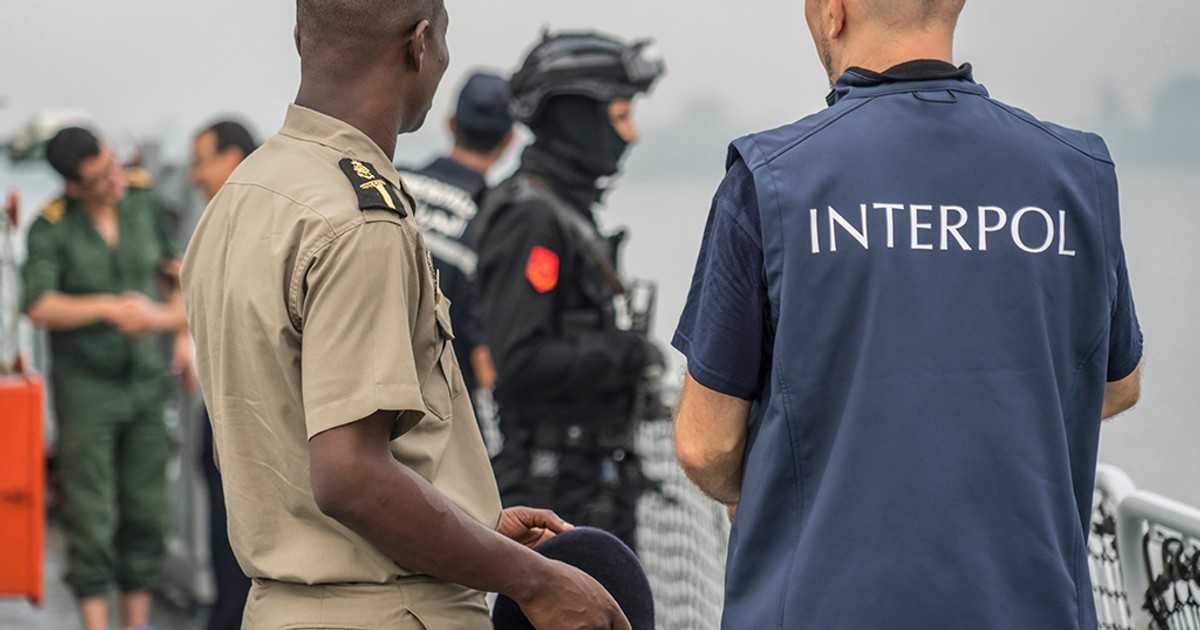
INTERPOL issued a global alert about trafficking networks driven by fake online job offers. Over 1,000 Nigerians ended up stranded in the UK after paying as much as $10,000 each for jobs that never existed.
Weeks later, the trajectory investigators describe is grimly consistent. The job seeker has been taken to a third country, supposedly for visa processing, through the region’s porous borders. His passport has been confiscated. His phone is monitored. And he is being ordered to call his family for money, or to recruit friends back home into the same scheme. For thousands of young Africans, a message that looked like a way out has become the entry point into one of the most sophisticated criminal enterprises operating on the continent.
The method now has an official name. INTERPOL refers to it as Model Q, a term created to distinguish the criminal operation from the legitimate company whose identity it systematically impersonates. In early July, law enforcement agencies from thirteen West African countries gathered in Accra alongside officials from INTERPOL headquarters in Lyon, and Ghana’s Economic and Organised Crime Office (EOCO) for a three-day operational workshop dedicated to dismantling these networks.
The Director-General of Ghana’s Criminal Investigations Department, COP Lydia Donkor, told participants that “trafficking has gone digital,” describing how criminal groups have replaced traditional recruitment with coordinated online operations built on fake employment portals, social media outreach and mobile payment systems.
The pattern is not unique to West Africa. In 2023, INTERPOL issued a global alert about trafficking networks driven by fake online job offers. Over 1,000 Nigerians ended up stranded in the UK after paying as much as $10,000 each for jobs that never existed. Unlike similar scams elsewhere, where victims usually just lose money, the West African version often results in people losing their freedom as well.
The choice of a neutral term is itself a part of the story. The company in question is QNET, a Hong Kong-headquartered lifestyle and wellness direct-selling company. For years, investigators across the region filed these cases under the company’s name. Officers raiding trafficking compounds routinely recover forged QNET registration forms and counterfeit company documents, props used to convince victims and their families that they are dealing with a legitimate international business.
According to law enforcement officials at the workshop, the distinction matters because the criminal groups operate independently of the company, exploiting its name to manufacture credibility. INTERPOL’s adoption of the Model Q terminology formally recognises that distinction.
QNET has publicly acknowledged the misuse of its brand and has participated in law enforcement workshops addressing the issue. “Our brand, products and business model have been misrepresented by fraudulent individuals and criminal networks,” Ramya Chandrasekaran, Chief Communications Officer of QI Group, the parent entity of QNET, told the Accra workshop, adding that the greater harm falls on the victims and communities deceived by the schemes.
Organised crime, run like an enterprise
What distinguishes Model Q from older trafficking operations, investigators say, is its integration. EOCO Executive Director Raymond Archer described it to the workshop as a “fully integrated criminal ecosystem.” In practice, that means the same network recruits victims, traffics them across borders, launders the proceeds and pressures victims into recruiting others.
The money trail is equally sophisticated. Proceeds typically move from mobile money platforms into informal transfer networks and then into cryptocurrency, becoming harder to trace at each stage. Investigators at the workshop identified cross-border fund tracing as their single greatest operational challenge.
The model is also self-perpetuating. Some victims eventually recruit others under threat or coercion, making it difficult for investigators to distinguish willing offenders from people acting under duress.
Why borders are the criminals’ best asset
The Accra workshop laid bare a structural problem: these networks operate seamlessly across jurisdictions, while the agencies pursuing them do not. Recruitment may happen in one country, transit in a second, exploitation in a third, and the money in a fourth. Suspects use burner phones. Rescued victims often know nothing about their captors beyond a brand name that does not belong to them.
National legislation exists. Ghana’s Human Trafficking Act dates to 2005. But as Archer told delegates, regional cooperation is no longer optional when the criminal enterprise itself is regional. INTERPOL’s Assistant Director for Vulnerable Communities, Rosemary Nalubega, made a similar argument, noting that criminal groups deliberately exploit differences in national legal systems and enforcement capacity.
Perhaps the most closely watched element of the regional response is the role of the private sector, specifically the company whose brand sits at the centre of the crime wave.
QNET and EOCO signed a memorandum of understanding in 2025 covering intelligence sharing, joint public awareness campaigns, and support for investigations. According to figures presented during the workshop, the collaboration has contributed to arrests and to the rescue of more than 300 suspected victims of fraud and migrant smuggling operations. The company has also introduced mandatory identity verification for new independent representatives and rolled out fraud-awareness campaigns across Ghana, Nigeria, Senegal, Sierra Leone and Burkina Faso, extending beyond digital channels into billboards, television, radio and community outreach in local dialects.
The arrangement raises a genuine policy question for the region: what obligations, and what role, should companies have when their brands are weaponised by criminals? Some governments have historically responded to brand-linked fraud by restricting or suspending the companies themselves. Chandrasekaran pushed back on that approach in Accra, arguing that “banning a company does not stop criminals,” since the networks operate independently of the businesses they impersonate.
International organisations are placing increasing emphasis on exactly this kind of cooperation. In March 2026, UNODC and INTERPOL convened the Global Fraud Summit in Vienna, bringing together around 1,300 participants from government, law enforcement, business and civil society. One of the summit’s outcomes included the launch of the Global Public-Private Partnership Framework against Fraud, encouraging closer cooperation across sectors; it has since attracted more than 113 endorsements. The EOCO-QNET collaboration was presented during the summit as a case study in public-private cooperation, while QNET was among the organisations endorsing the framework. The open question in West Africa is whether such partnerships can scale as quickly as the criminal networks they seek to disrupt.
The Accra workshop ended with commitments to deepen intelligence sharing and coordinate cross-border investigations. Whether those commitments outpace the criminal networks is another matter. West Africa’s youth unemployment and migration pressures continue to provide Model Q operators with a steady pool of potential victims.
The challenge is no longer identifying the criminal model. It is dismantling the networks behind it before the next WhatsApp message promising opportunity becomes another victim’s story.
