

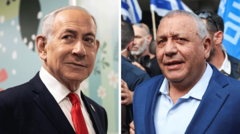
(ABS NEWS) Caretaker Prime Minister Benjamin Netanyahu and opposition leader Gadi Eisenkot began talks aimed at resolving the stalemate left by October’s parliamentary election after Netanyahu publicly offered a national unity deal that would put Eisenkot first in a rotating premiership.
The talks, reported by the BBC, come with neither bloc holding a majority in the 120-seat Knesset: Netanyahu’s right-wing bloc holds about 53 seats while Eisenkot’s four-party grouping has about 48. The arithmetic leaves the two Arab-led lists, which together won a record 19 seats, in a potentially decisive position.
Netanyahu made the rotation proposal public on social media and urged immediate negotiations. Eisenkot responded by inviting Netanyahu to “genuine and accelerated negotiations,” saying he would test Likud’s seriousness “over the next 24 hours,” according to reporting cited by the BBC.
Eisenkot has been formally tasked by President Isaac Herzog with forming a government and has the statutory 28-day window to do so, which makes Dec. 6 the practical deadline unless an extension is granted, the president’s office said in a formal announcement after post-election consultations.
Observers and party statements cited in coverage show Eisenkot has already concluded agreements with at least two parties, strengthening his position as he seeks alliances to reach the 61-seat threshold. Still, key obstacles remain: most Jewish parties pledged before the election they would not sit in a government that included the main Arab-led lists, complicating options that rely on those parties’ direct participation. How such pledges might translate into votes or abstentions in any Knesset confidence vote is unresolved.
Reports indicate the initial round of talks was scheduled to open with a security briefing at the defence ministry’s compound, the Kirya, rather than at the Herzliya venue Eisenkot initially proposed. That shift was noted in contemporaneous coverage and reflects rapid logistical arrangements among senior leaders.
Eisenkot has also accused Likud of deliberately stalling coalition negotiations to force a fresh election, an allegation reported as his claim; independent confirmation that Likud pursued such a strategy has not been established. Similarly, while Netanyahu’s rotating-premiership proposal sets out a possible path to power-sharing, the detailed legal and personnel arrangements — including the length of each rotation and ministerial portfolios — have not been published or ratified.
The election on Oct. 27 produced an unusually high Arab-Israeli turnout and the largest-ever combined representation for Arab-led lists, which analysts say increases their leverage in forming a governing majority. Israel has never had a single-party majority government; coalition-building is the constitutional norm and has repeatedly produced protracted negotiations, notably in the 2019–2022 period when political fragmentation led to five national votes.
With Netanyahu’s bloc short of a majority and Eisenkot scanning for partners, the immediate questions are whether a detailed agreement can be reached on a rotation timetable acceptable to multiple parties, whether Arab-led lists will play a direct or indirect kingmaker role, and whether any proposed deal can deliver a reliable 61-seat majority in the Knesset.
Subscribe to our breaking news bulletin

