

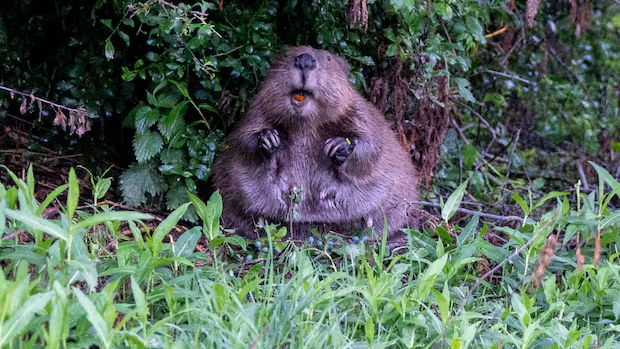
By the time a mother beaver named Willow waddled into a clearing, a hush had fallen over an excited crowd taking part in a “beaver safari” in the British capital.
The mammals may have become a local attraction, but the colony also appears to have helped solve a long-term problem in the neighbourhood. Simply by doing what beavers do best — building dams — they have protected nearby streets and Greenford tube station from routine flooding.
“Everything downstream is much more protected from flooding than it was before, all because they want to hold that water back so that they have enough water to swim in and feel safe,” said Şeniz Mustafa, with the Ealing Beaver Project.
“It just has such a brilliant secondary benefit for us.”

The return of beavers to London
The beavers were transported to London from Scotland in 2023 as part of an effort to try to “rewild” pockets of the sprawling urban metropolis.
Beavers haven’t lived in London for about 400 years. As elsewhere in the U.K., they were hunted for their fur, meat and musk and disappeared from the landscape.
A limited number started to be reintroduced to the region in 2009, beginning in Scotland. London got its first beavers in 2022, after a male and female pair were released into a specially designed enclosure in Enfield, in the northern part of the city.
They were given the names Justin Beaver and Sigourney Beaver.
A year later, after several community groups banded together to push for another beaver project in London, five were released into a wetland area called Paradise Fields, less than 10 kilometres from Heathrow Airport.
A major part of the original project pitch was that, as natural engineers, the beavers could reduce flooding, allowing the local council to scrap or scale back planned, expensive engineering works.
Two and a half years later, project staff say the Greenford station hasn’t flooded since.

Big momma
There are believed to be at least eight beavers at the 10-hectare site, including Willow, who Mustafa says holds the distinction of being the heaviest beaver ever translocated in the U.K. At the time, she weighed 30 kilograms.
“I am sure she weighs a little bit more now but I don’t want to body shame her, but she is a big mum.”
The matriarch of the colony had kits, in 2024 and 2025, including two named Chompy and Chewy by staff. She recently gave birth again, but it’s not clear how many kits she had.
The fenced-in Ealing beaver project is part of an effort to improve the often scarce natural environment in London.
There are proposals to release more beavers in Croydon, in south London.
In 2021, London Mayor Sadiq Khan launched a rewilding fund that has provided £2.48 million ($4.5 million) to dozens of projects to create and restore habitat in the capital.
In a statement to CBC News, his office said it was “fantastic” to see beavers at the Ealing site thriving in their new environment.
“It’s incredible that in only a few short years they have potentially helped stop flooding at a local station, transformed Paradise Fields into a flourishing wetland and helped to improve the biodiversity of the area.”

Boosting biodiversity
Beavers create deadwood which provides homes for insects that, in turn, become food for other species.
Mustafa says there appear to be new fish, as well as more birds and insects such as dragonflies.
She’s an “urban beaver officer,” and part of her job involves engaging with the public and promoting the idea that beavers and humans can coexist peacefully.
The park is publicly accessible, and unlike many of London’s gated green spaces, it is open 24 hours a day.
Mustafa says she has heard park users say that the beavers’ presence has made the site feel safer. Not only have they felled trees that have made the canopy less dense and more open, but they have also attracted crowds to the area.

Beaver safari
A few times a week at dusk, Mustafa leads often sold-out beaver safaris, which cost nearly £28 pounds, or more than $50. People are given binoculars, escorted through the site and taught about all things beaver, including the fact that the ones in London are the Eurasian species.
They are similar, but not identical, to the Northern American species found in Canada’s woodlands and marshes.
Safari participant Amanda Ram, 25, excitedly clutched her binoculars as Willow wandered toward the crowd and lingered for around 15 minutes.
“That was the most amazing thing I’ve ever seen,” she said in an interview with CBC News afterward.
Ram signed up for the tour after learning about the project from a David Attenborough documentary called Wild London, which focused on the intersection of wildlife and the urban environment.

Outside the brightly painted gates marking the entrance to the project is a large mall made up of big-box stores. The tube station is a short walk away.
“I think it’s really cool that there’s a McDonald’s right here and there’s a TK Maxx and then there’s, like, this project which you wouldn’t expect to be in this park,” Ram said.
Beavers are a protected species in the U.K., which means it is an offence to capture, kill or disturb them.
Last year the U.K. government changed the law to allow beavers to be released into the wild in England, if the government grants a license after considering nearby infrastructure and farming.
The Wildlife Trusts, made up of dozens of wildlife conservation groups across the U.K., hope to release 100 beavers into the wild this year.
“I’m hoping that we’ll inspire other projects,” said Mustafa.
“We will prove … that people and beavers can live together in an urban landscape.”


