

Stories from the community
Zero-dose childrenRoutine immunisation
Home-coming healthcare: Malawians returning from South Africa met by health teams
Fleeing xenophobic violence in South Africa, thousands of travel-stressed Malawian families arrived home to health screenings, nutritional supplementation, catch-up jabs and a link-up to their new local clinic.
- 7 October 2026
- 5
min read - byJosephine Chinele
- Add as preferred Google source
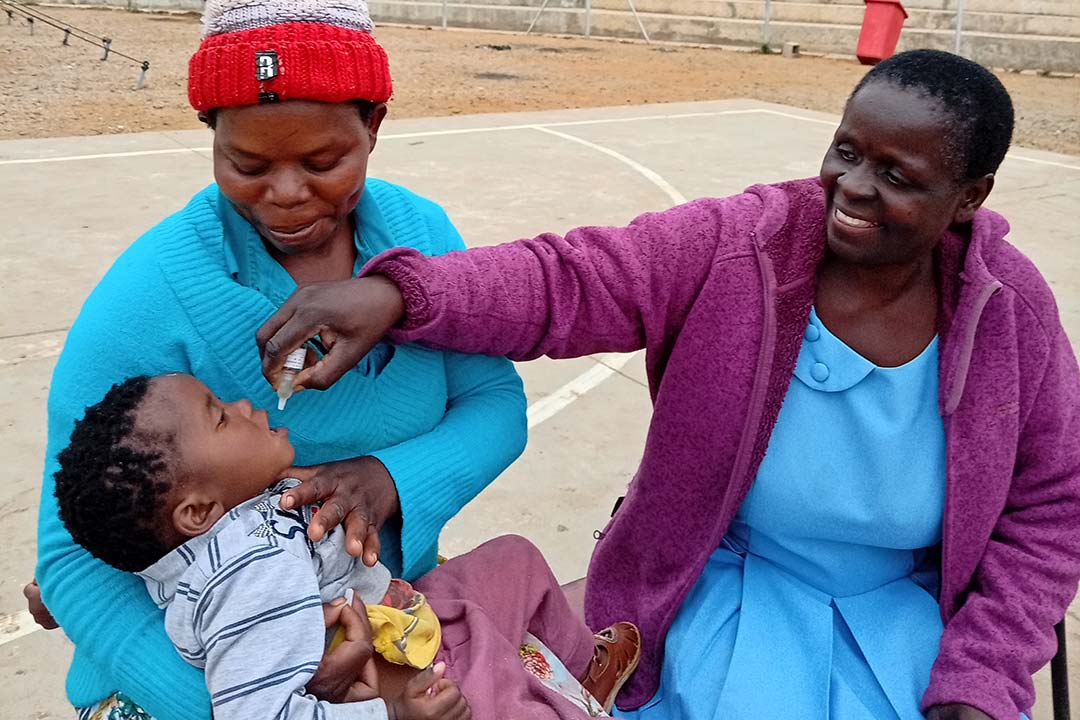
Jesca Gowa administers vaccine to Angella Bonongwe’s dauther. Credit: Josephine Chinel
At a glance
- Waves of anti-immigrant violence in South Africa have triggered the homeward journey of nearly 60,000 Malawians as part of a voluntary repatriation scheme.
- Some 4,300 of the “returnees” – a large number of them in fact born in South Africa – were aged under five. Because their families were largely undocumented migrants, their likelihood of having missed routine vaccinations was considered higher than normal.
- A temporary arrival shelter sought to patch the immunity gap before it could fuel new disease outbreaks. Nurses worked round the clock to offer catch-up vaccines and therapeutic supplementary food and get the new arrivals back on track.
For the six years she lived in South Africa, 37-year-old Angella Bonongwe missed home. Her child, meanwhile, missed out on essential vaccines.
Bonongwe was one of the final cohort of people repatriated to Malawi from South Africa, in the wake of a series of xenophobic attacks on migrants.
According to Department of Disaster Management Affairs (DoDMA), Malawi’s government has so far facilitated and funded the voluntary repatriation of 59,931 citizens from South Africa.
Bonongwe’s two-year-old daughter, who was born in South Africa, is among more than 4,300 “returnees” aged under five. Children in this age group have been offered immunisation on arrival, an offer Bonongwe accepted with pleasure and relief.
“I’m happy that my child has been vaccinated. I’m just feeling like maybe she was missing something,” Bonongwe says, as she moved to the next stage of health screening at a temporary arrival terminal and shelter located at Joyce Chitsulo stadium in Mwanza, a district bordering Mozambique.
Bonongwe’s arrival home coincided with the final round a nationwide polio immunisation vaccination campaign, which had been prompted by the discovery of a case of the paralysing disease in an unvaccinated seven-year-old in Blantyre in December 2025. Malawian health authorities have said that the circulation of highly contagious illnesses like polio and measles in the region mean large-volume cross-border population movement, which demands careful management.
Another returning mother, Alice Raphael, said she had queued up to have her infant and her two-year-old immunised against polio at entry. “I feel every child needs to have vaccines at home, and they will catch up with other vaccines accordingly when we are settled in our home district,” she said.
Welcome-home vaccines
Jesca Gowa, a Health Surveillance Assistant (HSA) assigned to Joyce Chitsulo stadium, says all health workers under Mwanza District Health Office worked in shifts to serve the returning citizens around the clock.
Some returning children were already fully immunised, she said, while others had received inconsistent immunisations, and some had never received a single vaccine, she explained.
“For those that were vaccinated, there are discrepancies on our routine immunisation and the South <a href="https://absafricatv.com/the-north-african-people-with-a-forgotten-christian-heritage/” title=”The North African people with a forgotten Christian heritage”>African one. We have a way of merging the two to ensure that the children catch up,” she added.
Gowa said, “I have enjoyed screening and vaccinating the returning children. Their mothers have been very willing to have their children receive the vaccines and go through the routine screening process and even receiving treatment.”
Zero-dose children return home
A total of 2,341 returning children were vaccinated at entry at the Joyce Chitsulo Stadium temporary shelter. Thirty-one of them were identified as zero-dose children, the Mwanza DHO says.
“The presence of zero-dose children among the returnees may be attributed to frequent population movement between South Africa and Malawi, disruption of routine immunisation services, loss or absence of vaccination records, limited caregiver knowledge and missed opportunities for vaccination during the ‘March and March’ protests in South Africa,” said Mwanza DHO’s Acting Director of Health and Sanitation Services, Dr Fancis Makiya.
He says 5,285 children aged 0–15 years were screened and 0.3% were identified as having severe acute malnutrition (SAM), while 0.5% had moderate acute malnutrition (MAM).
Ready-to-use therapeutic food (RUTF) and Corn Soya Blend (CSB) were provided for the management and treatment of severe wasting, while Likuni phala (fortified soya enriched flour) was distributed as a general take-home ration to pregnant and breastfeeding women, Dr Makiya said, adding, “Children requiring in-patient care were referred to the appropriate health facilities for continued management. We also strengthened disease surveillance for polio and measles.”
According to Mwanza DHO, the joint deployment of HSAs, mobilisers and police officers worked well, with mobilisers and police helping guide returnees to the health workers, making screening and vaccination easier and faster.
But congestion in the limited available space, as well as transport for night-shift health care were challenges, Dr Makiya said. That slowed down nutrition screening and counselling, a problem that was compounded by a shortage of materials, from screening tools to stationery.
He concedes there was also some difficulty in identifying vaccination histories, “The teams responded by working together, prioritising children under ten. But some returnees were uncooperative, especially in the first buses, and we missed them. Some caregivers did not attend counselling sessions due to time limitations.”
Keeping track
But Dr Makiya also revealed that the health teams at the re-entry stations made sure to record all children’s information, and linked them up to the health facility serving their destination community for continued follow-up.
This also coincided with the third round of a polio vaccination campaign. Data obtained from Blantyre DHO indicates that 1,245 returnee children received vaccines at this repatriation centre in June.
Professor Adamson Muula, an epidemiologist at Kamuzu University of Health Sciences (KUHes), observes that cross-border travel is, on its own, risky for disease transmission.
“Malawi has been having several outbreaks and vaccinating at entry would help the children be protected from these outbreaks, at the same time protecting Malawian children from possible diseases the returning children would bring into the country,” he said. Kamuzu, the town where his institution is located, was also host to the first temporary shelter for returnees when the voluntary repatriation scheme kicked off in June.
“Most Malawians [returning from South Africa] were undocumented migrants, already disadvantaging them from receiving primary health care, including routine immunisations. So vaccination at entry into Malawi is key,” he added.
The Malawi government officially closed voluntary repatriation of Malawians from South Africa and the Joyce Chitsulo Stadium temporary repatriation centre on 12 August 2026.

