

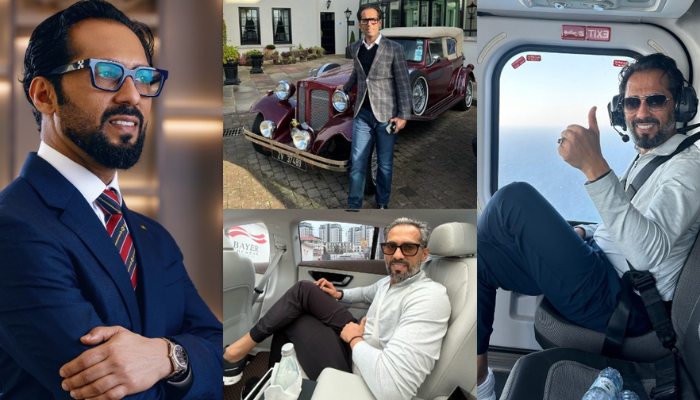
Meet Africa’s youngest billionaire investing $100m in Dangote’s planned Kenya refinery
Mohammed “Mo” Dewji has spent much of his career proving that African businesses can compete with global giants. Now the Tanzanian billionaire has set his sights on one of the continent’s biggest industrial projects, offering to invest $100 million in Aliko Dangote’s planned oil refinery in Kenya.
The pledge, first disclosed in an interview with Bloomberg on Thursday, would bring together two of Africa’s most influential industrialists behind a refinery expected to reshape fuel supply across East Africa. While Dewji says he would have preferred the project to be built in Tanzania, he made clear that geography will not stand in the way of investment.
Read also: Tanzania’s richest man offers $100m for Dangote’s planned Kenya refinery
“I would lean more toward Tanzania than in Kenya,” Dewji said. “Definitely reach out to him and we can chat about it.”
The proposed refinery, to be built in Lamu on Kenya’s coast, is expected to process about 700,000 barrels of crude oil a day, making it one of Africa’s largest refining facilities. According to Reuters, the project will be financed through a mix of internal cash flow, bonds and a planned initial public offering. Construction is expected to take about three years and supply refined petroleum products across Kenya and neighbouring countries.
For Dewji, the investment would fit naturally into a business empire built on manufacturing, consumer goods and long term industrial expansion across Africa.
Popularly known as Mo, Dewji is Tanzania’s best known industrialist and the country’s only billionaire. As chairman and chief executive of MeTL Group, he transformed a family trading business founded by his grandparents and expanded by his father into one of East Africa’s largest indigenous conglomerates.
Read also: Dangote’s Kenya refinery plan faces environmental pushback
After studying at Georgetown University in the United States and spending a short period at management consulting firm McKinsey, Dewji took charge of the company in his twenties and accelerated its expansion across manufacturing, agriculture, logistics, energy, food processing, and consumer goods.
Today, MeTL operates in more than 30 industries, with businesses spanning textile manufacturing, flour milling, beverages, and edible oils. The group has operations in Tanzania and 10 other African countries, including Kenya, Uganda, and Ethiopia, making it one of the region’s largest African-owned industrial companies. According to Forbes, Dewji’s net worth is estimated at about $2.1 billion, ranking him among Africa’s richest people.
Beyond business, Dewji has also built a reputation for philanthropy. In 2016, he became the first Tanzanian to sign the Giving Pledge, committing to donate at least half of his wealth to charitable causes during his lifetime. Two years later, he made international headlines after being kidnapped at gunpoint in Dar es Salaam. He was released unharmed after nine days in captivity.
His expansion strategy has focused on producing affordable goods for African consumers. One of his latest investments is a planned $50 million soft drinks factory in Mombasa, Kenya, where MeTL Group intends to manufacture Mo Cola, Mo Xtra, and Mo Malto. The company plans to sell Mo Cola at a fraction of the price of rival brands, challenging the long-standing dominance of Coca-Cola in East Africa.
That strategy has helped turn MeTL into one of the region’s largest homegrown industrial groups, supplying products ranging from cooking oil and sugar to fuel, textiles and household goods.
Read also: Africa richest man deepens East Africa bet with Tanzania
His latest interest in Dangote’s refinery signals an ambition that extends beyond consumer products into strategic infrastructure.
According to Bloomberg, Dewji has not yet discussed the proposal directly with Dangote but intends to initiate talks himself.
The refinery was originally considered for Tanzania’s port city of Tanga before Dangote shifted the project to Kenya’s Lamu coast, citing commercial and technical reasons. Despite his preference for Tanzania, Dewji said the change of location would not stop him from backing the project.
Investor interest has continued to build. A senior Dangote executive told Bloomberg that several potential investors had approached the company.
“So many potential investors have been approaching us,” the executive said.
For Dangote, the Kenya refinery would be the group’s biggest refining investment outside Nigeria. The facility is expected to mirror the Lagos refinery, which currently processes about 650,000 barrels of crude oil a day and is undergoing expansion.
If Dewji joins the project, it would represent more than a financial investment. It would unite two of Africa’s most successful entrepreneurs behind one of the continent’s most ambitious industrial developments, reflecting a broader shift towards African capital financing African infrastructure and manufacturing.


