

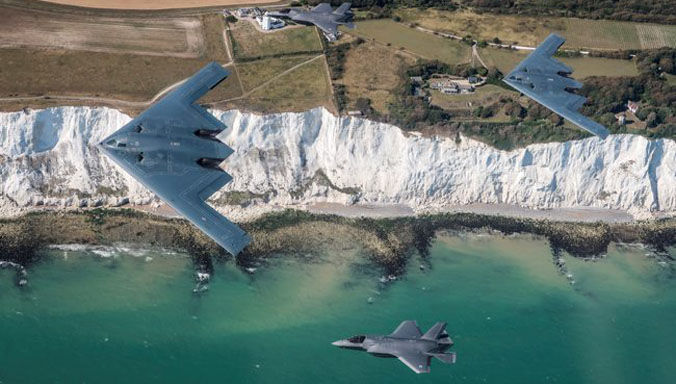
- Deterrence and defence is a core element of NATO’s overall strategy to prevent conflict and war.
- NATO’s deterrence and defence posture is based on an appropriate mix of nuclear, conventional and missile defence capabilities, complemented by space and cyber capabilities.
- The credibility of NATO’s nuclear forces is central to maintaining deterrence, which is why the safety, security and effectiveness of these forces are constantly evaluated in light of the changing security environment and technological developments.
- NATO’s current nuclear policy was updated in 2024 and is based on the Alliance’s 2022 Strategic Concept, as well as guidance from Heads of State and Government at NATO summits.
- The Nuclear Planning Group (NPG) is the senior body for consultation and decision-making on NATO’s nuclear deterrence.
- Allies maintain political control of all aspects of NATO’s nuclear deterrence at all times and under all circumstances.
NATO’s nuclear deterrence policy
Nuclear deterrence has been at the core of NATO’s collective defence strategy for over 75 years. The fundamental purpose of NATO’s nuclear capability is to preserve peace, prevent coercion and deter aggression. NATO’s goal is a safer world for all; the Alliance seeks to create the conditions for a world without nuclear weapons, in accordance with the goals of the Treaty on the Non-Proliferation of Nuclear Weapons (NPT), to which all NATO Allies are States Parties. However, as long as nuclear weapons exist, NATO will remain a nuclear alliance.
NATO’s current nuclear policy was updated in 2024 and is based on the 2022 Strategic Concept – the Alliance’s core policy document and blueprint for future adaptation – as well as guidance from Heads of State and Government at NATO summits
NATO will take all necessary steps to ensure the credibility, effectiveness, safety and security of the nuclear deterrent mission. The Alliance is committed to ensuring greater integration and coherence of capabilities and activities across all domains and the spectrum of conflict, while reaffirming the unique and distinct role of nuclear deterrence
The Alliance ensures the broadest possible participation by Allies concerned in NATO’s nuclear deterrence, demonstrating the Alliance’s unity and resolve. For decades, Allies’ commitments and contributions to NATO’s nuclear deterrence have been a central part of NATO’s broader deterrence and defence posture, and a source for security and stability in Europe. These contributions represent an enduring commitment to share both the benefits as well as the risks and costs of nuclear deterrence.
Nuclear consultation and decision-making
NATO Allies retain political control of all aspects of the Alliance’s nuclear decision-making. The key principles of NATO’s nuclear policy are established by all NATO Heads of State and Government. The development and implementation of NATO’s nuclear policy are the responsibility of the Nuclear Planning Group (NPG), NATO’s senior body responsible for nuclear deterrence, which was founded in 1966. The NPG provides the forum for consultation and decision-making on all issues that relate to NATO nuclear deterrence (including nuclear policy, planning, force posture, capabilities and exercises) in peacetime, crisis and conflict. All Allies – with the exception of France, which has decided not to participate – are members of the NPG.
The role of NATO’s nuclear forces
The fundamental purpose of NATO’s nuclear forces is deterrence. Nuclear weapons are unique and the circumstances in which NATO might have to use nuclear weapons are extremely remote. However, should the fundamental security of any Ally be threatened, NATO has the capabilities and resolve to impose costs that would be unacceptable to an adversary and far outweigh the benefits that any adversary could hope to achieve. Any employment of nuclear weapons against NATO would fundamentally alter the nature of a conflict.
Strategic nuclear forces
Three NATO Allies – France, the United Kingdom and the United States – are nuclear weapons states, as defined in the NPT
The strategic nuclear forces of the Alliance, particularly those of the United States, are the supreme guarantee of the security of the Alliance. The independent strategic nuclear forces of the United Kingdom and France have a deterrent role of their own and contribute significantly to the overall security of the Alliance. These Allies’ separate centres of decision-making contribute to deterrence by complicating the calculations of potential adversaries – an adversary must contend with NATO’s decision-making, but also that of the United States, the United Kingdom and France.
Nuclear sharing arrangements
NATO’s nuclear deterrence posture relies on the United States’ nuclear weapons forward-deployed in Europe, as well as on the capabilities and infrastructure provided by Allies concerned. The United States maintains absolute control and custody of its nuclear weapons forward-deployed in Europe
A number of NATO Allies contribute dual-capable aircraft (DCA) to the Alliance on a voluntary basis. These aircraft are central to NATO’s nuclear deterrence posture and are available for nuclear roles at various levels of readiness. In their nuclear role, the aircraft are equipped to carry nuclear weapons in a conflict, and personnel are trained accordingly. These nuclear sharing arrangements are a visible manifestation of the transatlantic link between Europe and North America and the indivisibility of the Alliance.
All Allies that participate in the NPG play important roles in sharing the burden of nuclear deterrence by participating in and contributing to nuclear consultations and decision-making, hosting nuclear-related events and providing conventional support to nuclear operations. Allies also contribute in other ways, for example by planning, hosting and participating in exercises
NATO’s nuclear sharing arrangements are fully consistent with the Nuclear Non-Proliferation Treaty (NPT), which was negotiated long after the first US forward-deployed nuclear weapons arrived in Europe, and takes these arrangements into account
Exercises
To ensure the credibility, effectiveness and preparedness of NATO’s nuclear deterrence, the Alliance conducts regular exercises.
Exercise Steadfast Noon is the Alliance’s annual nuclear deterrence exercise. The exercise is a long-standing routine training activity and part of NATO’s broader efforts to maintain readiness while also ensuring transparency. It has been conducted for over a decade and is the current iteration of a long line of NATO nuclear exercises. The exercise involves fighter aircraft capable of carrying nuclear weapons, but does not involve any live weapons. The exercise is not linked to current world events. A different NATO Ally hosts Steadfast Noon each year.
At the 2023 Vilnius Summit, Allies emphasised that they will strengthen training and exercises that simulate a conventional and, for Allies concerned, a nuclear dimension of a crisis or conflict, facilitating greater coherence between conventional and nuclear components of NATO’s deterrence and defence posture across all domains and the entire spectrum of conflict
Evolution of NATO’s nuclear policy
Nuclear deterrence has been at the core of NATO’s mutual security guarantee and collective defence since the creation of the Alliance in 1949. The very first NATO Strategic Concept (1949) referenced the requirement to “ensure the ability to carry out strategic bombing promptly by all means possible with all types of weapons without exception.” The United States subsequently committed nuclear weapons to NATO in July 1953, with the first American theatre nuclear weapons (i.e., tactical weapons that could be used in theatre operations, as opposed to longer-range strategic weapons) arriving in Europe in September 1954.
NATO’s nuclear sharing arrangements, which were already in place by the time negotiations for the Nuclear Non-Proliferation Treaty (NPT) began in the 1960s, were codified by the United States and the Soviet Union as a precursor to the final agreed NPT text. The United Kingdom has also assigned its nuclear forces, including its submarine-based nuclear system maintained under a Continuous At-Sea Deterrent posture, to the protection of NATO Allies since 1962
Since the height of the Cold War, NATO has reduced the size of its land-based nuclear weapons stockpile by over 90 per cent, reducing the number of nuclear weapons stationed in Europe
At the 2012 Chicago Summit, Allies agreed the Deterrence and Defence Posture Review (DDPR). This key document helped guide NATO’s nuclear deterrence policy over the following decade. Its core concepts were built upon in the 2022 Strategic Concept, which currently forms the baseline of NATO’s nuclear deterrence policy
In response to Russia’s war of aggression against Ukraine, at the extraordinary NATO Summit on 24 March 2022, NATO Heads of State and Government affirmed that the Alliance will significantly strengthen its longer-term deterrence and defence posture and develop the full range of ready forces and capabilities necessary to maintain credible deterrence and defence. They further committed to enhancing preparedness and readiness for chemical, biological, radiological and nuclear threats
At recent summits, Allies have reiterated their commitment to continue modernising NATO’s nuclear capabilities, increasing flexibility and adaptability of the Alliance’s nuclear forces, and strengthening NATO’s nuclear planning capability to enhance preparedness, while exercising political control at all times
