

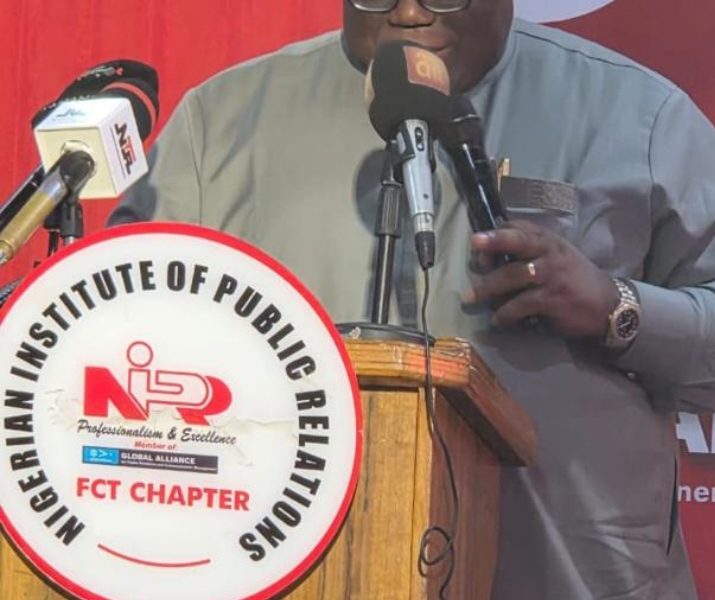
Prof. Tunji Olaopa delivering his goodwill message at the NIPR event in Abuja on Tuesday.
- Share
- Tweet
The Chairman, Federal Civil Service Commission (FCSC), Prof. Tunji Olaopa, has urged members of the Nigerian Institute of Public Relations ( NIPR) to give attention to development communication to fix the country
Olaopa made the call on Tuesday in Abuja during a meeting of public relations experts under the auspices of the Professional Platform of the Federal Capital Territory’s chapter of the NIPR
In a goodwill message Olaopa delivered as a special guest on the occasion, he acknowledged the vital role of NIPR members in the success of corporations and governments
According to Olaopa, development communication is unarguably a core component of any national change programme to reset Nigeria as it touches on national values remodeling and culture change
He lamented that due to the culture of ‘something for nothing’ which supplanted what was a culture that valued national sacrifice as service and as deferred gratification up unto the mid-70s in Nigeria, before the onset of the era when the oil boom created a culture of entitlement, Nigerians have ceased to understand what development is all about
Olaopa who said that he had shown interest in strategic and development communication for a long time commended Prof. Osita Ogbu of University of Nigeria for his seminal work Development As Attitude: How National Progress is Shaped by Leadership Philosophy and Citizens Orientation for addressing his concern so profoundly
He said: “Let me observe from the outset by saying that I have more than a casual interest in your core competence as professionals and as an institute. Strategic and development communication, in my estimation, is core critical to delivering on my institutional reform model as public service change imperative and catalyst to national socioeconomic transformation .”
He decried a situation where government communication or what information officers do has been largely oriented to a denial of what people know as truth rather than communicating to build public trust
He said that he was worried, as a reformer and change agent, about the expanding reputational risks and national de-marketing that the nation suffers through misplaced social media activism rooted largely in the recycling of ignorance as activism
” With just smartphones and internet connection, virtually anyone can circulate information, whether true or false, to global audiences within seconds thus inflicting reputational damage that will take ages to correct
“All of these are my challenges to the NIPR to rise up to raise the bar of practice and professionalism in our joint efforts to fix Nigeria”, he said
In the same vein, a former Director of Public Affairs at the Nigerian Communications Commission ( NCC), Dr Tony Ojobo, urged public relations experts to recalibrate their strategic communication in the public sector
Drawing from his experience at the NCC, he urged public relations practitioners to communicate with integrity in order to earn the trust of stakeholders such as the citizens
According to Ojobo, the citizens are already aware that the government is faced with challenges and that what is required is a communication strategy that would assure them that the authorities are working on finding solutions
Don’t Miss
BREAKING: Terrorists Invade Borno School, Abduct Students

Latest News
BREAKING: Terrorists Invade Borno School, Abduct Students
1 day ago
on
June 29, 2026
By
NewTimes

President Bola Tinubu
In a fresh outbreak of violence in Borno State, gunmen suspected to be Boko Haram and the Islamic State West Africa Province (ISWAP) terrorists on Monday invaded Government Day Secondary School in Lassa, Askira/Uba Local Government Area
They abducted an unspecified number of students writing the National Examinations Council (NECO)
The terrorists reportedly invaded the school at about 9:00 a.m., fairing sporadically into the air and causing panic among students, teachers and residents before whisking away an unknown number of candidates into the bush
A teacher was reportedly killed during the attack, while another sustained injuries
Confirming the incident, the spokesperson of the Borno State Police Command, ASP Nahum Daso, said some students remain unaccounted for
“At about 9:00 a.m., an unspecified number of Boko Haram and ISWAP terrorists attacked a secondary school and shot sporadically into the air. During the attack, an unspecified number of students were abducted, while some are still missing,” Daso said
He added that the command could not immediately confirm reports of fatalities among the victims
The PRO added that security operatives, including the military, the Civilian Joint Task Force (CJTF) and the area commander in Askira/Uba, have launched a coordinated search-and-rescue operation and are combing the surrounding forests in an effort to locate the abducted students and apprehend the attackers
Continue Reading
For The Record
Life Challenges, No.2: The Certainty Of Death
Published
4 days ago
on
June 27, 2026
By
NewTimes

Prof. Toyin Falola.
By Toyin Falola
Poetic Preamble
You will die
I will die
When?
How?
Time?
Where?
Don’t ask me
For years, we have continually asked the wrong questions. There have been so many inquiries about why humans die. This is because death has been a faithful companion from the beginning and will likely remain until the end. The most important question now should not be why humans die. A more appropriate question is to ask how societies choose to live knowing full well that they will die. With the right questions, one may begin to understand how we see death
When Death Forgets to Whisper
Death did not knock
It knew the door had long forgotten laughter
It slipped inside like a shadow that had memorized every corner of the house
Running its cool fingers along the backs of chairs where names were carved
Counting empty plates for past guests
Judging silence by the weight of dust
Morning came, but it forgot how to grow light
Above the earth, the sun swung like a weary witness
Unable to convince the flowers that another season was worth blooming
There is a loneliness.
that even language cannot bury.
It walks barefoot through abandoned rooms,
calling names that answer only with echoes.
The walls remember every voice,
Yet offer none back.
Memory becomes a cemetery.
where every thought is another gravestone
Hands that rocked futures to sleep
rest quietly at their elbows
Eyes that held entire universes
have shut, taking nothing with them
Books remain open,
letters remain unfinished,
dreams remain waiting at stations
where no traveler returns
The river flows on
Like it cares for the thirst of those who have died
Trees raise their arms to the sky
Like heaven cannot hear their questions
Birds practice their melodies for their ears
That are now unfamiliar with listening
The wind gathers forgotten footsteps.
and scatters them among fields
where no one remembers who walked there first
And discover
that grief has learned
to imitate warmth
Night grows older.
The moon lowers its pale face.
into the black well of the sky,
searching for those
whose names have dissolved into eternity.
Even the stars appear cautious,
as though they fear
that shining too brightly
might awaken another farewell
In the end,
Death owns nothing; it creates.
It gathers every king and every child,
every poet and every laborer,
yet cannot keep their love,
their kindness,
their songs
Still, there are evenings.
when the silence is so complete
that the earth itself seems to mourn.
On such nights,
The soul stands at the edge of remembrance,
looking into the vast country of absence,
and wonders
how something as small as a heartbeat
could have held
an entire universe
Philosophy
No matter what era or period, all human civilizations are faced with one inevitable certainty: death. If we are all going to die, then why do we reach for earthly pleasures knowing that our time will come to an end? Why build empires, have relationships, start families, seek greatness for a temporary life? Africa’s vast number of cultures may not have one definitive answer to what death means. But they do, however, provide one collective consensus; life is about how we choose to react to our mortality. Death is inevitable. In many ways, it’s equally mysterious. But it is our greatest teacher that life is temporary, and we as a generation must choose what we want to leave behind. After all, death is the one thing we can all know for certain. But life is about the decisions you make before death.

As the quality of life gets better by the day, humans have built cities, created empires, and accumulated wealth. They long to keep these achievements and continually amass more. This desire makes them pursue immortality through various means without success. The certainty of death for every attempt eludes their efforts, not merely for biological reasons but as a significant reality of human civilization
Historically, the awareness of death’s certainty has inspired different responses across African communities. These inquiries have produced philosophies, rituals, and traditionally grounded systems in response to the need to make sense of the mysteries behind human mortality
Africa is culturally rich in traditions. It would be myopic and misleading to speak of death from a single African philosophy. For a continent with thousands of ethnic affinities, languages, religious practices, and cultural systems, the understanding of mortality differs with little or no similarities in some instances. The Yoruba, for example, share a different notion and approach to death with the Akan, in the same way both systems share a different view from Islamic traditions, influencing major groups in West and East Africa. These beliefs are equally different from ancient Egyptian traditions on the afterlife. Yet, amidst this diversity, there remains a singular recurring theme that connects all: an understanding that death is not a private event. It is a communal event with significance that extends beyond the individual.
This confirmation is important as it bridges the gap between what we know and what modern discussions believe. In recent times, modern discussions have discussed death in isolation, unlike many African traditions that approach the subject of mortality through relationships. The death of an individual when it happens becomes a communal event. It goes down, documented as history, and brings family and friends together. In African societies, the deceased leaves behind a body and numerous obligations, memories, stories, and lessons. This approach shows how African mortality is interconnected with social existence.
The African perspectives of death and what it connotes do not eliminate the tragedy it comes with. It would be naïve to imagine that African societies readily accept mortality with calmness. Death in Africa, just like any part of the world, is accompanied by grief, uncertainty, and fear. The death of a child, a loved one, either as a result of natural or unnatural causes, such as war, famine, disease, and displacement, has left individuals scarred throughout African history. Mortality has reshaped entire communities across Africa massively. The peculiarities of mortality in these instances have pointed out the dynamics of human mortality. Death is not just philosophical. It assumes befitting shapes to prey on human life. The transatlantic slave trade, colonial violence, civil wars, and other human conflicts are reminders that death can arrive violently, to disrupt lives and shatter hopes.
These realities genuinely frustrate any attempt to create it as a mere transition or a tale for caution. We should not forget that death is an interruption. It terminates possibilities and leaves questions unanswered. Many are aspirations that have died over death. Any philosophical enquiry into death requires an honest acknowledgement of its darker dimension. A child who drops out of school over the death of a parent or guardian, or the parent who buries a child, may find no comfort in abstract reflections on nature.
As cruel as it sounds, it is precisely the nature of these dark realities that societies develop coping mechanisms to death. In significant parts of Africa, memory is one means with which humans have learnt to cope with death. Africans find ways to incorporate their deceased into collective consciousness. This they have achieved, through oral traditions, genealogies, praise poetry, and historical narratives, to ensure that those who depart continue to occupy a place within the social imagination.
This approach should not be confused with any claim that remembrance defeats death. It does not. A remembered loved one remains dead
Celebrated heroes and historical figures all remain dead. They do not return. They are only preserved in memory for significance against complete erasure. Memory in this regard is just a means to allow the past to remain connected with the present. This accounts for why the names of great rulers, scholars, reformers, and visionaries remain within contemporary consciousness even in death
In our time, death has done more in debunking any thoughts of permanence and visibility that digital access promotes. As much as the world celebrates visibility, death serves as a reminder that these presences are fleeting. The applause dies, the camera flickers and stops, wealth changes hands, and successors occupy offices. What remains is the substance of one’s contribution
This futility may help shed light on why death is a central theme across religious and philosophical thought. Islamic traditions with significant influence on African societies view death as a passage to accountability before God. Traditional cosmologies believe that death brings continuity: reincarnation between generations. Modern thinkers, on their part, hold that mortality gives urgency to human life. When we think of death, we spend time pursuing opportunities, seeking greatness and fulfilment faster.
Despite their variations, these perspectives have done something profound. They all lead to a common realization that thinking about death compels a reflection on the essence of life. Perhaps this is humans’ greatest lesson on death
Death is the perfect demonstrator of the rule of law. It equalizes gently. It takes rulers and subjects alike. It gets to the poor and the rich. However, we should not mistake death’s equality in the same light. Death carries more consequences for some than others. Some have been remembered while others have been forgotten. The distinction lies in what actions they put forward during their time on earth
Get real. Death is a non-negotiable part of human existence. It requires no proof, and not a single advance in technology and science has found a way to forestall its eventuality. It is so certain that its arrival comes without an invitation. It remains indifferent to the social distinctions and ambitions that characterized the lives of its captives. It has been a part of human existence for generations, finding its way into the existence of new generations who share no similarities with the previous ones. Over the years, death has been confronted as though it were a new revelation instead of the generational reality it is.
A fate worse than death
As bad as your death is, rejoice! You cannot mourn yourself. You are not invited to the funeral ceremony. You are not the archivist of your end. You belong to memory. You live in the fragile hearts of the living who cry for a few hours and move on. You live in the darkness of your grave
There is a death worse than yours: when you bury your only child and do the grieving and crying. I am afraid I cannot wish you well at this time, as I know people who are walking corpses, praying to die but cannot commit suicide
Wait!
Continue Reading
Latest News
Path To
Published
5 days ago
on
June 25, 2026
By
NewTimes
The Chairman, Federal Civil Service Commission, Prof. Tunji Olaopa delivering his goodwill speech during the Office of the Head of the Civil Service of the Federation (OHCSF) Sensitization on Mentoring Market Place held in Abuja on Thursday.
The Chairman, Federal Civil Service Commission ( FCSC), Prof. Tunji Olaopa, has proffered a path to attaining
Olaopa spoke at the Office of the Head of the Civil Service of the Federation (OHCSF) Sensitization on Mentoring Market Place held in Abuja on Thursday
He said that the event was yet another “significant component of the FCSSIP25 reform blueprint that signposts talent management, leadership pipelining and capacity development as reform imperatives.”
While noting the value of mentoring in any profession, Olaopa acknowledged that the process had taken place in some measure in the civil service in the past
Noting the necessity of recalibrating mentorship, Olaopa, however, lamented that the profession of public administration and the civil service lose so much by letting the legacy of the administrative wisdom of vintage bureaucrats fritter away as they retire over the years
He wondered whether the civil service had ever systematically built and managed a database of the vanishing skills of outstanding officers and mentors while they were still in service and to be leveraged when required from time to time
Decrying the dearth of frameworks for mentorship in the civil service, Olaopa asked: “Where for example is the institutionalised mentorship-rooted learning infrastructure in the federal service that enables handholding, performance consulting and skills transfer between officers across grade levels and cadres beyond those that are merely incidental? What for example is our policy as an administrative system for the preservation of MDAs’ institutional knowledge resources and expertise with the breakdown of our traditional system of manpower forecasting and succession planning as we know it?”
For Olaopa, however, mentorship must not always be top-down. Consequently, he urged the adoption of a reverse mentoring which could narrow the skills gaps between tech-savvy young civil servants and their old seniors by the former teaching the latter how they could navigate the intricacies of artificial intelligence (AI) for policy work and public administration
He also urged the adoption of a framework that would encourage public private partnerships (PPPs) to deepen staff exchange with the private sector and non-state institutions to accelerate skills acquisition as touching on the building of commercial skills, and the imperative need to mainstream good corporate governance principles into public governance codes
” It will therefore be worth our while to target seasoned professionals beyond the public sector and in the Diaspora, through strategic networking, as profiled administrative leaders-potential and
take advantage of mentors who are capable of opening doors of new professional circles, key stakeholders, and all, for enhanced policy intelligence and problem-solving”, he said
He lauded the ongoing human rech, he said , a window to revisit the recruitment embargo may never have been available for many more years
“Happily, the HR audit is going to enable us to undertake deep-seated workforce skills inventory and gap analysis, so we will be in a position to determine the service capacity deficits in time-series.If, however, this well-thought-through mentorship scheme will be game changing, then, we will need to implement deep-seated changes in our career management system. This suggests that we must restore personalised career development plans for profiled officers being pipelined for administrative leadership in time and space”, he added.
Paying tribute to the Head of the Civil Service of the Federation, Mrs Esther Didi Walson-Jack, Olaopa said that she had brought positive changes to the civil service. He said that he had worked with many senior people in the civil service but that Walson-Jack was exceptional.He paid tribute to her collegiality and her quest to resolve areas of conflict with the FCSC
Stressing the importance of mentoring, Walson-Jack said that while it was not compulsory, it was imperative for those who desire to improve themselves, develop new competences, and grow to a better level. According to her, she herself has many mentors in areas such as career, marriage and spiritual life
Reflecting on the legacies she is bequeathing as her career comes to an end, she said that there was no greater reward than leaving an organisation better than one met it, adding that the strength of a nation is tied to that of the civil service
Continue Reading


Opinion5 days agoLamentations In The Land


Opinion2 days agoVeronica Ngalasi Igwe: Loving, Giving And Forgiving Unto Death
- Opinion2 days ago
Kano State And Mass Weddings

Opinion3 days ago
Olu Falae’s The Triumph Of Grace: Critical Insights For Deepening Administrative Reform In Nigeria


Latest News1 day agoBREAKING: Terrorists Invade Borno School, Abduct Students
