

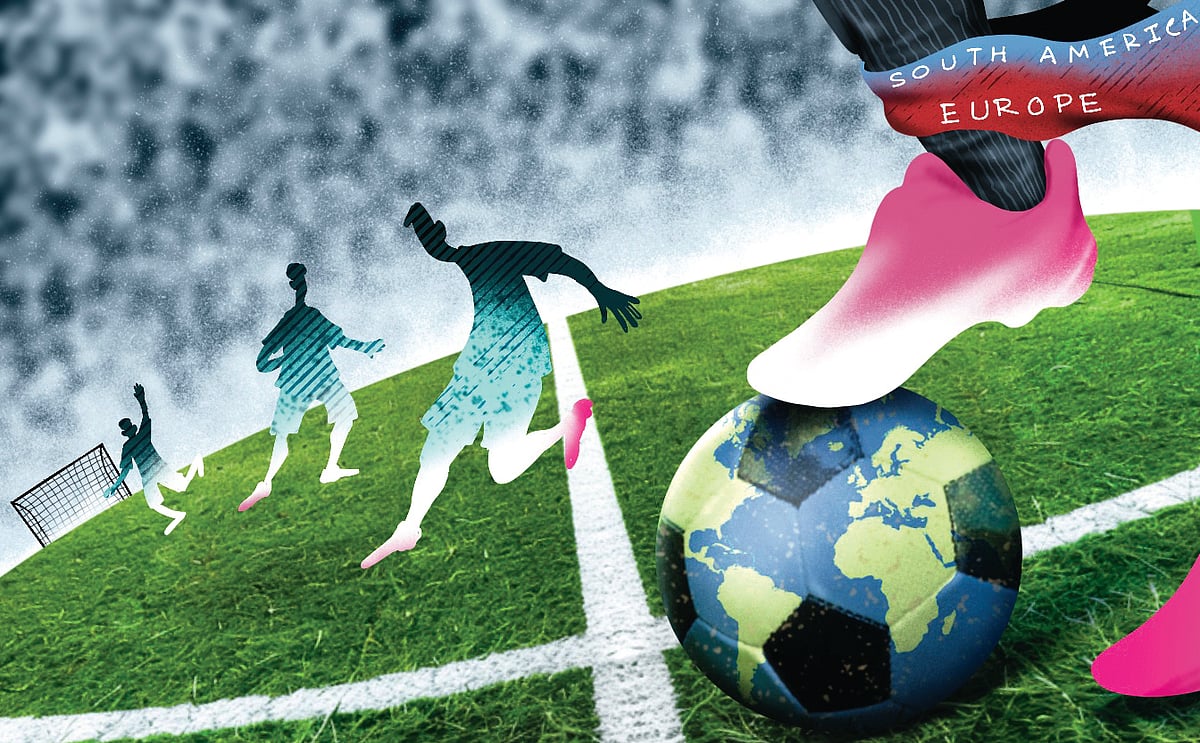
The final will be a clash between the South American and European champions—a first for a World Cup final(Express illustrations | Sourav Roy)
Updated on: 17 Jul 2026, 6:30 pm
A hundred and two matches down and only two to go. Let’s bring on the countdown, the excited announcer, the tacky music and the inevitable Trumpian overtones for the last couple of times. Will Lionel Messi and his gravitational aura, for one last time, bend the arc of history Argentina’s way, or will Spain—often so frugal, at times so gossamer—further cement the current epoch as theirs?
The final 90 minutes on Sunday night will be so layered, so luminous and powered by so much stardust that the spectacle itself may ultimately feel understated. That is, unless Messi & Company re-engineer the joyride of the last World Cup final, when Argentina’s talisman went head-to-head with Kylian Mbappé in a superlative six-goal thriller. This time, Messi faces the teenager Lamine Yamal, who is yet to fully explode at the tournament. What better time than the final?
The showpiece event is, however, instructive for another reason. The Old World still has a firm grip on the World Cup, even in its supersized 48-team form. The scale, length, debutants, locality—three North American nations—and some early results had suggested a shift in power, or at least that the outlines of a different future. But ultimately, the illusion faded and the powerhouses reasserted authority.
Nine out of 10 African teams progressed from the group stages. While that seemed a testimony to their progress, one by one they fell in the round of 32—except for Morocco. The continent’s last representative exited in the last-eight stage. The Moroccan Football Association is well-resourced and organised. Their quarter-final run proved that Morocco’s third-place finish in Qatar was no fluke. There was no shame in their elimination by France, but the makeup of Morocco’s squad highlighted part of the structural problems facing African football: 19 of the 26 players were born outside the country. Just one player of their starting XI against Brazil was born in Morocco.
Congo, Tunisia and Algeria also fielded rosters with more than half the players born abroad. Tournament sensation Cape Verde selected 14 diaspora players and took Argentina to extra-time in a valiant defeat. Fifa held up the Cape Verdians as proof that they are living up to their mission statement by distributing development money. Yet, before the tournament, manager Bubista had told me that there was still a vast amount of work to do on the ground to develop the domestic league and infrastructure in the island nation.
Under Fifa president Gianni Infantino, more than $5 billion has been distributed in development money to the 211 member associations. It’s a strategy replicated from Sepp Blatter and is key to his political survival: in return for financial support, Infantino receives votes.
African nations are a generous beneficiary of Fifa development money. In the 2016-2022 report on Forward Development funds, African member associations were the largest recipients, receiving $518 million in total. But with such a heavy reliance on the diaspora to bridge the qualitative gap with Europe, it begs the question of how African federations run their national team setups and football at large in their countries. Crucially, the audits of these forward development funds are never made public.
At least, Africa had a proper presence in the knockout phase. Japan had enjoyed gushing reviews from the world media, but for all their perceived mobility, agility and speed, they could not dislodge a disjointed Brazil in the round of 32. The Samurai Blues failed to defend a 1-0 lead and, as Asia’s last representative, exited ignominiously. Perhaps Japan have stagnated in recent years and Asian football at large has failed to progress. Saudi Arabia, Qatar, Iraq, Jordan, Uzbekistan—and even South Korea, whose campaign collapsed amid internal strife—had little business at this tournament.
This speaks to a larger theme. Scotland, the Czech Republic, Panama and Curaçao were also mere bystanders at the World Cup. The tournament has simply become too bloated. How many games will you genuinely remember from the 2026 edition? Maybe Mexico-England at the Azteca Stadium, and Argentina’s ties with Cape Verde and Egypt. Will Argentina’s semi-final with England, a match steeped in history, emotions, iconography and Thomas Tuchel’s inexplicable decision to play a five-man backline to protect a 1-0 lead, also make the cut?
South America is Europe’s historic rival at the World Cup. Argentina remain the defending champions, but Brazil have fallen by the wayside. The five-time world champions last won the tournament in 2002, when Ronaldo spearheaded the Seleção. With the exception of Vinícius Júnior and central defenders Gabriel and Marquinhos, Brazil’s contemporary generation is mediocre and manager Carlo Ancelotti is perhaps too pragmatic to revive an ailing football nation. The result was predictable: a dysfunctional team that passed too slowly and pressed rarely endured Brazil’s worst World Cup campaign since 1990.
If Brazil are in denial, Germany share the same state. Since winning the World Cup in 2014, they have exited the global finals early. At a micro level, the German FA, the largest football association in the world, has been severely mismanaged and Julian Nagelsmann displayed too much arrogance in his managerial role. But perhaps, the decline of Die Mannschaft is also the story of the decline of Germany’s social democracy, with its divisive politics, nose-diving economy and a rail network that is now an affront to the country’s famous punctuality.
Germany is surrounded by social democracies that facilitate access to football at the grassroots level—the Netherlands, Belgium, Norway and France—which serve as a pipeline to professional academies for the most talented. Western Europe has industrialised its youth development, shrewdly capitalising on the multicultural makeup of its societies as well.
It shows in the results. Since 2006, Western Europe has won 11 of the 15 spots on the podium. Croatia and Argentina have stood in the rest of the world. This World Cup has been no different: three of the four semi-finalists are from Europe. The final will be a clash between the South American and European champions—a first for a World Cup final. Argentina truly play a brand of controlled possession built around the ageing, often-static, always-talismanic Messi, who has been instrumental in engineering some of the greatest comebacks at this World Cup. Yet, his brilliance perhaps obfuscates another truth: where would Argentina be without him?
Samindra Kunti | Football and investigative journalist based in Belgium
