

Simon Maina/AFP via Getty Images
Quotas designed to bring gender parity to parliaments have an overall positive impact on support for female political leadership – especially after women members of parliament take office. Furthermore, there is no evidence of a backlash among men
That’s what I found in a study published in October 2025 looking at the impact of gender-parity quotas in Namibia, in sub-Saharan Africa
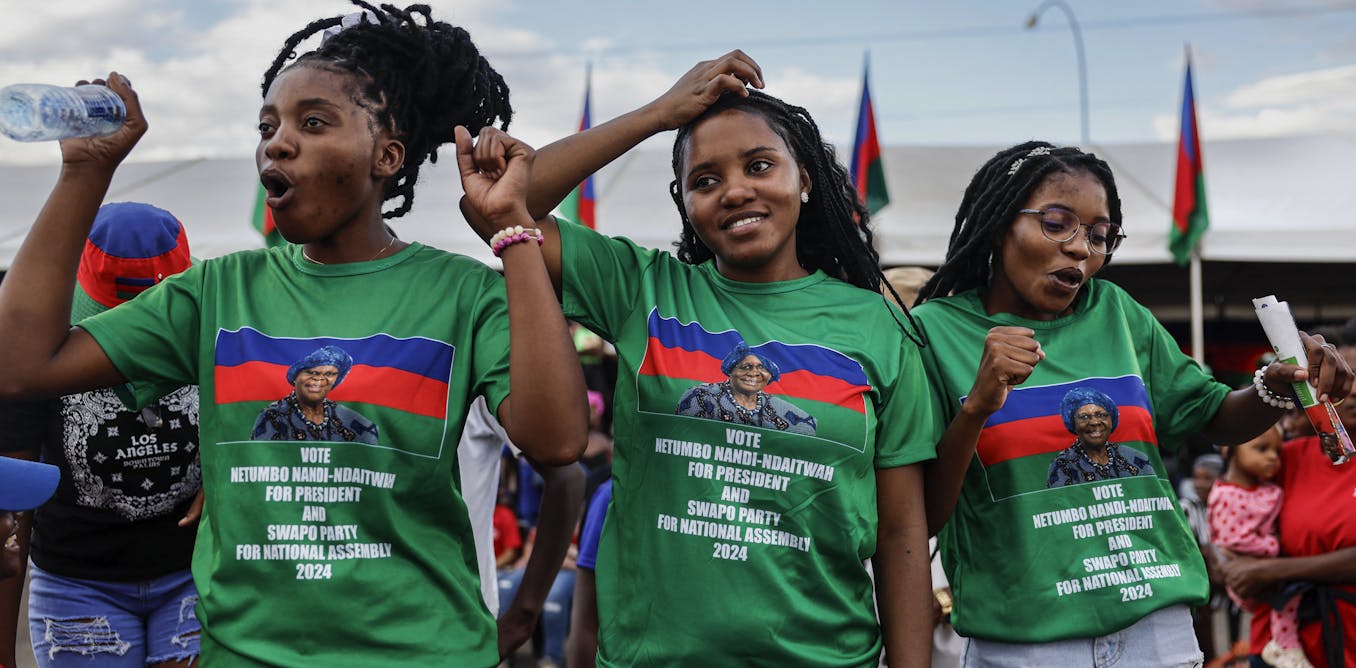
In 2013, Namibia’s dominant political party, the South West Africa People’s Organization, or SWAPO, quietly rewrote its internal rules. From that point forward, every spot on its parliamentary candidate list would alternate between a man and a woman
Most prior research on measures to encourage gender parity in politics focuses on national or legislative policies rather than voluntary party quotas. Namibia offers an unusually “clean” case in that SWAPO is electorally dominant and did not face grassroots pressure to adopt its quota policy. That makes it possible to isolate the effects of the quota itself, rather than any preexisting trend in public attitudes.
And the impact on the subsequent 2014 election was clear. Women’s representation in the National Assembly nearly doubled overnight, rising from 21% to 41%
But the more surprising story unfolded outside Parliament. Using several waves of nationally representative surveys from 2006 to 2017, I traced how ordinary Namibians reacted when women suddenly became far more visible in national politics
Vladimir Chlouba, CC BY-SA
The findings are striking. Women who lived in SWAPO strongholds, the communities where the surge in female MPs was most evident, became more supportive of women’s right to hold political office. Their attitudes tilted upward by about four-tenths of a standard deviation on a four-point scale of support for female leadership. Put simply, women were more likely to endorse the statement “women should have an equal chance to be elected to political office” over “men make better leaders” when asked to pick one of the two claims.
Just as striking is what did not happen. Men did not move in either direction. They did not become more supportive of women in politics, but they did not become less supportive, either
The absence of backlash is as important as the positive change among women. It suggests that the fear that quotas will inflame male resentment – a common concern in culturally conservative settings – did not materialize in this case
Perhaps the most striking point is the timing. Public opinion did not shift when the quota was announced. It shifted only after women actually took office and became plainly visible as political leaders
Why it matters
Around the world, women hold fewer than 3 in 10 parliamentary seats. In sub-Saharan Africa, the average share of women in parliaments is 27%. However, this masks wide variation. A handful of trailblazers, such as Rwanda, pull the figure up, while women remain severely underrepresented in many countries across the continent
In many countries, deeply entrenched cultural norms cast politics as a male domain and lead citizens to doubt women’s capacity to lead. Yet exposure to women who defy stereotypes can begin to challenge these assumptions, reshaping what people believe is possible
The case of SWAPO in Namibia shows that quotas, introduced voluntarily by a political party rather than imposed by law, can challenge people’s gender bias without triggering the backlash many observers predict
What still isn’t known
This study shows that voluntary quotas shift attitudes, but several questions remain. First, we do not yet know how durable these changes are. Do they last only as long as female leaders remain highly visible in Parliament, or do they persist across election cycles?
Second, visibility is almost certainly not the only mechanism encouraging change. The next step is to examine how media coverage, local campaigning and community-level engagement shape perceptions of women leaders
It is also important to think about how these effects might vary country to country. Namibia is in some ways a special case. SWAPO has dominated Namibian politics for over three decades. Whether my findings travel to more competitive environments or to regions beyond Africa is a question worth pursuing
What this study does make clear is that quotas adopted voluntarily, without legal coercion, can change how ordinary citizens think about leadership
Sometimes the most convincing argument for women in politics may simply be watching women govern. The symbolic impact is too often overlooked, and in places where formal reforms are politically difficult, it may be the most promising starting point
The Research Brief is a short take on interesting academic work

