

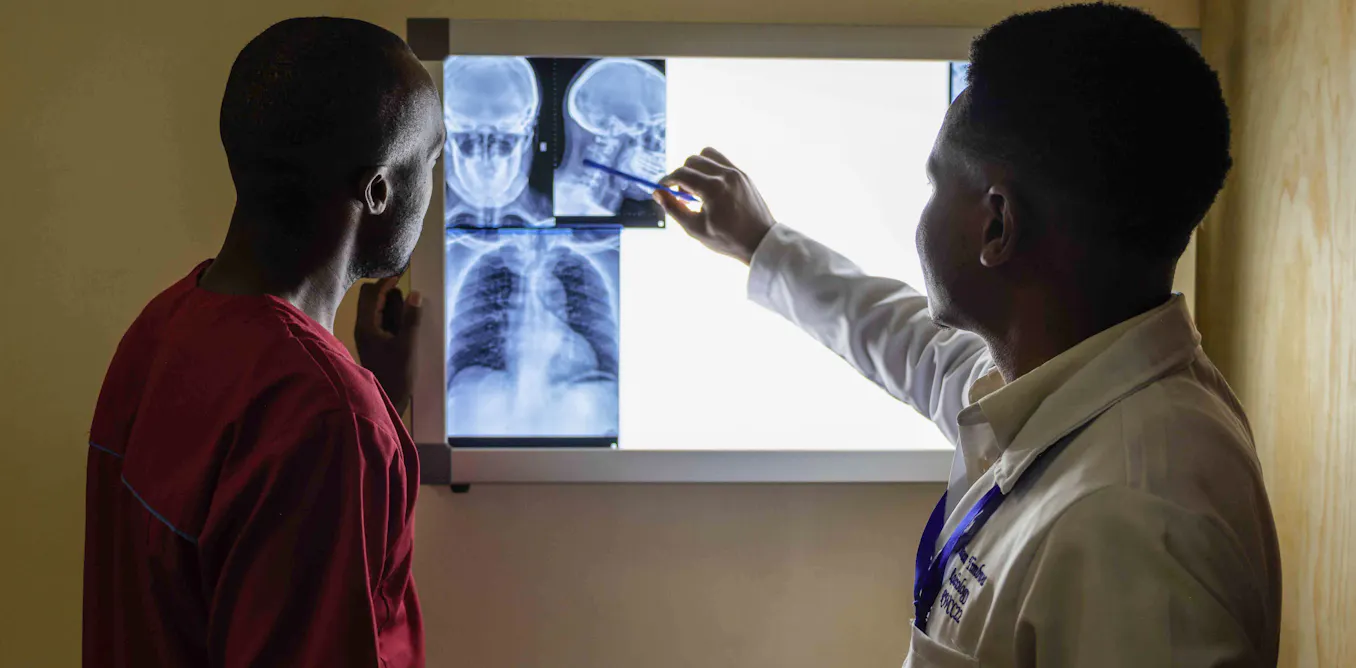
For generations, the stethoscope has symbolised diagnosis. A doctor uses it to listen to the body, turning faint signals into clinical judgment. Healthcare AI promises a different kind of listening.
In South Africa, mobile clinics use artificial intelligence (AI) to examine chest X-rays for signs of tuberculosis (TB). A study in rural areas of KwaZulu-Natal province used this approach to screen nearly 10,000 people.
The technology is also being used on a much larger scale. Figures presented by the Stop TB Partnership in December 2024 showed that a South African programme incorporating AI-assisted chest X-ray screening had covered more than 450,000 people through 33 mobile clinics across the country. In Zimbabwe, similar technology is being used in mining communities to screen for silicosis, a lung disease associated with exposure to silica dust.
These new tools draw on patterns in patient records, laboratory results and population data. This is the promise of smarter healthcare. But whose health needs do these systems recognise when data do not represent everyone equally?
Shiven Naidoo, a PhD student in bioinformatics (using computer technology to collect, store and analyse biological data) at the University of the Witwatersrand, and I explored this question in our recent research. The question we set out to answer was whether algorithms (the rules AI systems use to turn data into predictions or recommendations) unintentionally reinforce existing health disparities. We developed a conceptual framework that looked at how populations are represented in health data. We also looked at how algorithms classify and prioritise them, and how those classifications can shape access to healthcare.
We found that digital health technologies risk reinforcing health inequalities. The problem begins with whose information is collected. Patients in rural and poorly recess to healthcare, incomplete medical records and fragmented digital systems. Disconnected health information systems can leave patients with incomplete medical histories, particularly when they move between facilities or provinces
The problem also extends to genetics. Most genomic research into how DNA shapes health has relied on data from people of European ancestry. This means that tools used to predict disease risks can be less accurate for African populations.
Using more representative local data, regularly auditing these systems for bias and involving affected communities in their design and evaluation can help ensure that technological advances don’t come at the expense of equitable healthcare.
For example, a screening tool could be tested using data from the rural and urban clinics where it will be used. Such testing might reveal that a tool accurately identifies disease in one population but misses more cases in another because of differences in underlying health conditions or how the disease presents. Researchers could then use these findings to refine the tool, adjust its screening criteria and test it again to ensure it performs reliably across different patient populations.
Governing through data
We drew on French philosopher Michel Foucault’s concept of “biopolitics”. This approach examines how populations are governed through measurement, regulation and statistical observation.
This lens helped us look beyond the accuracy of the data used, to the consequences of classification. Assigning people to categories of risk, vulnerability and priority can influence who receives intervention and where re
In southern Africa, uneven infrastructure and unequal access to care shape whose experiences enter datasets.
But representation is only the starting point. The criteria AI systems use to assess patients and allocate healthcare re
Our paper considers how AI algorithms can embed benchmarks for “normal” health that marginalise people with rare conditions. The criteria used to prioritise patients can similarly disadvantage certain groups within a population.
A 2019 study found that a healthcare algorithm used in the United States underestimated the health needs of Black patients because it used healthcare spending as a measure of medical need. Since less money was historically spent caring for Black patients with comparable health needs, the system assigned them lower risk scores. This made them less likely to be identified for additional care.
The concern is beyond who is represented in the data. It extends to what assumptions shape how data are interpreted and used.
Who is represented in the data?
Much of the genomic data informing advanced health technologies comes from European populations. African populations remain significantly under-represented.
Polygenic risk scores illustrate the consequences. These tools use genetic information to estimate disease risk. Scores developed mainly from European genetic data can perform poorly in black African populations. This limits their clinical usefulness.
Our analysis also considers who has the infrastructure to produce data. Pathogen genomic surveillance uses sequencing and analysis to track how disease-causing organisms evolve and spread. It depends on sequencing capacity, digital infrastructure and specialist expertise.
These resources are concentrated in major centres. As a result, samples from outbreaks in less-equipped communities may be sequenced late or not at all. This leaves important transmission patterns poorly understood. During the 2013–2016 Ebola outbreak in west Africa, for example, an interruption in viral genome sequencing meant that some samples were only analysed later. This limited the opportunity to use genetic evidence to track how the virus was spreading between communities in real time. Such information could have helped health authorities identify transmission chains earlier and target surveillance and isolation efforts more effectively.
These examples concern different technologies. But they illustrate a shared problem. Unequal capacity to generate and analyse data can shape whose health needs digital systems recognise.
When efficiency hides exclusion
We also examined how gaps in the data and the assumptions built into its use can shape predictions and decisions about re
Aggregate vulnerability measures can obscure differences within communities. Data that under-represents rural areas or inadequately captures conditions in informal settlements can leave particular needs unrecognised.
For example, a community with incomplete records may appear to have lower health needs. A patient moving between provinces may become a fragmented case history. A clinic with poor connectivity may generate less usable data.
Processing available data more efficiently cannot, by itself, correct these gaps.
An apparent objective assessment of health need may instead reflect who can reach clinics, whose records are complete, and which facilities have functioning digital infrastructure.
What follows from the analysis?
Decisions about whether to adopt AI health technologies should consider equity alongside clinical performance and cost. Health technology assessments should examine who is represented, who may be disadvantaged and whether data governance reflects local priorities.
We also propose regular audits, transparent decision-making processes, and community participation in design and evaluation.
Strengthening African research governance is another part of the response. The principles of local oversight, inclusive consent and equitable data use should also guide how healthcare AI technologies are assessed and adopted.
Equitable healthcare requires scrutiny of the entire path from data collection to classification and intervention. The question is not simply whether AI processes health data effectively. But whose needs it recognises and how that recognition shapes access to healthcare.

