

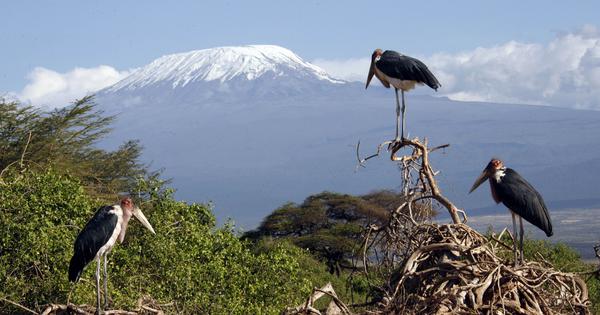
East Africa’s shrinking mountain glaciers on three peaks in Kenya, Uganda and Tanzania will soon be no more. The 2025 State of the Climate in Africa report (page 13) estimates that the ice areas on Mt Kenya, the continent’s second-highest peak, have shrunk 96% in the past 115 years. The ice cap will cease to exist in three to five years, says the report. Rainer Prinz, who studies climate-glacier relationships, explains the intricate processes behind the retreat and what the consequences will be.
What makes up the ice caps?
Glacier ice consists of snow accumulated over decades and centuries. Some snow may melt during summer or warm seasons. But some remains and is covered by more snow falling during the wet seasons. Glacier ice, which makes up the bulk of the white mountain tops, is formed by this process.
There are glaciers on Mt Kenya, Kilimanjaro in northern Tanzania and Rwenzori, on the border between Uganda and the Democratic Republic of Congo.
These glaciers have increased and decreased in size during the past centuries and millennia following wetter and drier climatic conditions. The glaciers as features might be as old as 10,000 years, but the ice itself is considerably younger.
The current glacier retreat is unprecedented, outside the range of its natural variation. During the past decade we recorded 40%-60% glacier area loss in east Africa. So, half of the ice melted within 10 years.
What is the real value of an ice cap?
Glaciers and ice caps have different values in different regions. It is a widespread misconception that glaciers in east Africa act as water towers or reservoirs. In truth, they are too small to have a significant effect on the water cycle.
One reason is that they are not simply melting, they are partly evaporating. Water can change directly from its solid form (ice) to the gaseous phase (vapour) in a process called sublimation. This is a process typical of tropical glaciers as the atmosphere in the high mountain tops is so dry. There is little meltwater runoff contributing to the river system.
A second reason is the small volume of water stored in the glaciers. Mt Kenya’s glacier area was about 69,000m² in 2022 and stored about half a million cubic metres in ice. If you were to melt all that at once and distribute the water evenly over the mountain, there would be no more water than falls during a single rainfall event. The water towers of east Africa are its forests, not its glaciers.
The scientific value of the glaciers lies in what they tell us about climate. One of my teachers once said, “glaciers are machines that translate weather into climate”. That is to say, scientists can interpret long-term climate signals from short-term weather patterns etched in the glaciers.
East African glaciers have a high significance as instruments providing information about the climate in the mid-tropical troposphere (the lowest level of the atmosphere in the tropics but still 5km-6km above ground), where our traditional measurements are scarce.
Why have east Africa’s ice caps been receding?
Learning how to read the glaciers as climate signals was the aim of a series of our research projects.
Our research shows that the recession of east African glaciers since the late 19th century was primarily due to a decline in snowfall on the mountains.
Reduced snowfall leads to limited mass gain. It also reduces the glacier’s ability to reflect sunlight, as without a frequent white cover of fresh snow, the ice appears darker and takes up more energy.

This decrease of snowfall is driven by shifting sea surface temperature patterns in the Indian Ocean. The shifts are complex because the ocean surface has warmer and colder areas. Those patterns change seasonally and on multi-year time scales due to ocean currents and atmospheric systems, but have a strong influence on the transport of moist air masses towards east Africa and thus the rainfall amounts. Climate changes affect those patterns.
So, the impact of climate change on the east African glaciers is not a direct temperature signal, it is more complex. A regional drying signal is triggered by sea surface temperature changes caused by global warming.
What are the consequences?
There will be ecological impacts and changes in high mountain ecosystems. This is because glaciers are also a habitat for specialists like certain species of algae and other micro-organisms. Their habitat will disappear. Other habitats will grow at the expense of glaciers and habitats from lower areas will move higher up, exerting pressure on the niche environments of high mountain summit areas.
East Africa will lose its iconic white mountain tops. Snow will occasionally fall on the summits but no sustained white ice will shine in the low lands. This might have an impact on tourism.
Certainly, science will lose research sites, and tropical glaciers are rather few. There are still some in the South American Andes, but in east Africa and Indonesia we will soon lose sites of future research on the climate-glacier relationship.
A point mostly overlooked is the potential spiritual impact of glacier recession. Glaciers are often the home of gods or spirits (good and evil). Where will they move after the glaciers are gone? Will the gods take revenge on humans for destroying their homes?
What next?
In principle this process of glacier retreat is reversible. For instance an increase of annual snowfall of 40% would keep the glacier mass on Mt Kenya in equilibrium. But the way the world is going now, there is no hope for sustainable glaciers in east Africa. Even under wetter climate change scenarios, conditions will become too warm for snow on the mountain tops.
East African mountains will shed their glaciers soon. The good news is that there will be limited impact on the present flows of fresh water. Climate change and its consequences will bring reduced rainfall, degradation of forests, water management conflicts and the like. But this is not because of glacier shrinkage.
Rainer Prinzis Senior Scientist, Department of Atmospheric and Cryospheric Sciences, University of Innsbruck.
This article was first published onThe Conversation.
We welcome your comments at
letters@scroll.in.Get the app
ANDROIDiOS

