

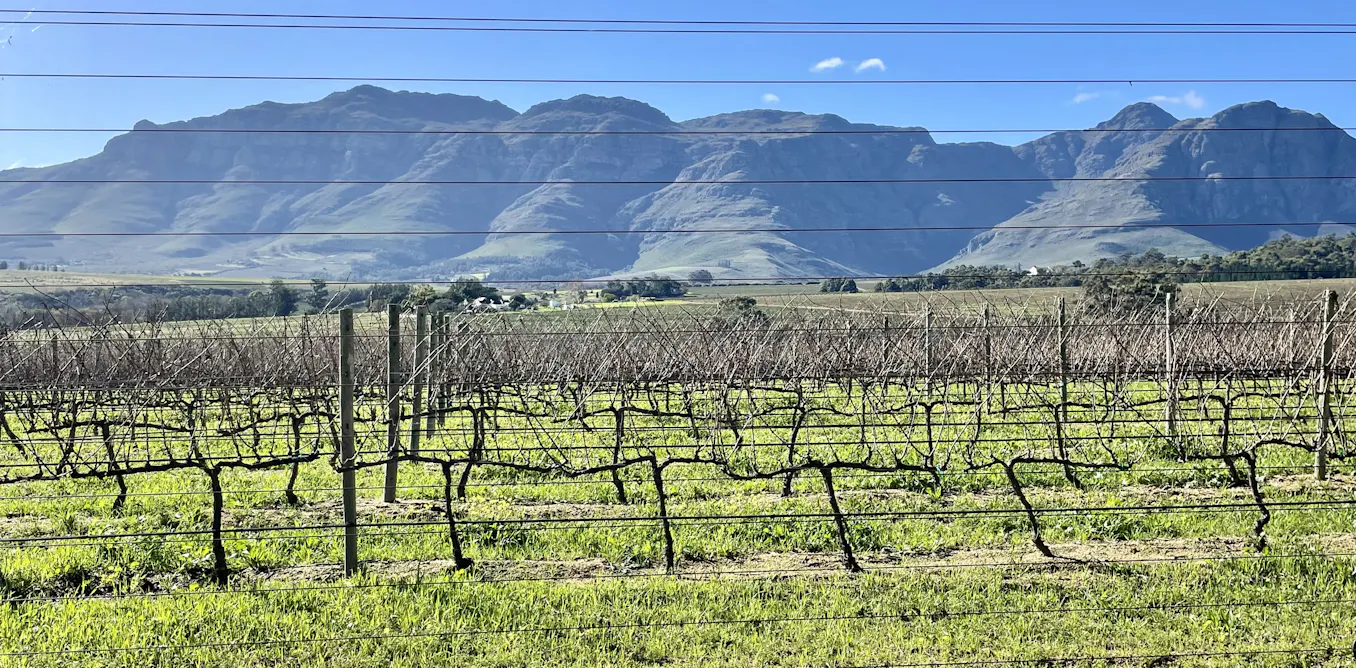
More than <a href="https://apps.fas.usda.gov/newgainapi/api/Report/DownloadReportByFileName?fileName=An+Overview+of+the+South+African+Wine+Industry_Pretoria_South+Africa+-+Republic+of_SF2024-0032.pdf” rel=”nofollow noopener” target=”_blank”>500 vineyards are scattered across the slopes and valleys of South Africa’s Western Cape, one of the world’s most biologically diverse landscapes. The region produces about 90% of South Africa’s wine, but winemakers there are increasingly struggling with drought, excessive heat and erratic rainfall.
Temperatures in the region have risen 1.5 to 2 times faster than the global average over the past five decades. And extreme storms have become more intense as climate variability increases. The late 2010s brought a significant challenge for winemakers, as three years of severe drought placed vineyards under intense stress and reduced grape production.
As climate variability places increasing pressure on grape production, many wine producers are building on sustainability measures that have long been part of vineyard management.
Hannah Herrero
We are a team of geographers and sustainabilityscientistswho studyenvironmental change, environmental health, conservation, agriculture and land management. Our team wanted to better understand how farmers in South Africa’s wine-producing regions are responding as a range of environmental and economic pressures rise. We talked with growers, conservation practitioners and wine industry experts in the Western Cape and analyzed how 107 vineyards, about 20% of the total, were using sustainable land stewardship practices to adapt.
In many agricultural landscapes, production and conservation goals are frequently viewed as competing priorities. But our research found that many vineyard operators in the Western Cape see long-term stewardship and conservation of soil and wildlife habitat as essential strategies for business success.
Conservation as an investment, not a constraint
The Western Cape is home to the Cape Floral Region, a global biodiversity hot spot. It includes fynbos, a unique biome containing thousands of endemic plant species, including types of proteas, ericas and restios that are found nowhere else on Earth.
Sustainability certification and conservation programs, such as World Wildlife Fund Conservation Champions, have helped encourage vineyards to protect biodiversity in the region. Many growers use these sustainability certifications to increase their wine’s marketability. But we found they have also embraced conservation for how it can benefit their vineyards. Rather than viewing conservation as land taken out of production, many said they see it supporting the ecological processes essential to their business.
The majority of South Africa’s vineyards today participate in the Integrated Production of Wine certification system, created by the South African wine industry and researchers in 1998 to reduce environmental harm. The system sets standards governing pesticide use, water management, wastewater treatment and environmental stewardship. It also uses independent auditing of participating farms and wineries to ensure those claiming certification meet the standards.
To manage the water supplies their vineyards depend on, growers described restoring native vegetation, including the removal of alien species, along waterways and reducing erosion to protect wetlands and rivers. Research shows that healthy natural systems can improve water retention in the soil and contribute to the overall resilience of the landscape in the face of more extreme climate conditions.
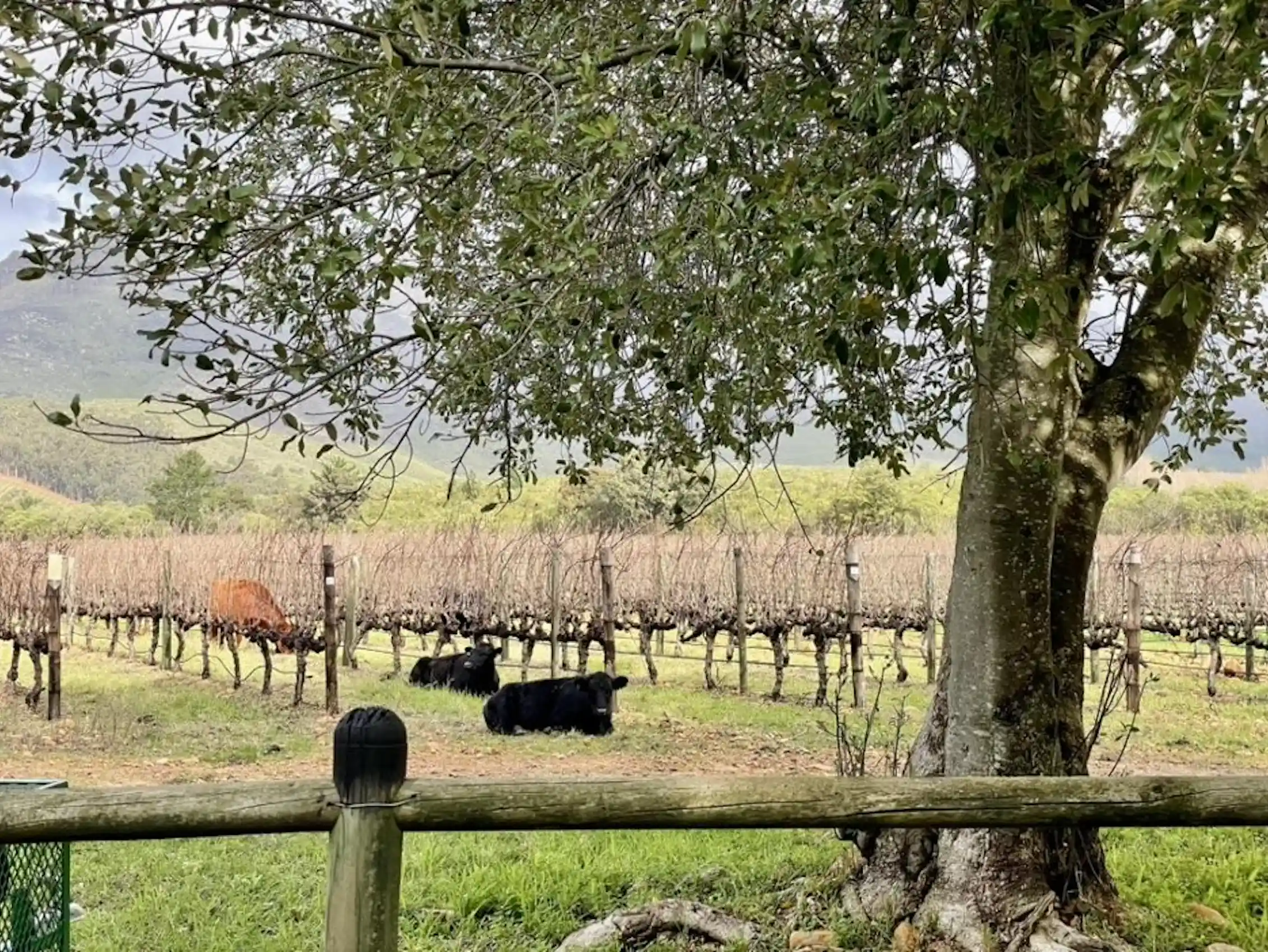
To boost their soil’s health, some growers are planting cover crops, such as legumes, cereals like oats and rye, and brassicas such as radish and mustard, between vine rows. Growers broadly described using cover crops, compost, mulching and other practices to improve soil structure and increase organic matter in the soil. Cover crops require maintenance and can provide habitat for pests, but research shows that the right cover crops, when well maintained, can benefit vineyards by reducing erosion and increasing water retention and nutrients in the soil.
Several producers also described efforts to reduce their reliance on chemical pesticides, which is beneficial not only for the environment but also their businesses as chemical costs continue to rise. We heard about vineyards that monitor pest populations closely and respond in targeted ways rather than using pesticides broadly.
Some growers encourage beneficial insects and manage habitats that support natural pest control. The creation of habitats for natural pest predators can reduce the overall disease risk too. While chemical treatments remain part of many vineyard operations, growers reported increasing interest in other approaches that prevent disease and pest outbreaks, such as pruning, to reduce their total chemical use.
Sustainable practices like these are well established in South Africa’s wine industry, but our interviews suggest their use has been expanding in recent years. Rather than focusing solely on treating problems after they arise, these approaches emphasize prevention, monitoring and ecological balance.
Sustainability must also make economic sense
The stewardship practices we observed in South Africa are investments in long-term business resilience for many growers.
Many of the wine producers we interviewed described facing rising costs and market uncertainty. Exports, labor and chemicals are all expensive. They emphasized that maintaining healthy soils, conserving water and reducing vulnerability to drought and disease are essential to keeping their vineyards productive.
As concerns about drought, climate pressures and profitability rise, the area in vineyard production in South Africa has also decreased. Several growers described diversifying their business models and even switching crops to make their businesses more resilient to hotter, drier conditions.
Lessons beyond South African wine
Farmers around the world are confronting the realities of a changing climate. Our research shows that effective solutions can come from recognizing the interconnectedness of nature and production.
The experience of South Africa’s winegrowers shows that farms can be managed more sustainably when they’re seen as part of larger ecological systems.
Students Zoe Van der Walt, Jack Spining and Dryver Finch contributed to this article.

