

Skip to main content
Loading News Article
We’re loading the full news article for you. This includes the article content, images, author information, and related articles
/
/
St. George’s University Bolsters Africa’s Healthcare Workforce With Historic Graduation | Streamline
Back to News/Health
Health
St. George’s University Bolsters Africa’s Healthcare Workforce With Historic Graduation
St. George’s University graduates a new cohort of doctors in Botswana, addressing Africa’s critical healthcare worker shortage amid its 50th-anniversary celebrations
SOStreamline Official.Verified
Jul 4, 2026
(edited)Reading
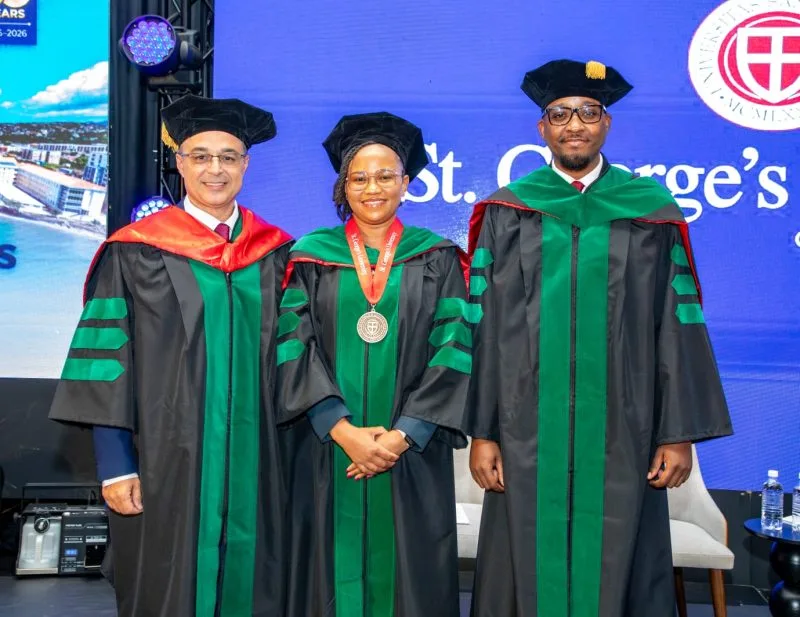
As the African continent grapples with a systemic shortage of healthcare professionals, transnational medical education is increasingly bridging the critical workforce gap. This dynamic was vividly displayed on June 27, 2026, when St. George’s University (SGU) School of Medicine hosted a landmark commencement ceremony in Gaborone, Botswana, officially graduating a new cohort of doctors poised to enter the African health sector
The Grenada-based institution, celebrating its 50th anniversary, strategically chose Botswana to honour its expanding network of African alumni. The graduation arrives at a highly sensitive time for regional policymakers, who are battling aggressively against the “brain drain” phenomenon while attempting to scale healthcare capacity to meet the demands of rapid urbanization and a complex disease burden
Confronting the Doctor-to-Patient Deficit
World Health Organization (WHO) data continually underscores the severity of the medical personnel deficit across Sub-Saharan Africa. While the global standard advocates for a minimum ratio of 1 doctor per 1,000 citizens, many African nations operate with ratios as bleak as 1 doctor per 5,000 or even 10,000 residents. The influx of newly qualified SGU doctors into local clinical practice represents a vital infusion of expertise into these overstretched systems
“As we celebrate 50 years of St. George’s University, we are proud to recognize the achievements of our graduates from Botswana and across Africa,” stated Dr. Marios Loukas, President and Dean of the SGU School of Medicine. “This ceremony provides an opportunity to celebrate their accomplishments alongside their families, friends, and mentors, while acknowledging the important contributions they are making to healthcare throughout the continent.”
A Blueprint for Leadership: Dr. Stephen Modise
The keynote address was delivered by Botswana’s Minister of Health, Dr. Stephen Modise, himself a distinguished SGU alumnus. Dr. Modise’s career trajectory—from an international medical student in the West Indies to the pinnacle of national health leadership—served as a powerful architectural blueprint for the graduating class
In his address, Dr. Modise emphasized the foundational ethos of the medical profession amid challenging operational environments
“Healthcare is, above all, a profession of service. Every graduate we celebrate today represents years of dedication, sacrifice, and perseverance, and each has the potential to make a meaningful difference in the lives of patients and communities,” Dr. Modise remarked
He further noted the strategic value of international medical education when harmonised with domestic healthcare priorities: “Botswana has benefited greatly from healthcare professionals who have pursued medical education internationally and returned home with the knowledge, skills, and commitment to strengthen our health system. I congratulate today’s graduates and encourage them to continue serving with excellence, integrity, and compassion.”
The Broader Implications for East and West Africa
The ripple effects of this graduation extend far beyond the borders of Botswana. In Kenya, the government is currently overhauling its national health insurance framework, a transition that demands a massive deployment of frontline doctors to staff primary care facilities in devolved counties
Similarly, in Nigeria, the ongoing exodus of locally trained physicians to the United Kingdom’s National Health Service (NHS) and the United States has triggered a domestic crisis. The Nigerian Medical Association consistently reports severe staffing shortages in federal medical centres. Institutions like SGU are increasingly viewed by ambitious African students as rigorous pathways to world-class medical credentials, with governments now focusing on creating favourable domestic working conditions to ensure these globally trained doctors return home to practice.
The presence of a high-level SGU delegation in Gaborone—including Dr. Gaurov Dayal, CEO of Medforth Global Healthcare Education, and Dr. Mark Clunes, Provost and Vice President of Academic Affairs—signalled a long-term institutional commitment to the African market. By anchoring clinical training in global standards while celebrating outcomes on African soil, cross-border educational partnerships are proving essential to fortifying the continent’s fragile healthcare infrastructure against future epidemiological shocks.
Hot discussions around this story
Keep the conversation in one place—threads here stay linked to the story and in the forums
Fresh thread
No linked discussion yet. Start one without leaving this page.
Sign in to start a discussion
Start a conversation about this story and keep it linked here
Sign in
Other hot threads
View forums
E-sports and Gaming Community in Kenya
1130786Sports & Recreation
Active 13 months ago
The Role of Technology in Modern Agriculture (AgriTech)
1029915Agriculture & Food Security
Active 13 months ago
Popular Recreational Activities Across Counties
529601Sports & Recreation
Active 13 months ago
Investing in Youth Sports Development Programs
829391Sports & Recreation
Active 13 months ago
You Might Also Like

Group Demands State of Emergency to Halt Health Sector Collapse
Jul 4, 2026
Lung Association Exposes Severe Health Risks of 300 Million Pounds of Semiquincentennial Fireworks
Jul 4, 2026
The Silent Epidemic of Fatty Liver Disease Linked to Modern Processed Diets
Jul 4, 2026

