

Expert SpeakRaisina Debates
Published on Jan 07, 2026
Forged amid mounting economic strain, the trade deal inked in Busan reflects a fragile de-escalation between the United States and China rather than a durable reset of their economic relationship
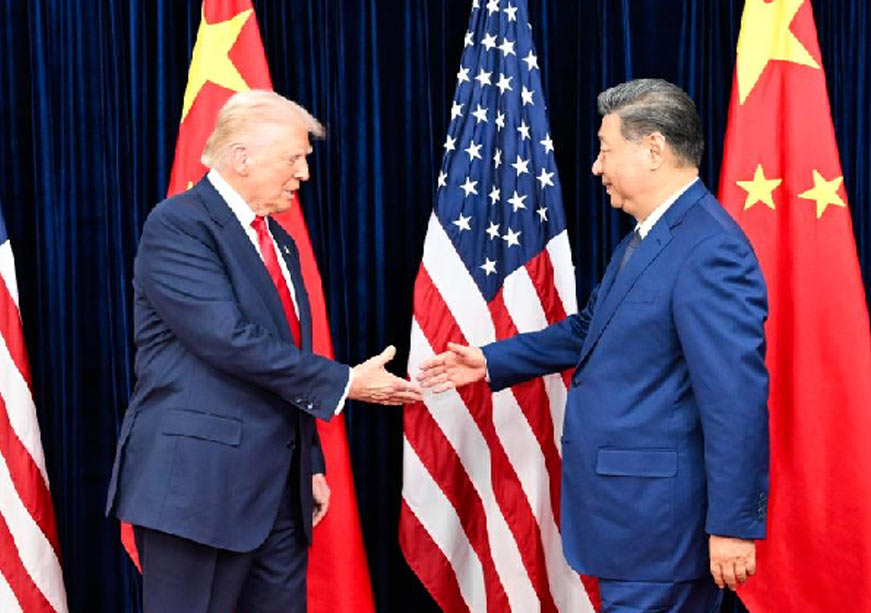
On 30 October 2025, in Busan, South Korea, President Donald Trump and President Xi Jinping signed an ostensibly historic trade agreement between the United States and China. The timing was long overdue, as the world’s two most consequential economic powers finally stepped back from a combustible brink
To understand why this agreement matters — particularly its questionable durability — it is necessary to revisit the geopolitical context that preceded it
The Roots of the Trade War
The US-China trade war originated from a clash of ambitions. On one hand was the United States, the world’s foremost capitalist democracy. On the other hand, China, an authoritarian state ruled by the Communist Party and widely seen as poised to surpass the United States in geopolitical weight and technological strength
These differences were compounded by tensions in the Taiwan Strait and the South China Sea — flashpoints that continue to define the rivalry between Washington and Beijing
As a result, tariffs became symptoms of a deeper political unease between the two superpowers
Escalation with Tariffs and Retaliatory Tariffs
The language of economic hostilities was inevitable. The United States imposed aggressive tariff hikes, while China responded in kind. President Trump threatened an additional 100 percent tariff hike on Chinese goods, effective 1 November 2025, citing China’s export restrictions on critical rare earth materials, including lithium-ion batteries, synthetic garnets, and other technologies deemed vital to US national security. This threat was ultimately averted by the agreement
Washington also threatened to terminate its used cooking oil trade with China, arguing that domestic production could replace imports. This move was widely seen as retaliation for China’s refusal to purchase American soybeans, which Beijing justified by pointing to alternative suppliers in South America
President Trump threatened an additional 100 percent tariff hike on Chinese goods, effective 1 November 2025, citing China’s export restrictions on critical rare earth materials, including lithium-ion batteries, synthetic garnets, and other technologies deemed vital to US national security
The figures tell the story of an unravelling economic relationship. In 2024, the United States imported 1.27 million metric tons of used cooking oil from China, valued at US$1.1 billion, making it China’s top market for this product. Following China’s decision to cut tax rebates in late 2024 and the subsequent US tariff escalation in 2025, American cooking oil imports from China plunged by a staggering 65 percent between January and August 2025, falling to just 290,690 tons worth US$286.7 million.
Soybeans became an even starker case in point. In 2024, China imported US soybeans valued at approximately US$12.64 billion. From May 2025 onward, however, China purchased precisely zero—either by weight or by value
Global Markets Become Collateral Damage
Following the announcement of the additional 100 percent US tariff threat in early October 2025, the Nasdaq Composite Index closed 3.6 percent lower, while the S&P 500 fell 2.7 percent. The Hang Seng Index fell 2.49 percent by the opening bell on 13 October
The escalation did not stop at goods. Both countries raised port entry fees for each other’s shipping firms. China went further, blacklisting five American subsidiaries of Hanwha, the South Korean shipping company, accusing them of supporting US shipbuilding efforts
Beijing deployed its most powerful leverage: rare earths. China controls access to the majority of the world’s rare earth minerals vital to technologies ranging from semiconductors and robotics to jets. In a significant escalation, on 9 October, 2025, exporters anywhere in the world were required to apply for a licence to sell products containing even the smallest component of Chinese rare earths
Chinese officials and state-controlled media framed these actions as retaliation for the US Department of Commerce’s September 2025 decision to blacklist Chinese companies from acquiring advanced American technology. Domestically, President Xi Jinping also had political incentives to project strength ahead of a key Communist Party leadership meeting. The message to both audiences was clear — China would prevent the supply of strategic materials that might enable technological development in the US.
Mending Fences
Against this backdrop, China had more incentive to de-escalate. After all, the United States remained its largest market
The agreement signed in Busan sought to establish a framework of reciprocal commitments designed to stall further deterioration in trade relations, thereby restoring a degree of predictability to the global markets
The data evidenced this trade imbalance. In 2024, US goods imports from China totalled US$438.7 billion, a 2.7 percent increase over 2023. US goods exports to China amounted to US$143.2 billion, representing a 3.0 percent decline from the previous year. The resulting US goods trade deficit stood at US$295.5 billion, a 5.7 percent increase over 2023. Although the US recorded a services trade surplus with China of US$33.2 billion, it was nominal relative to the overall deficit
Equilibrium with the Busan Agreement
The agreement signed in Busan sought to establish a framework of reciprocal commitments designed to stall further deterioration in trade relations, thereby restoring a degree of predictability to the global markets
Under its terms, China agreed to take effective action to end the flow of fentanyl to the United States and to suspend the global export controls on rare earths that it had announced on 9 October 2025, for a one-year period. Beijing further undertook to permit the export of rare earths, as well as gallium, germanium, antimony, graphite, and related materials, for the benefit of US end users, thereby removing the controls it had imposed since 2023. China committed to suspending all retaliatory tariffs announced since 4 March 2025 on a wide range of agricultural and food products, including chicken, wheat, corn, cotton, soybeans, pork, beef, and aquatic products. As part of an effort to revive agricultural trade, China agreed to purchase 12 million metric tons of US soybeans during November and December 2025, followed by annual purchases of at least 25 million metric tons from 2026 through 2028, and to commence purchases of US sorghum as well as hardwood and softwood logs. The agreement also required China to remove sanctions imposed on various shipping entities and to halt investigations against US companies operating in the semiconductor supply chain.
In return, the United States committed to reducing the 20 percent tariff on imports from China related to fentanyl to 10 percent for a one-year period running from 10 November 2025 to 10 November 2026, while continuing to apply the existing 10 percent reciprocal tariff during this suspension period. This effectively lowered the overall tariff burden from 57 percent to 47 percent. Washington further agreed to extend certain tariff exclusions that were due to expire on 29 November 2025 until 10 November 2026. The US also undertook to suspend for one year, beginning 10 November 2025, the implementation of the rule titled “Expansion of End-User Controls to Cover Affiliates of Certain Listed Entities”. Alongside these trade concessions, the United States affirmed its intention for dominance in the maritime, logistics, and shipbuilding sectors, while continuing coordination with South Korea and Japan to strengthen US shipbuilding capacity.
The agreement itself does not reflect mutual trust, as evidenced by its conditional commitments and short timelines. Each side conceded just enough to preserve present-day self-interest. A flare-up in the Taiwan Strait, or a new dispute over technology, could collapse overnight the delicate progress achieved by this agreement
A Pause, Not a Permanent Thaw
The US and China arrived in Busan out of necessity rather than willingness. The United States faced rising domestic costs alongside market instability, while China confronted slowing demand and mounting export pressures. The agreement itself does not reflect mutual trust, as evidenced by its conditional commitments and short timelines. Each side conceded just enough to preserve present-day self-interest. A flare-up in the Taiwan Strait, or a new dispute over technology, could collapse overnight the delicate progress achieved by this agreement.
The United States and China must move beyond figurative handshakes. They can only do this by beginning to construct a meaningful foundation for a durable relationship of coexistence — one that demonstrates political will to resolve deeper conflicts with permanence. Until then, the Busan agreement only buys time. It slows down the slide towards economic uncertainty, but it does so without altering the fundamental trajectory of the US–China relationship
Qaiser Shamimis a distinguished expert in fiscal policy, trade relations, and corporate governance
The views expressed above belong to the author(s). ORF research and analyses now available on Telegram! Click here to access our curated content — blogs, longforms and interviews.

PREVNEXT
Author
Qaiser Shamim
With over four decades at the forefront of public service and international corporate strategic advisory, Mr. Shamim is a distinguished expert in fiscal policy, trade
Read More +
Related Search Terms
Publications
Delhi Water Crisis: Restore, Recharge, And Reuse to Conserve Water
Urbanisation | Water
Jun 28, 2026

