

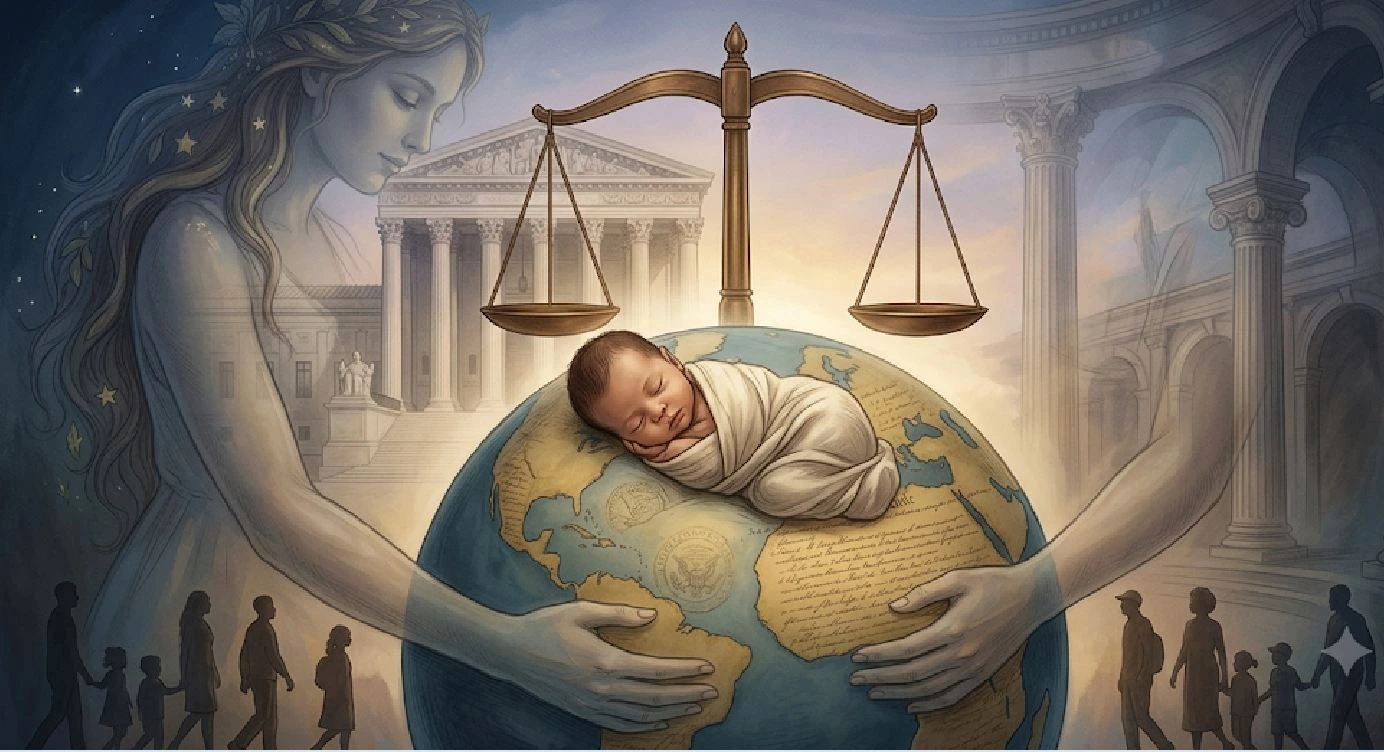
Constitutions occasionally produce judgments that transcend the dispute before them and become meditations on the very idea of the State. The United States Supreme Court’s decision in Trump vs Barbara is one such moment.
On June 30, 2026, the Court invalidated Executive Order 14160, issued by President Donald Trump, which sought to deny automatic citizenship to children born in the United States to mothers who were unlawfully or only temporarily present. The majority held that such children remain citizens by birth under the Fourteenth Amendment, reaffirming one of the oldest constitutional promises in the American republic.
Yet, the case was never simply about immigration. It posed a deeper constitutional question that every republic must eventually confront: What is citizenship made of? Can it be redefined by executive power? Does it depend upon bloodline, domicile or parental status? Or is it inseparably tied to the soil on which a child first enters the world?
Chief Justice John Roberts, writing for the majority, answered by returning to constitutional history rather than contemporary politics.
The opinion traces birthright citizenship through four defining stages. It begins with England’s common law, particularly Calvin’s Case (1608), where Sir Edward Coke articulated the reciprocal relationship between sovereign and subject: protection in exchange for allegiance. Under that principle, every child born within the sovereign’s dominion became a subject at birth, regardless of the parents’ nationality or duration of residence. Only diplomats’ children and births outside effective sovereign authority constituted exceptions.
That principle crossed the Atlantic with English law and became embedded throughout the American colonies and the newly independent States. In a nation built by immigrants, jus soli—the right of the soil—provided certainty that birthplace, not ancestry, determined citizenship.
The Civil War transformed that inherited principle into constitutional command.
The infamous Dred Scott decision had denied citizenship to people of African descent despite their birth in America. The Reconstruction Congress answered through the Civil Rights Act of 1866 and, ultimately, the Fourteenth Amendment, ensuring that birth on American soil—not race or lineage—would determine membership in the constitutional community.
That understanding was cemented in United States vs Wong Kim Ark (1898), where the Court recognised the citizenship of a child born in America to Chinese parents despite the prevailing hostility of the Chinese Exclusion era.
Against this long constitutional tradition, the government argued that citizenship should instead depend upon parental domicile and primary allegiance.
The majority rejected the proposition with notable simplicity.
The Citizenship Clause, Justice Roberts observed, says nothing about “mother”, “father”, “lawful” or “temporary”. Those words appear repeatedly in the executive order, but nowhere in the Constitution itself. For one reason. “They did not matter.” Citizenship, the Court declared, remains “the right to have rights”—the legal status from which every other constitutional guarantee flows.
The separate opinions reveal that the constitutional debate remains far from settled.
Justice Ketanji Brown Jackson viewed the Fourteenth Amendment as an enduring anti-caste charter designed to prevent new forms of exclusion after slavery. The Reconstruction Amendments, she argued, were never intended as a narrow historical correction, but as a permanent constitutional commitment against inherited systems of subordination.
Justice Brett Kavanaugh agreed that the executive order was unlawful, but preferred a narrower route. Congress, he maintained, retains authority to legislate in this field; the president acting alone does not.
The dissents offered a fundamentally different understanding of nationhood.
Justice Clarence Thomas argued that American citizenship rests upon consent, domicile and permanent attachment rather than mere geography. Justice Samuel Alito similarly maintained that birth alone cannot sever legal ties to foreign sovereigns. Justice Neil Gorsuch’s own questions, however, exposed the conceptual difficulties within that theory. If undocumented families have permanently lived in America for years, where exactly is their legal domicile? Can anyone truly belong nowhere?
The majority’s answer remained rooted in constitutional certainty rather than administrative complexity.
Behind the legal arguments lies a philosophical question older than any modern constitution: why does citizenship matter so profoundly? Because every durable civilisation rests upon a shared sense of belonging.
Law alone cannot sustain a republic if citizens cease to recognise themselves as members of a common constitutional enterprise. Rights, duties, taxation, military service, democratic participation and public trust all presuppose an accepted political identity. History repeatedly confirms this truth.
Will and Ariel Durant, after surveying thousands of years of civilisation, concluded that societies rarely collapse solely because of foreign conquest. They decay internally when institutions lose legitimacy and citizens lose faith in their shared identity.
Paul Kennedy similarly demonstrated that military and economic power ultimately depend upon stable political institutions. Yet, those institutions themselves depend upon a settled understanding of who constitutes the political community.
Citizenship is, therefore, more than legal status. It is the architecture of belonging.
The essay widens further by placing Western constitutional thought alongside classical philosophy and Indian civilisational ideas.
Marcus Aurelius reconciled patriotism with universal humanity when he wrote that as emperor he belonged to Rome, but as a human being he belonged to the world. India expresses a similar insight through Vasudhaiva Kutumbakam—the world is one family.
Neither philosophy abolishes political communities. Both insist that constitutional belonging and universal human dignity can coexist without contradiction. Nations require borders and legal identities, yet they must never surrender their moral obligations towards humanity itself.
The essay’s most original argument arrives in its defence of birthright citizenship. Every human being, it observes, is born somewhere. Birthplace is the only universal, immediate and objectively verifiable fact available at the moment life begins. Bloodlines require endless documentation across generations. Domicile may become legally indeterminate. Allegiance cannot meaningfully exist in a newborn child. Documents depend upon the very State whose obligations are being questioned. The earth alone requires no certificate. It is, in the writer’s words, nature’s first registration.
This principle carries profound humanitarian consequences. Citizenship based solely upon descent risks producing stateless children whenever parentage fails to transmit nationality. International law, therefore recognises nationality as a fundamental human right and encourages States to prevent statelessness by recognising birth on their territory.
The metaphor that follows gives the essay its emotional centre.
The Romans spoke of terra mater—Mother Earth—and later alma mater, the nourishing mother. A mother, the author writes, does not ask for a child’s papers before offering milk. She nourishes because the child exists before her. Protection precedes proof.
Citizenship born of the soil follows the same moral logic. It is not a reward earned after birth, but a relationship created at birth.
The conclusion returns to constitutional restraint. Trump vs Barbara does not deny that immigration presents difficult political questions. It simply insists that those questions must be resolved through legislation rather than executive decree. No president can redefine the constitutional people through administrative action.
To reinforce that principle, the essay closes with Lord Atkin’s celebrated dissent in Liversidge vs Anderson (1942), reminding readers that even during war judges must stand between the individual and executive overreach.
That is ultimately the enduring lesson of Trump vs Barbara. Between the child and the decree. Between the citizen and the State. Between power and constitutional promise. That is where every constitutional court must stand if the republic is to remain true to itself.
—The writer is an advocate in Bengaluru
