

The November 3, 2026, United States midterm elections should provide an important lesson for political parties across the world, particularly those in Ghana. The outcome was significant, but perhaps even more instructive was the message that many Democratic candidates took to the American electorate.
They did not simply ask Americans to vote against Donald Trump and the Republicans. They spoke about the cost of living, healthcare, housing, employment, corruption, corporate influence and the growing financial difficulties confronting ordinary households.
They spoke about people who work hard but struggle to make ends meet. They questioned why citizens of one of the richest countries in the world should find it increasingly difficult to buy groceries, pay rent, access healthcare and provide for their families. That was the substance of their campaign.
The Democrats won control of both chambers of Congress, according to the Associated Press’s November 4 election report. While the outcome reflected several factors, including dissatisfaction with the Trump administration, economic concerns and opposition to its policies, the emphasis on everyday household problems was particularly significant.
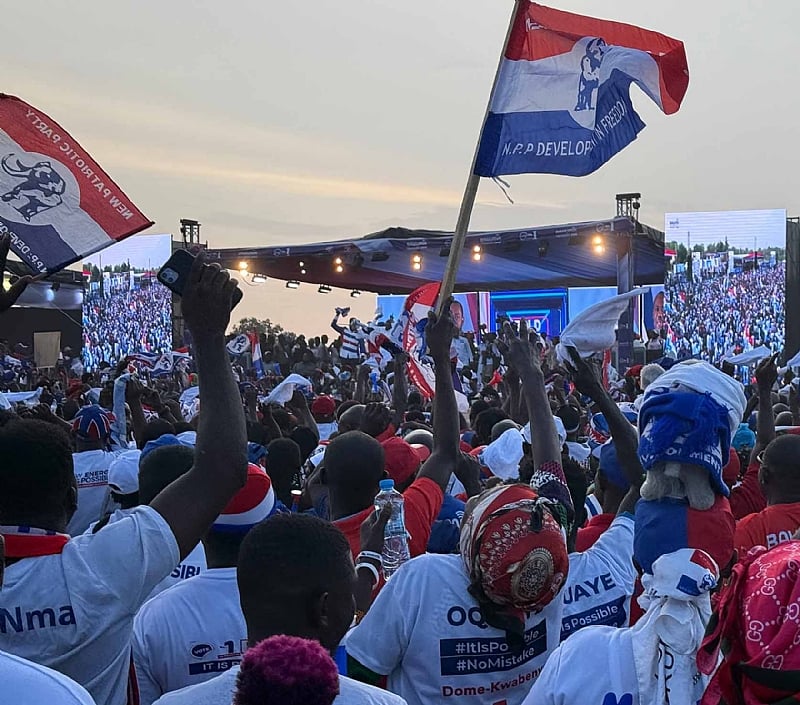
The question I want to ask is this: What can the New Patriotic Party (NPP) learn from the Democrats? More importantly, what exactly is the NPP communicating to ordinary Ghanaians as it prepares for another political contest?
Jon Ossoff: Government Must Serve Ordinary People
One cannot discuss the Democratic campaign without mentioning Senator Jon Ossoff of Georgia. At his February 7, 2026, Rally for Our Republic, Ossoff challenged the Trump administration over rising prices, healthcare costs, economic uncertainty and what he described as government serving the interests of the ultra-rich rather than working-class Americans. His message was direct. Americans had been promised that their economic circumstances would improve, yet many were struggling with the prices of everyday necessities.
He questioned the priorities of a government that, in his view, was failing ordinary workers while protecting the interests of wealthy individuals and powerful corporations. Ossoff also raised concerns about healthcare, Medicaid, school lunches, rural hospitals and the welfare of vulnerable Americans. His argument was not merely that the Republicans had made mistakes. It was that government must be judged by how its decisions affect the lives of ordinary people. That is an important distinction.
Political parties often become so preoccupied with winning elections that they forget the very people whose votes give them the authority to govern. Ossoff’s campaign reminded Americans that the economy is not merely about impressive national statistics, stock market performance or the wealth accumulated by a few individuals. It is also about whether a mother can afford groceries, whether a worker can pay the electricity bill and whether an elderly person can obtain medical care.
Abdul El-Sayed: Why Should Life Be So Difficult?
Another Democratic politician whose message deserves attention is Dr. Abdul El-Sayed of Michigan. His campaign revolved around a simple but powerful question: Why should it be so difficult for ordinary people to live decent lives in one of the world’s wealthiest countries? El-Sayed spoke about the difficulty of buying groceries, paying rent, owning a home and accessing healthcare. He challenged the influence of billionaires and corporations over American politics. His argument was that political decisions should be made in the interests of citizens, not determined by wealthy individuals and corporate interests financing political campaigns.
His campaign priorities included affordable housing, healthcare for all, quality education, clean water, economic opportunities and getting corporate money out of politics. He also proposed “Medicare for All “and measures to make retirement more affordable for senior citizens. What makes his message particularly interesting is that he did not restrict his campaign to abstract political arguments. He connected policy proposals to the everyday experiences of ordinary people.
When people complained about grocery prices, he talked about groceries. When they worried about rent, he talked about housing. When they feared medical expenses, he talked about healthcare. He was communicating with people about the things that mattered to them. There is something Ghanaian politicians can learn from this approach.
The Wider Democratic Message: Affordability, Accountability and Economic Justice
Ossoff and El-Sayed were not the only Democrats talking about these issues. Across the country, Democratic candidates placed considerable emphasis on affordability, healthcare, wages, corruption and the influence of wealthy interests on public policy.
A September 2026 report by the Washington Examiner identified affordability, healthcare and corruption as central themes in Democratic midterm messaging. The Washington Post’s analysis of more than 8,000 political advertisements in competitive 2026 races also found that the economy dominated campaign advertising. Wages, housing, affordability and high costs featured prominently, while corruption and healthcare attracted substantial attention.
These messages were not necessarily identical across every state or candidate. The Democrats are a broad political coalition, with moderates and progressives holding different positions on several policy questions. Nevertheless, many candidates found common ground in addressing the economic difficulties confronting ordinary Americans. That is an important lesson about party cohesion.
Candidates can have different personalities, different approaches and different policy preferences without losing sight of the common purpose of their political organization.
What is the NPP’s Message to Ordinary Ghanaians?
Now let us return to Ghana. What is the NPP telling the ordinary Ghanaian? What is it saying to the young graduate who has completed university but cannot find a decent job? What is it telling the mother who struggles to provide three meals a day for her children? What is it telling the small-business owner who must contend with the cost of electricity, taxation, credit and other operating expenses? What is its message to the farmer who invests in agriculture but cannot obtain reasonable returns on the investment? And what is it telling the pensioner who worked for decades, contributed to the national pension scheme and now receives a monthly pension that cannot adequately provide for basic necessities? These are not peripheral political concerns. They are the substance of national development.
The NPP must appreciate that Ghanaians are interested in more than the identity of its next presidential candidate. They want to know what the party has learnt from its previous administration and what it intends to do differently. It is not enough to remind Ghanaians of the achievements of the erstwhile Akufo-Addo administration, if there were any achievements at all. Neither is it sufficient to criticize the current Mahama administration.
The party must present a credible alternative. If the NPP believes that the present government is mishandling the economy, it must explain what it would do differently. If it believes that corruption is undermining national development, it must identify the institutional reforms it would introduce to prevent the misuse of public resources. If it wants to address unemployment, it must move beyond campaign promises and explain how sustainable jobs will be created. Ghanaians deserve specifics, not slogans.
Corruption and the Systematic Misuse of Public Resources
One of the issues that featured prominently in the Democratic campaign was the relationship between political power, wealth and accountability. Ossoff questioned the concentration of influence among wealthy individuals and the interests they represented. El-Sayed made getting corporate money out of politics one of his central campaign promises. There is a lesson here for Ghana. We cannot continue to discuss national development without confronting corruption, public-sector waste, political patronage and the misuse of public resources.
Ghana is endowed with considerable natural and human requate public services, unemployment, poor infrastructure and limited economic opportunities. Where does the national wealth go? Who benefits from public expenditure? Why do some public projects become monuments to waste? Why should taxpayers repeatedly bear the consequences of questionable decisions made by people entrusted with public office?
These questions should not be the exclusive preserve of opposition politicians. They should form part of the national political conversation, irrespective of which party is in government. The NPP must demonstrate that its commitment to fighting corruption is not dependent on whether it is in opposition or in power. It must also be prepared to examine its own record honestly. A political organization that demands accountability from others must be willing to subject its own administration to the same standards.
Why is the NPP Not as Bold as the Democrats?
What is becoming increasingly apparent is that during its eight years in office, the NPP committed numerous mistakes and made questionable decisions across virtually every sector of national life. Galamsey, corruption, nepotism, favouritism and other governance failures became major concerns. Today, the NDC appears to be engaged in a game of political equalization. Almost every time the NPP criticizes the government over an issue, the NDC is quick to point to a similar incident or practice under Nana Addo’s administration. The argument is invariably that the NPP has no moral right to criticize because it did the same thing when it was in power. This is unfortunate. A country cannot make progress if political accountability is reduced to a competition over which party committed the greater wrong. The mistakes of one government must never become an excuse for the mistakes of another.
There is also a striking contrast between the apparent cohesion of the Democrats in the United States, bringing together Christians, Muslims, Jews, Blacks, Whites, Latinos, men and women, and the deep-seated divisions within the NPP. The NPP seems to have forgotten a fundamental principle of democratic politics: numbers matter. A party that seeks political power must be broad-based, inclusive and welcoming. Yet, the NPP alienated and expelled several of its own stalwarts, some of whom could have remained valuable assets to the party. Although a few have since returned, their return has not necessarily translated into genuine reconciliation, integration or a renewed sense of belonging.
Nobody may be bold enough to say it publicly, but it is an open secret that many Ghanaians perceive the NPP as an Akan-dominated party. This perception raises an uncomfortable but important question: How easy is it for a Northerner, particularly a Muslim, to emerge as the leader of the party and enjoy the full confidence and support of its traditional power centers? I know the party will be quick to dismiss this suggestion. However, many Ghanaians are not convinced by the outward displays of unity and inclusiveness. There is a feeling that much of what is being presented is cosmetic, while the underlying divisions and prejudices remain unresolved. The hypocrisy is simply too much.
All these developments point to one troubling conclusion: the NPP does not appear ready for the 2028 elections. And those who are already looking beyond 2028 to 2032 may be in for a rude awakening. The NPP cannot afford another electoral defeat, particularly if that defeat comes with a further loss of parliamentary seats to the NDC. A party can survive losing an election, but repeated electoral setbacks, internal fragmentation, unresolved grievances and a shrinking parliamentary presence can threaten its very survival.
The NPP must therefore look beyond choosing a presidential candidate. It must confront its internal contradictions, rebuild trust, embrace genuine inclusiveness and demonstrate that it has learnt from its years in government. Otherwise, 2028 may not simply be another election lost; it could mark the beginning of a much deeper political crisis for the party.
My Final Thoughts: The Pensioner Must not be Forgotten
There is one constituency whose circumstances should feature more prominently in Ghanaian political discussions: our pensioners. After decades of contributing to national development, many retirees find themselves struggling to survive on monthly pensions that have not kept pace with the rising cost of living. For some, the monthly pension is insufficient to meet the cost of food, electricity, water, transportation and medication.
The NPP should have a clear position on pension adequacy, pension indexation, the management of pension funds and the protection of contributors’ interests. It should also address the institutional weaknesses that have generated concerns about the management of Ghana’s three-tier pension system. Why should pensioners have to spend their retirement years demanding answers about the adequacy of their benefits and the management of their contributions? Why should those who spent their productive years serving the country have to struggle for dignity in retirement?
El-Sayed’s decision to make senior citizens’ economic security part of his campaign agenda is worth examining. His proposed Aging Affordably in America agenda addressed Medicare costs, Social Security financing and the ability of older people to remain in their homes. Ghanaian political parties should similarly recognize that pension policy is not a favour to retirees. It is a matter of social justice and the fulfilment of obligations to people who contributed to the nation’s development.

