


Series24 Jul 2023
The rise of Africa at the World Athletics Championships
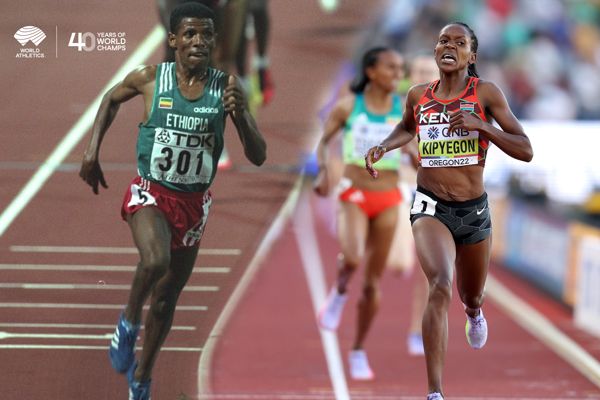
Haile Gebrselassie and Faith Kipyegon at the World Athletics Championships (© Allsport / Getty Images)
At the inaugural edition of the World Athletics Championships held in Helsinki in 1983, a total of 123 medals were won, but only three of those medals went to Africa. Four decades down the line, the fortunes of the continent have witnessed a meteoric rise, owing to the sheer determination and resilience of its athletes.
Humble beginnings
In Helsinki, Nigeria’s Ajayi Agbebaku became the first African World Championships medallist when he clinched bronze in the men’s triple jump. Moroccan Said Aouita won another bronze in the men’s 1500m and Ethiopian Kebede Balcha claimed silver in the men’s marathon. While the efforts of the trio seemed like a drop in the ocean at the time, their exploits laid a foundation that future generations would build on. Aouita himself would go on to win the Olympic 5000m title the following year in Los Angeles and become world champion at the next edition of the championships in 1987.
Ajayi Agbebaku competes in the triple jump at the inaugural World Championships in Helsinki (© Allsport / Getty Images)
In fact, five gold medals from Rome in 1987 went to Africa, with three of them being won by Kenya. Paul Kipkoech set the pace by becoming the continent’s first world champion after dominating the men’s 10,000m, setting a then championship record of 27:38.63 in the process. Kenya finished fifth on the medals table that year, and the nation has consistently placed highly ever since
The 1990s ushered in a new generation of athletes that redefined the track and field landscape, and the third edition of the World Championships staged in Tokyo proved to be a pivotal moment for Africa. Firstly, up until that point, all of the world titles won by African athletes had been claimed in middle- and long-distance events. However, Zambia’s Samuel Matete challenged the status quo when he stormed to gold in the men’s 400m hurdles, while his fellow African Frankie Fredericks of Namibia won a silver medal in the men’s 200m and would become world champion two years later.
Matete had set the stage for his triumph after racing to an African record of 47.10 at the Weltklasse Zurich meeting a couple of weeks earlier. That record still stands almost 32 years on, and the performance places him ninth on the world all-time list. He would later win silver medals in the next two editions of the World Championships and another at the Atlanta 1996 Olympic Games
The North African invasion
The second striking thing about Tokyo 1991 is that Algeria’s Hassiba Boulmerka became the first woman from an African nation to win a world title, or indeed a medal of any colour. Reflecting on her feat, she said: “I screamed for joy and for shock, and for much more. I was screaming for Algeria’s pride and Algeria’s history, and more. I screamed finally for every Algerian woman, every Arabic woman.”
At the 1992 Olympics, Boulmerka struck gold and although she lost the world title to China’s Liu Dong the following year in Stuttgart, she would reclaim it in Gothenburg in 1995, achieving her final major victory
Hassiba Boulmerka of Algeria takes the 1995 World 1500m title in Gothenburg (© Getty Images)
Boulmerka wasn’t the only one making waves for Algeria during that era. Her compatriot Noureddine Morceli was stamping his authority in the men’s 1500m and other middle-distance events, culminating in world records across five events, three back-to-back world titles over 1500m (in 1991, 1993 and 1995) and Olympic gold in Atlanta
Moroccan icon Hicham El Guerrouj picked up the baton from where Morceli left off. The Algerian would not have wished for a better successor, seeing as El Guerrouj became the first man to beat Morceli in four years when the duo raced at the Grand Prix final in Milan in 1996. El Guerrouj went on to assert his supremacy on the global stage with four consecutive world 1500m gold medals in 1997, 1999, 2001 and 2003, and double gold in the 1500m and 5000m at the 2004 Athens Olympics.
Nicknamed ‘King of the mile’, he also set several world records, and his indoor 1500m record of 3:31.18 set in 1997 would stand for 22 years before being broken by Ethiopia’s Samuel Tefera. In 1998 in Rome, El Guerrouj broke Morceli’s 1500m world record (3:27.37) with a time of 3:26.00, which still stands, along with world records in the mile and 2000m, underlining his exceptional depth and talent.
His teammate Nezha Bidouane recorded a spectacular breakthrough when she upstaged the Olympic champion Deon Hemmings of Jamaica and defending world champion Kim Batten of the US to win the women’s 400m hurdles at the Athens 1997 World Championships with a then area record of 52.97. Bidouane went on to win silver in Seville in 1999 in another area record, as Nigeria’s Glory Alozie also took silver in the 100m hurdles, and the Moroccan would reclaim the 400m hurdles title in 2001.
Nezha Bidouane wins the 400m hurdles at the 2001 World Championships in Edmonton (© Getty Images)
East African dominance
While the North Africans were dominating the middle distances, East Africa was showcasing its strength in the long distances, with Ethiopian legend Haile Gebrselassie headlining this spectacular cast, starting from Stuttgart in 1993. Gebrselassie was in a class of his own, especially in the 10,000m, and he would go on to claim four titles in a row in the event (1993, 1995, 1997 and 1999), making him the first athlete in the history of the World Championships to accomplish this grand feat.
Fondly referred to as one of the greatest long-distance runners in history, the Ethiopian added two Olympic gold medals in his signature event and four world indoor titles to his medal kitty. He also broke the 5000m and 10,000m world records several times, along with the world indoor records for 2000m and 3000m
Gebrselassie garnered a total of seven individual outdoor World Championships medals – the highest number of medals won by an African athlete at the World Championships. Kenya’s Ezekiel Kemboi would also win seven World Championships medals over the course of his career: four consecutive gold medals from 2009 to 2015 in the 3000m steeplechase, and three silver medals won in 2003, 2005 and 2007.
Almost 25 years after making such history, Gebrselassie is still in awe of his exploits. He said: “Winning a world title for the second time makes you very happy. To win it the third time makes you even more happy. But to win the 10,000m four times – four times consecutively without interruption – and to win it at the World Championships, is miraculous. It still gives me goosebumps each time I think about this achievement.
“My secret for consistency is very simple. I never focused on winning my races,” he added. “My focus was on my trainings and the discipline. I always took my training seriously and followed the disciplines meticulously. My diet, rest and recovery were my priorities. I think this made me consistent.”
As the multiple world record-holder was approaching the twilight of his career, two spectacular stars emerged on the global scene: Tirunesh Dibaba and Kenenisa Bekele. And even more enthralling was the fact that they were both his compatriots. In 2003 Bekele beat his more experienced counterpart to snatch gold in the 10,000m as part of an Ethiopian medal sweep, with Sileshi Sihine settling for bronze. The following year, he broke both the indoor and outdoor world records over 5000m, and the 10,000m outdoor record.
Teammates Kenenisa Bekele and Haile Gebrselassie after the final of the 10,000m (© Getty Images)
Bekele went on to match Gebrselassie’s four-time winning streak in the 10,000m, adding titles in 2005, 2007 and 2009, and he was unbeaten for almost eight years. He was able to pull off the 5000m and 10,000m double at the Beijing 2008 Olympics and went a step further at the World Championships in Berlin in 2009 by replicating the feat, becoming the first man to ever do so and the only African man with five gold medals to his name. Bekele would also be regarded as the most successful runner in the history of the World Cross Country Championships with a jaw-dropping 11 titles across both long and short course races.
The evolution of Africa’s female athletes
The 2000s witnessed an evolution, especially for Africa’s female athletes. History was made in Edmonton in 2001 when Senegalese Amy Mbacke Thiam struck gold in the women’s 400m in a national record of 49.26, becoming the first African woman to win a sprint title
Still in Edmonton, Francoise Mbango Etone emerged as the first African woman to claim a medal in a field event by clinching silver in the women’s triple jump for Cameroon, while South African Hestrie Cloete became the first African woman to win a field event, carting away the gold medal in the high jump which, until then, was mainly regarded as European turf. In fact, five African women won titles in Edmonton, including Maria Mutola (800m), Derartu Tulu (5000m) and Nezha Bidouane (400m hurdles), making it the best outing by African women at the World Championships at the time.
Hestrie Cloete celebrates during the high jump at the 2001 World Championships (© Allsport / Getty Images)
Two years later in Paris, Uganda gained its first ever world gold medal when Dorcus Inzikuru won the inaugural women’s 3000m steeplechase
Dibaba also won her maiden 5000m title in Paris but came of age in Helsinki in 2005, becoming the first athlete – male or female – to win a 5000m and 10,000m double at the same championships. She inspired an all-Ethiopian podium in both races as her fierce rival and reigning Olympic champion Meseret Defar took silver in the 5000m, and her older sister Ejegayehu Dibaba snatched bronze in both races.
Tirunesh Dibaba added two more gold medals in the 10,000m in 2007 and 2013, making her the only woman to ever win two consecutive 10,000m titles. She garnered a total of five individual gold medals over the course of her World Championships career to become the first African athlete with the highest number of gold medals
She would repeat her 5000m and 10,000m double exploits at the 2008 Olympics, where she was rewarded with a win in an Olympic record (improving the mark set by her cousin Derartu Tulu in Sydney in 2000) and area record in the 10,000m, and another gold over 5000m, making her the first woman to win the double at the same Olympics
With an illustrious career boasting six World Championships medals, six Olympic medals and four world cross country titles among other laurels, Tirunesh Dibaba is proud of the indelible mark she left
“Whenever I remember my achievements, I really feel proud and I’m so happy about them, especially when it’s World Championships time and my name is mostly mentioned even when I’m not there,” she said. “I worked hard to achieve the double, and to be the first African woman to do it was God’s gift
“It’s beautiful to be the most decorated female African athlete; I still have the feeling of the victory, especially when I hear it from my people and in the media. I can say I’m a lucky woman.”
The two-time African champion is also inspired by the fact that she and Bekele are tied for the most gold medals by an African. “I feel proud,” she said. “Being from the same village and country makes it really special.”
Kenya’s Vid 10,000m double at the World Championships, in 2011
The Moscow 2013 World Championships produced Africa’s first female medallist in the 100m, as Cote d’Ivoire’s Murielle Ahoure finished second to Jamaica’s Shelly-Ann Fraser-Pryce. Ahoure repeated the feat in the 200m
Ahoure’s teammate Marie-Josee Ta Lou would match that achievement four years later in London, and she would go one better in Doha where she won bronze in the 100m
Marie-Josee Ta Lou after taking the silver medal over 100m at the World Championships London 2017 (© Getty Images)
Kenya and South Africa to the world
After 32 years of competing at the World Championships, Beijing in 2015 proved to be a turning point for the continent as Kenya topped the medals table for the first time, dethroning perpetual winners USA after amassing seven gold medals
Kenya’s ascent in Beijing was especially aided by medals from two unlikely events: the men’s 400m hurdles and men’s javelin, courtesy of Nicholas Bett and Julius Yego, respectively. That came 18 years after South Africa’s Marius Corbett emerged as the first African to win a field event when he won the men’s javelin in Athens
The East Africans also won titles in some of their key events such as the women’s 5000m (Cheruiyot), women’s 3000m steeplechase (Hyvin Kiyeng Jepkemoi) and men’s 800m (David Rudisha)
It was a momentous occasion for South Africa too, as Wayde van Niekerk stunned an elite field to win the men’s 400m in a then African record of 43.48, becoming the first man from the continent to win the event at the World Championships, while Sunette Viljoen took a bronze medal in the women’s javelin as the first African woman to make the podium in the throws
Wayde van Niekerk wins the 400m at the World Championships London 2017 (© Getty Images)
The following year, Van Niekerk smashed Michael Johnson’s world record with a 43.03 run in Rio, becoming the only man to have won an Olympic or world 400m title from lane eight. He would retain his world title in London in 2017 and add a silver in the 200m to the mix, while his compatriot Luvo Manyonga dominated the men’s long jump and became the first African man to win gold in the event, with teammate Rushwahl Samaai taking the bronze.
No minnows in athletics
Uganda made a statement at the 2019 World Championships with gold medals from Halimah Nakaayi in the women’s 800m and Joshua Cheptegei in the men’s 10,000m. Not done with claiming a maiden world title, Cheptegei shattered Bekele’s world records over both 5000m and 10,000m the following year, making him the 10th man in history to hold both records simultaneously. The Olympic champion over 5000m successfully defended his world title in Oregon.
Burkina Faso made the medals table for the first time with a triple jump bronze by Hugues Fabrice Zango in Doha in 2019 and he upgraded to silver three years later in Oregon, where Nigeria’s Tobi Amusan took the 100m hurdles title after breaking the world record with 12.12 in the semifinals
Hugues Fabrice Zango in the triple jump at the World Athletics Championships Doha 2019 (© Getty Images)
Another star in Oregon was Kenya’s Faith Kipyegon and she has continued to rise. After winning the world U20 1500m title in 2012, Kipyegon made her senior World Championships debut in Moscow the following year, finishing fifth in the 1500m final
She would make the podium at the next four editions – securing silver in 2015, gold in 2017, silver in 2019 and gold again in 2022. Joining her on two of those podiums was Ethiopia’s Gudaf Tsegay, who claimed 1500m bronze in 2019 and silver in 2022, when she also gained 5000m gold
Kipyegon had become a mother in between those four championships, having welcomed her daughter Alyn in June 2018. “She acts as an extra motivation for me,” Kipyegon said. “I am a mother, a mentor and a role model to my daughter. I want to show her and other girls in Kenya that you can do anything you set your mind to.”
She continues to lead by example
As the World Athletics Championships Budapest 23 beckons, African athletes have thrown down the gauntlet with some exceptional performances. From Kipyegon’s electrifying world records in the 1500m, mile and 5000m, all within 50 days, and Ethiopian Lamecha Girma’s record-breaking exploits in the 3000m steeplechase, to superb recent sprint performances by Ta Lou and Botswana’s rising star Letsile Tebogo, it is Africa’s time to shine.
Yemi Olus-Galadima for World Athletics
BACK

