


Want to bookmark your favourite articles and stories to read or reference later? Start your Independent Premium subscription today.
`;
document.body.appendChild(modal);
modal.addEventListener(‘click’, () => {
document.cookie = ‘mos-plan-select=; Max-Age=0; path=/; expires=Thu, 01 Jan 1970 00:00:00 UTC;’;
});
modal.querySelector(‘.subscribe-link’)?.addEventListener(‘click’, (e) => {
e.preventDefault();
document.cookie = ‘mos-plan-select=; Max-Age=0; path=/; expires=Thu, 01 Jan 1970 00:00:00 UTC;’;
setTimeout(() => {
window.location.href = ‘https://www.independent.co.uk/subscribe?regSourceMethod=Bookmarks’;
}, 500);
});
});
Did you know elephants are scared of bees? Seriously. The largest land animal on Earth can be deterred by one of the smallest. Across Africa, conservationists are using beehives to stop elephants from raiding crops, thereby helping farmers and wildlife coexist peacefully.
Bees are just one example of a much bigger shift taking place across the continent. From female rangers taking to the skies with drones to women reshaping conservation through AI, digital systems and nature’s own “wild innovation”, women across Africa are reimagining what conservation looks like.
African wildlife is facing mounting pressures; habitat loss, climate change, human-wildlife conflict and poaching continue to threaten ecosystems already under strain. Rangers are stretched thin, with experts estimating the world needs 1.5 million more to meet global biodiversity targets by 2030. Traditional conservation methods alone are no longer enough.
Increasingly, women are combining local knowledge with technology to help both wildlife and communities thrive. In doing so, these tools are not replacing humans – they are amplifying them to help rangers respond faster, work smarter, and strengthen coexistence between people and wildlife.
Over the past 13 years, working alongside female rangers around the world, I’ve seen how some of the most effective ideas often come from the people closest to the problem. This was why I started World Female Ranger Week (which this year ran from 23-30 June), celebrating women on the front line of conservation. Here are five stories that show how female rangers are transforming conservation across Africa through bold ideas and innovation.
The female rangers taking conservation to the skies
Not long ago, female rangers Ruth Katumbi Mathitu and Muna Kalutu could only marvel at drones they spotted hovering above local weddings. “I used to ask myself, ‘What kind of machine is this and how does it fly on its own?’” recalls Ruth.
Ruth and Muna are part of Team Owl, a group of six Kenyan female rangers trained as drone pilots in Wildlife Works Kasigau Corridor REDD+ Project, a vital elephant corridor linking Tsavo East and Tsavo West National Parks. For decades, rangers here relied mainly on foot patrols and vehicles. Now, teams can monitor wildlife, spot illegal activity, support rescues, and respond faster to emergencies from the skies.
After intensive training in flying drones, Team Owl ranger Jane Mwaingati says: “We no longer have to depend entirely on foot patrols. With a drone, we can scan the area from a distance, identify illegal activities, and alert the emergency response team.”
For the women involved, the shift is about more than technology. “My family is very proud and has been encouraging me on this journey,” Jane says. For Florence Mwakio, becoming a drone pilot has “made us realise that there’s truly no job a woman cannot do”.
The woman using data to reduce human-wildlife conflict
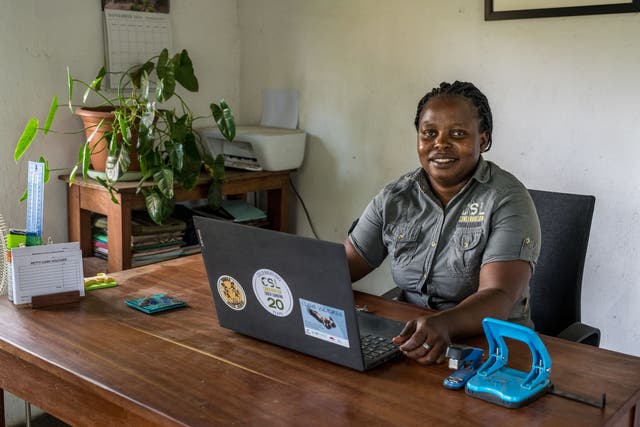
For Ruth Chitindi from Conservation South Luangwa (CSL) in Zambia, conservation begins with data. Ruth spends her days helping communities coexist more safely with wildlife using SMART technology – a digital conservation tool transforming how incidents are recorded and responded to. In landscapes where elephants, lions and other wildlife move through farming communities, conflict can be inevitable. Crop destruction, livestock predation and, in the worst cases, fatalities on both sides are an ever-present reality.
Before digital systems were introduced, CSL rangers relied on handwritten records, which made it harder to track and analyse. Today, CSL is the first in Zambia to use SMART technology to record human-wildlife conflict in real time. Using the data, Ruth helps conservation teams identify hotspots and focus support where it is needed most. Alongside targeted mitigation efforts informed by the data, human deaths linked to human-wildlife conflict dropped from 12 in 2023 to zero in 2025. “Passion for conserving wildlife and helping people is what drives this success,” says Ruth.
Using drones to understand whales from above
For marine scientist Dr Loraine Shuttleworth of Marine Dynamics, some of conservation’s most important breakthroughs are happening from the sky. Based in South Africa, Dr Shuttleworth uses drone technology to study and conserve cetaceans, including southern right whales and the endangered Indian Ocean humpback dolphin.
Her previous research used drone photogrammetry – a technique that allows precise measurements to be taken from aerial imagery – to monitor whale body condition and calf growth rates, offering critical insights into the health and reproductive success of South Africa’s southern right whale population. “What makes drones so powerful,” she explains, “is that a single flight can generate multiple valuable datasets. The same aerial imagery can be used to identify individual animals, assess body condition, monitor growth, document behaviour, and investigate social associations. This allows researchers to extract far more information than was previously possible from a single survey.”
.jpg?quality=75&width=640&crop=3%3A2%2Csmart&trim=0%2C76%2C0%2C75&auto=webp)
AI strengthening coexistence between people and elephants
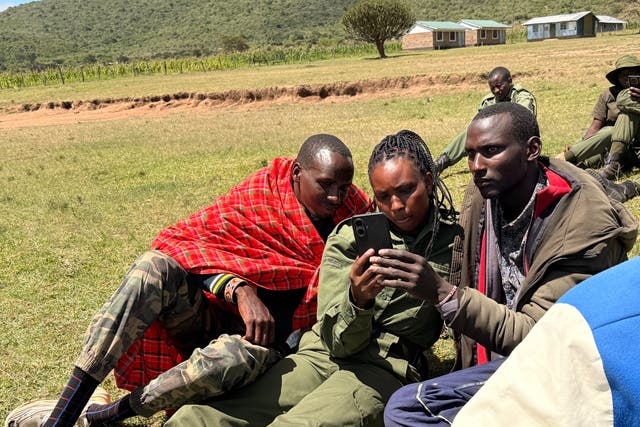
For ranger Sylvia Pemba, AI is helping transform conservation from reactive to proactive, as it has traditionally relied on ranger patrols, radio calls and fragmented reporting systems. Sylvia has been at the forefront of introducing VirtualRanger, an AI platform developed by William May and supported by the Mara Elephant Project (MEP) and How Many Elephants, designed to strengthen human-elephant coexistence by reporting elephant movements, human-wildlife conflict, habitat destruction, and illegal activity in near real time.
Syl community members, with the tools and confidence to use the platform, helping incidents move from local reporting to ranger awareness in under three minutes. This is significant because in remote landscapes, delays in information can mean the difference between prevention and crisis
The woman finding out what elephants won’t eat
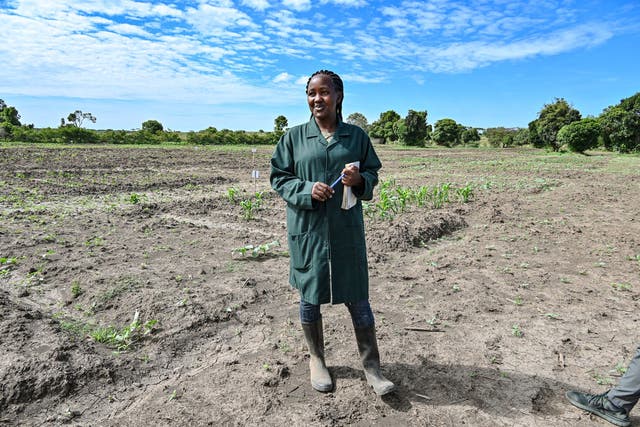
Most farmers spend their lives trying to keep elephants out of their farms. Abigael Pertet is doing the opposite. Her farm in the Maasai Mara in Kenya, supported by MEP, is specifically designed to better understand crop-raiding elephants – what they like to eat and, crucially, what they don’t.
Human-elephant conflict is the greatest threat facing African elephants today. As farms expand into ancient elephant corridors, crop-raiding incidents are increasing, leaving communities frustrated and wildlife vulnerable to retaliation. Abigael’s findings have been surprising: lavender, rosemary, chilli, tea tree, geranium and onions appear to be among the plants elephants don’t eat. These results could be game-changing for farmers who could grow alternative crops less appealing to elephants, thereby reducing conflict and diversifying income.
Tanzania’s female beekeepers
In Tanzania, some of the most effective conservationists protecting elephant migration routes are women working with bees. Along the boundaries between farmland and elephant corridors, more than 16km of beehive fences have been installed by the Tanzanian Elephant Foundation, supported in part by theHow Many Elephants Beehive Fence Project. The concept is deceptively simple: if an elephant disturbs the wire, thousands of fiercely protective wild bees chase them away. Even an elephant would rather turn away than risk being stung around its sensitive trunk and eyes.
The results speak for themselves: communities involved in the project have reported a 75 per cent reduction in crop damage and human-elephant conflict, helping farmers protect their livelihoods while allowing elephants to continue moving along ancient migration routes. But perhaps the most significant shift is women stepping into a traditionally male-dominated arena – harvesting and selling honey – earning additional income and becoming environmental leaders within their communities.
.png?quality=75&width=640&crop=3%3A2%2Csmart&trim=0%2C50%2C0%2C49&auto=webp)
Spending time with women working in conservation across Africa, I’m struck by how often the smartest solutions are also the simplest. Technology undoubtedly has a role to play in conservation’s future, but lasting change rarely comes from innovation alone. It depends on trust, local leadership, and finding ways for people and wildlife to coexist in landscapes that are under growing pressure. Increasingly, women are at the centre of that work.
Holly Budge is the founder of UK charity How Many Elephants and World Female Ranger Week, whose work has been celebrated worldwide, including by Sir David Attenborough. Voted ‘Woman of the Year in Non-Profit’ and listed in the Top 100 Women in Social Enterprise. Holly is an official UN Women UK Delegate and professional speaker. Her pursuits include summiting Everest and becoming the first woman to skydive Everest to raise awareness and funding for conservation; to date, she’s raised over £650,000. Find out more about her work athollybudge.com.
This article was originally published in July 2026.

