

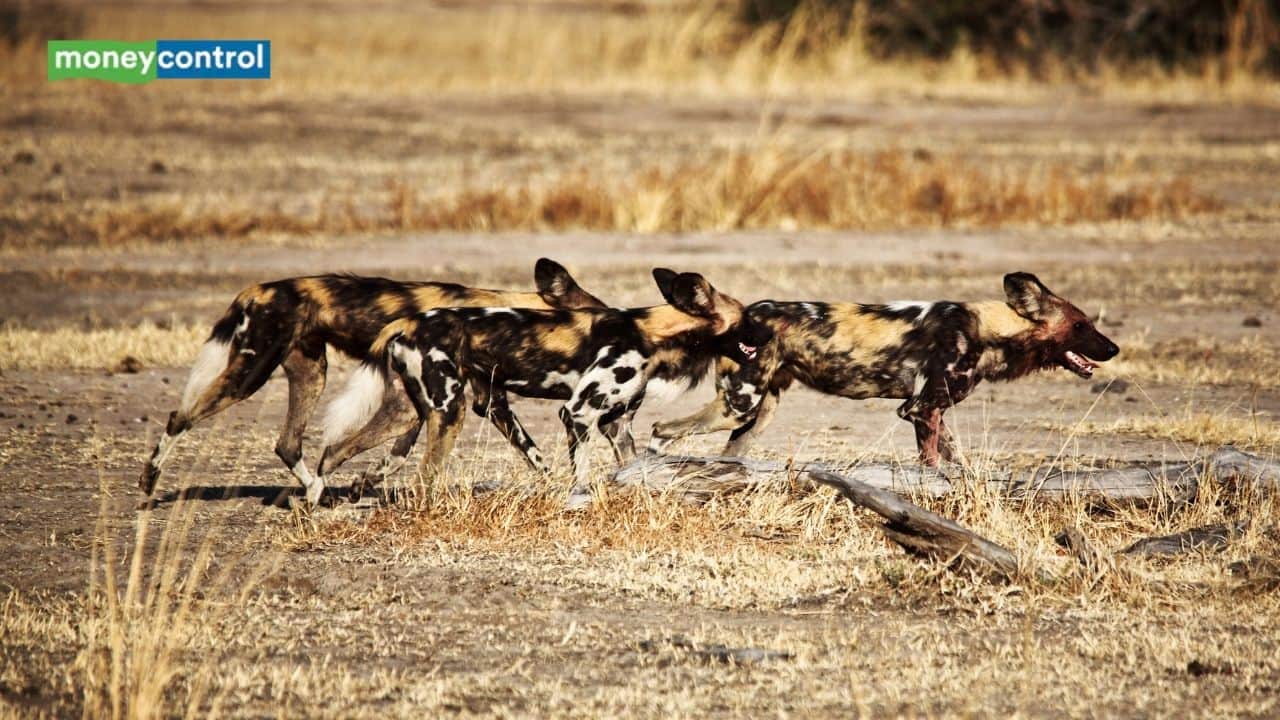
Three endangered African wild dog brothers travelled 4,100 km across Zambia in eight months, setting a mammal movement record while searching for new territory.
Sheetal Kumari
September 19, 2026 / 18:18 IST
(Representative Image: Canva)
- Three wild dogs traveled 4,100 km across Zambia.
- Record journey for a mammal in Africa.
- Shows connectivity for endangered species.
Did our AI summary help?
Webinar by Vishal Malkan
in your portfolio by Vishal Malkan

Three endangered African wild dog brothers have completed an extraordinary journey of more than 4,100 km across Zambia, setting a record for the longest recorded single journey by a mammal from the continent. The dogs spent about eight months travelling from Kafue National Park in western Zambia towards the Luangwa Valley in the east, crossing a landscape marked by roads, settlements, hunting activity and other dangers.
The journey is significant because it shows that African wild dogs can still move between distant wildlife areas despite increasing pressure from human development. The findings, published in the journal Ecology, also provide evidence that important connections between protected and unprotected landscapes remain available to wildlife.
African wild dogs travel across Zambia in search of new territory
The three males belonged to the Mayukuyuku pack in Kafue National Park. Their movement began in 2025, when the dogs, all about 3 years old, left their natal pack as part of a natural process known as dispersal. Young African wild dogs often leave their original groups when they reach maturity, particularly when breeding opportunities within their own pack are limited. They then travel in search of unrelated dogs, potential mates and a territory where they can establish a new home.
According to the study, the three males travelled through areas with varying levels of protection and human activity. They moved around major urban areas, including Kabwe, Kitwe and Ndola, and at times retraced their route after encountering difficult terrain or human activity. They also navigated around large reservoirs before continuing east towards the Luangwa Valley.
Why the African wild dogs’ journey matters for conservation
Researchers from the Zambian Carnivore Programme tracked 19 groups of dispersing African wild dogs as part of the wider study. Their movements showed that long-distance travel remains possible between several major wildlife populations in Zambia, even though the journeys expose the animals to significant risks outside protected areas.
Dr Matthew Becker, chief executive of the Zambian Carnivore Programme, said the movements demonstrate that natural links between Africa’s wildlife strongholds still exist, while also showing how dangerous those routes have become. He said conservation efforts should not focus only on fenced protected areas but also on maintaining connected landscapes through which animals can move.
The study found that wild dogs can move rapidly and in relatively straight paths through areas with high human activity. This behaviour may help them cross landscapes affected by roads, settlements and other forms of development. However, movement does not necessarily result in successful breeding or the establishment of a connected population. The researchers noted that immigration can itself be difficult because unfamiliar wild dogs may fight when they meet.
The danger is particularly severe from wire snares used for bushmeat hunting. Wild dogs can become trapped because the snares are difficult to detect, and members of a pack are reluctant to leave an injured animal behind. One female tracked in the study died after becoming caught in a wire snare, highlighting the risks animals face when they move beyond well-protected areas.
Endangered species still faces habitat and human threats
African wild dogs are classified as endangered, with only about 6,600 adults remaining across roughly 39 distinct populations, according to the hunting, snares and conflict with people are among the major threats facing the species
The study also documented another striking dispersal involving three sisters of the male dogs. Two of the sisters died during their movements, with snaring considered a likely cause in the cases described by researchers. At one point, the brothers and sisters encountered one another in Zambia’s Copperbelt mining region. The related animals spent the day together before separating again as they continued their searches for new ranges and potential mates.
Dr Nyambe Nyambe, director of the Kavango-Zambezi Transfrontier Conservation Area secretariat, said maintaining links between national parks, community areas and countries could allow species such as African wild dogs to continue moving through the landscape. The transfrontier conservation area spans five countries and is among the major conservation regions in southern Africa.
The researchers say Zambia’s remaining wildlife corridors offer an important opportunity to maintain connections between populations. About 40% of Zambia has some form of wildlife protection, although the level of protection varies considerably between national parks, game management areas, forest reserves and unprotected land. The record journey of the three brothers shows that these connections can still function, but also underlines the need to protect them as human activity expands.
The findings were published in Ecology in September 2026 in a study titled “Extraordinary movements connecting distant ecosystems by African wild dogs (Lycaon pictus)”. The research involved scientists from the Zambian Carnivore Programme, Montana State University, the Zambia Department of National Parks and Wildlife, the University of Oxford and other conservation organisations.
Sheetal Kumari is a skilled sub-editor and content creator with expertise in digital news, multimedia storytelling, and social media content. With a strong grasp of topics like science, politics, and many more, she crafts compelling narratives, transforming complex topics and trending stories into engaging, accessible reads across various media <a href="https://absafricatv.com/eu-court-of-justice-landmark-ruling-shattering-internet-platforms-long/” title=”EU Court of Justice Landmark Ruling: Shattering Internet Platforms' Long”>platforms.
first published: Sep 19, 2026 06:18 pm
Discover the latest Business News, Sensex, and Nifty updates. Obtain Personal Finance insights, tax queries, and expert opinions on Moneycontrol or download the Moneycontrol App to stay updated!
Watch
Trending news

‘I feel fully confident’: Gurgaon founder shares video of 81-year-old grandmother after Alaska cruise
- ‘Don’t stop, learn more’: Man says AI won’t replace developers, urges upskilling
- ‘Some sell it for house, children’: Harsh Goenka reacts to Delhi man selling ancestral gold for wife’s iPhone 18 Pro Max
- Salesforce employee flies to US, stays at 5-star hotel for 7 days offsite: ‘Tech companies know how…’
- How a masterstroke helped David Beckham build Inter Miami into $1.35 billion empire
- Deepika Padukone and Ranveer Singh welcome second baby girl
- Zubeen Garg’s first death anniversary: Fans and artistes gather in Assam to pay tribute to the late singer with music and prayers
- Quit IPS after 8 years, built 3 companies: How former police commissioner Rajan Singh founded ConceptOwl, HabitStrong
- Lived in a ₹3,000 rented home in Mumbai slum: Labourer’s son cracks JEE Advanced after studying on neighbour’s Wi-Fi
- iPhone 17 price drops to Rs 55,283 on Flipkart: Check deal, exchange offer and more
- Apple iPhone 18 Pro Max price drops to Rs 1,39,900 at Croma with bank cashback and exchange bonus: Here’s how this deal works
- 6 first-time authors whose debut novels became instant bestselling sensations
- Inside Urfi Javed’s house: DIY studio, walk-in closet, spacious living room and blue-white colour theme
- For 13 years, this 55-year-old teacher in Maharashtra has walked 5 km through a forest every day to teach one student
- Quote of the day by Sunita Williams: “Never give up. Trust your gut. And when the time comes, you…” – Sunita Williams explains why persistence, instinct and timing go hand in hand
`);
}
if(res.stay_updated){
$(“.stay-updated-ajax”).html(res.stay_updated);
}
}catch(e){ console.log(e); }
});
},2000); // Reduced from 8s to 2s for better Core Web Vitals (LCP/UX)
});

