

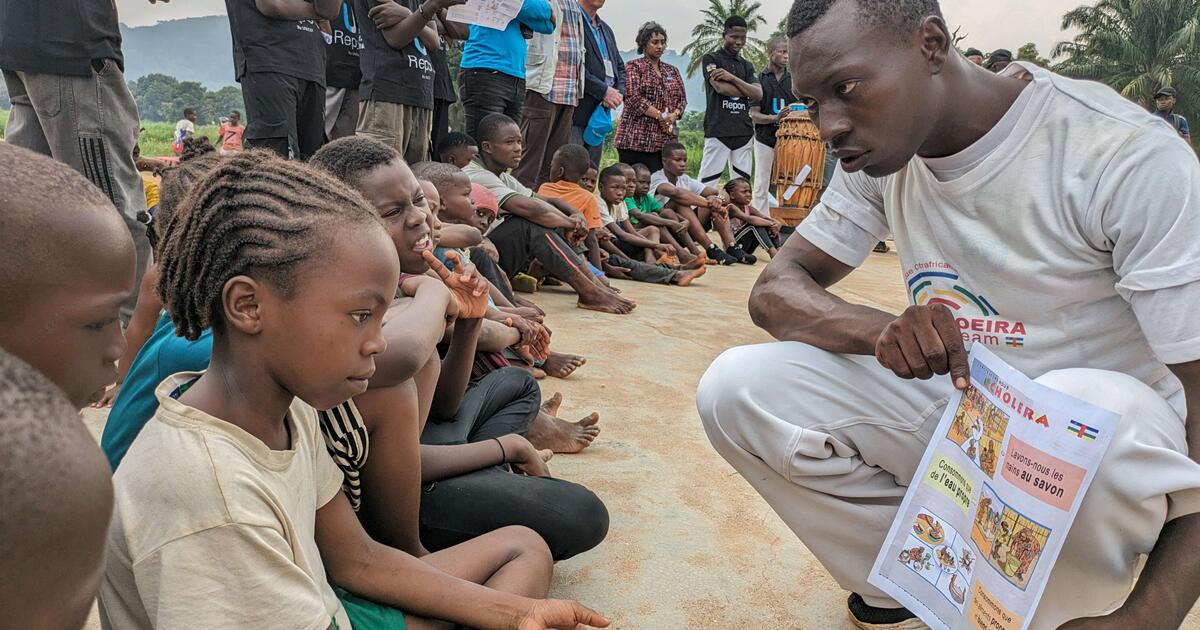
Children receive cholera prevention messages in the Central African Republic. Photo: UNICEF
UN relief chief visits Pakistan as country confronts climate crisis
The Under-Secretary-General for Humanitarian Affairs and Emergency Relief Coordinator, Tom Fletcher, has begun a visit to Pakistan to spotlight the growing humanitarian impacts of the climate crisis – and what it means for countries like Pakistan, which are on its front lines.
Earlier today in Islamabad, he met with Prime Minister Muhammad Shehbaz Sharif, and they discussed diplomatic efforts underway in the Middle East, the delivery of humanitarian aid through convoys across the border between Pakistan and Afghanistan, and partnership on global disaster preparedness.
Fletcher will also hold talks with Foreign Minister Mohammad Ishaq Dar and other senior <a href="https://absafricatv.com/government-to-earn-ksh22-5-million-monthly-from-mombasa-lpg-terminal-lease/” title=”Government to Earn KSh22.5 Million Monthly From Mombasa LPG Terminal Lease”>Government officials, as well as with humanitarian partners.
During his four-day visit, Fletcher will meet communities affected by floods and melting glaciers to hear directly about their needs, recovery efforts and local solutions. He will also visit community-based flood mitigation and preparedness initiatives.
The Under-Secretary General will underscore the need for sustained international solidarity, including funding for preparedness and early action ahead of disasters and investment in locally-led climate adaptation.
Humanitarians provide food, other vital relief to quake-hit communities
The United Nations Office for the Coordination of Humanitarian Affairs (OCHA) says that three weeks after the devastating earthquakes that struck Venezuela, the UN and its humanitarian partners continue to support communities in the areas hardest hit by the disaster.
According to the authorities, more than 4,700 people have been killed and over 16,700 injured. Local reports indicate that some families continue to seek information about missing relatives, while recovery operations are ongoing at a number of collapsed buildings.
The UN and its partners are providing assistance through four temporary camps in the city of La Guaira and in communities across several states. Since the onset of the response, the World Food Programme (WFP) has reached more than 67,000 people with food assistance. The International Organization for Migration has supported camp management and coordination services for more than 6,000 people in temporary sites, while UNICEF and its partners continue providing safe water, sanitation, vaccination, nutrition and child protection services for families affected by the disaster.
The UN recently launched an addendum to the 2026 Humanitarian Response Plan for Venezuela, seeking an additional US$298 million to support 1.3 million people affected by the earthquakes over the next six months. The UN and its humanitarian partners continue to appeal for sustained international support to address people’s most urgent needs and to support recovery efforts in the communities most affected by the disaster.*
*Donations made toUN Crisis Relief help UN agencies and humanitarian NGOs reach people in Venezuela with urgent support.
#Occupied Palestinian Territory
Gaza: humanitarian team meets displaced families sheltering near ‘Yellow Line’
OCHA teams have received initial reports of an armed group entering a solid waste management site in the vicinity of An Nuseirat in Deir al Balah governorate earlier this week. A security guard working at the site was reportedly detained and questioned for approximately 30 minutes, before being released.
OCHA reiterates that humanitarian personnel, premises and assets must be respected and protected at all times, and that humanitarian operations must be able to function safely and without interference.
Today, the Deputy Humanitarian Coordinator, Suzanna Tkalec, led a joint humanitarian mission to a former UN school in Bureij, Deir al Balah. The school currently hosts 18 displaced families and is located approximately 50 yards from the “Yellow Line.” The families reported living there for more than a year-and-a-half, with access constraints hampering the delivery of humanitarian assistance.
OCHA notes that 1.4 million people are estimated to require longer-term shelter support, including 850,000 people in need of emergency shelter.
The Deputy Humanitarian Coordinator and the team met with women and men from the community to discuss their most pressing needs. Their living conditions continue to be severely undermined by insecurity, the absence of alternatives, and severe gaps in access to drinking water, food, healthcare, sanitation and education.
Humanitarian partners are committed to mobilizing assistance to address the community’s most urgent needs.
Meanwhile, across Gaza, humanitarians continue to provide shelter assistance to displaced families. In the past month alone, more than 378,000 items – including tarpaulins, cleaning kits and jerrycans – were dispatched by 30 partner organizations.
However, without additional funding, depleted stockpiles cannot be replenished, putting vulnerable families at greater risk, particularly as humanitarians prepare for winter. Only a small fraction of the required winter stock is currently estimated to be available.
West Bank: education access deteriorates
Access to education continues to worsen in the West Bank. For over a year, six UNRWA schools in Jenin and Nur Shams camps have been inaccessible, and six UNRWA schools in East Jerusalem have been closed. Ten schools in Area C have been abandoned following the full displacement of communities due to recurrent settler attacks and related access restrictions.
OCHA notes that in the past three years, 121 Palestinian communities have experienced full or partial displacement due to settler violence and related access restrictions. More than 6,200 Palestinians, roughly half of them children, have been displaced within this context. More than 2,300 people have been displaced this year alone.
In June, WFP provided food vouchers and cash assistance to about 286,200 vulnerable people – as repeated displacement, recurrent settler attacks, damage to homes and infrastructure, and access restrictions continue to drive humanitarian needs.
#Central African Republic
UN relief chief fast-tracks funds for urgent cholera response
Emergency Relief Coordinator Fletcher has allocated $1 million from the UN’s Global Emergency Fund (CERF) for an urgent response to the cholera outbreak declared last month in the Central African Republic.
So far, more than 400 suspected cases and 36 community deaths have been recorded. UNICEF warns that children under 10 account for 44 per cent of all cases.
Cases have spread from the rural districts of Bimbo and Mbaïki to all districts of the capital Bangui, heightening the risk of rapid transmission in dense urban areas. The rainy season, low population immunity, limited access to safe water and sanitation, and the movement of people along the Oubangui River are compounding the situation.
The funding from CERF will fast-track life-saving interventions on health, community engagement, and water, sanitation and hygiene to reduce mortality and curb the spread of the disease.
UNICEF has already provided cholera kits to treat up to 300 patients, distributed 2,000 doses of oral rehydration salts and zinc for community-level treatment, and installed additional tents to expand the capacity of the national cholera treatment and referral centre from 40 to 70 beds.
Power grid collapse disrupts electricity nationwide
OCHA is monitoring the impact of yesterday’s nationwide power grid collapse in Cuba, the third in one week and the fifth since the beginning of the year.
While authorities work to reconnect the grid, as of this morning only around 40 per cent of customers in the capital Havana had electricity restored, with the situation outside the capital even worse.
These power outages highlight the increasing fragility of the country’s power system amid continued fuel shortages and shipping constraints.
Repeated nationwide outages continue to disrupt access to electricity, clean water, telecommunications, health services and economic activity, further deepening humanitarian needs across the country.
Hospitals in Havana limited their services while city water pumping systems stopped. Amid a hot summer, the two major cities of Havana and Santiago de Cuba face severe water supply disruptions mainly due to lack of fuel for pumping, raising the risks of disease outbreaks. In the Santiago area, communities wait for water distribution for many days, while in Havana, 450,000 people are affected. In total, around 1 million people lack access to water.
The UN and its humanitarian partners continue to provide support. As of the end of June, nearly 500,000 people had received clean water, and over 900,000 people had received food assistance.
Currently, the UN’s Plan of Action – which calls for $94 million to deliver life-saving aid to 2 million people – is just 40 per cent funded.
