

Expert SpeakRaisina Debates
Published on Apr 22, 2026
As Angola navigates alleged foreign interference, deeper analysis reveals how global rivalries can be instrumentalised to serve domestic political purposes
Image
The unfolding controversy in Angola over alleged Russian interference by two Russian political consultants, Igor Ratchin and Lev Lakshtanov, is no longer a matter of legal issue. It reflects broader geopolitical anxieties about a proxy war, domestic political rivalries, and, most importantly, the battle of narratives. Currently on trial, these two Russians are accused of orchestrating anti-government protests, spreading disinformation, and attempting to influence Angola’s next presidential election. However, the real question is not only whether there was foreign interference, but also whether these claims are being used for political purposes.
Angolan prosecutors argue that these two Russians were acting on behalf of Africa Politology. This covert network appeared to have emerged from the remnants of the Wagner Group following the death of its founder, Yevgeny Prigozhin, in 2023. This network, according to whistleblower Yalike-Ngonzo, has built a sophisticated disinformation architecture across Africa, designed to weaken Western influence, discredit multilateral institutions, and strengthen Russia’s geopolitical foothold.
The real question is not only whether there was foreign interference, but also whether these claims are being used for political purposes
Prima facie, these allegations against African Politology make sense. Ratchin and Lakshtanov, on behalf of the organisation, engaged several key political figures in the country, including General Higino Carneiro of the ruling Popular Movement for the Liberation of Angola (MPLA) and opposition leader Adalberto Costa Júnior of the National Union for the Total Independence of Angola (UNITA), and both were offered lucrative financial and strategic support in exchange for political influence. This modus operandi is reminiscent of the Cold War-era hybrid interference.
However, the accusation is far from being proved. Both the accused and their legal team deny any links to Africa Politology, insisting instead that their activities were limited to cultural cooperation, including plans to establish a “Russian House” in Luanda. For example, the alleged mastermind of the disinformation campaign, Maxim Shugalei, known for his successful spying operation on behalf of Prigozhin in Libya, was detained in Chad during the operation. In Libya, he successfully gathered information and prepared a strategy to support Seif al-Islam Gaddafi, the son of former leader Muammar Gaddafi. His escape from a Libyan prison later became a trilogy of action TV films, seemingly sponsored by Prigozhin. However, given the timing of his detention, there is serious doubt over his alleged involvement in Angola.
This incoherence raises questions about the Angolan government’s willingness to use the spectre of Russian interference as a scapegoat for regime survival. Since assuming power in 2017, President João Lourenço has gradually reoriented Angola’s foreign policy away from its traditional alignment with Moscow toward closer ties with Washington. This shift was symbolically reinforced by Joe Biden’s visit to Angola in 2024, during which the ambitious Lobito Corridor project, a strategic infrastructure initiative linking mineral-rich regions of Central Africa to Atlantic export routes, was unveiled.
This incoherence raises questions about the Angolan government’s willingness to use the spectre of Russian interference as a scapegoat for regime survival
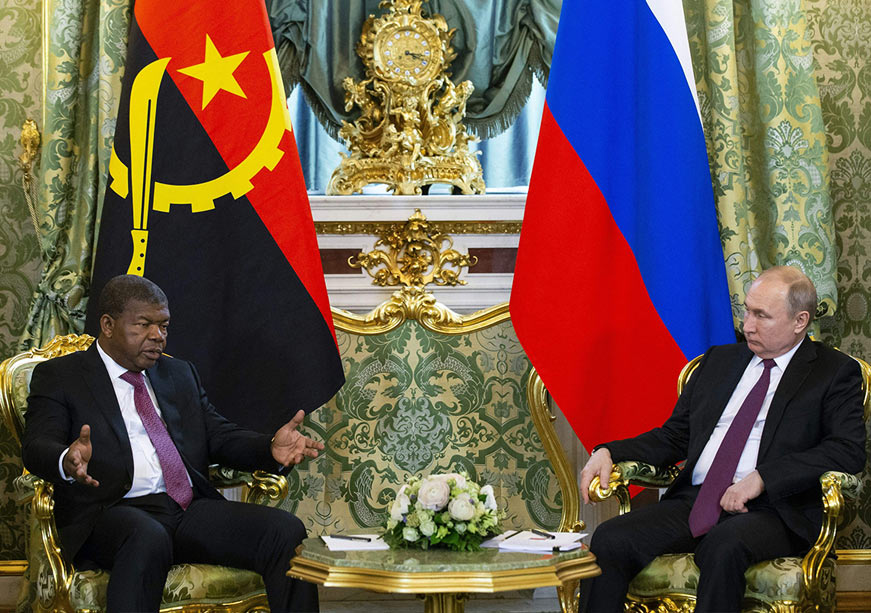
This westward pivot has not been without consequences. Russian economic interests in Angola have already been curtailed, with companies such as Alrosa and VTB Bank being forced to withdraw due to severe international sanctions following the Ukraine war. Diplomatic engagement has also been scaled down. Lourenço has not met Vladimir Putin since 2019. Against this backdrop, portraying Russia as a destabilising force could serve Angola’s double purpose. It legitimises internal crackdowns under the pretext of national security while putting the blame on Russia for influence operations aligning with Western narratives of Russian interference.
Indeed, the domestic political developments of Africa further elucidate this point. As Angola approaches a critical electoral cycle, questions over succession loom large. And like many other African leaders, Lourenço may also seek to extend his tenure through constitutional manoeuvring. In this context, the marginalisation of rivals becomes a necessary political objective. General Higino Carneiro, though from the same ruling MPLA party, has cross-party appeal and is seen by many as a potential successor. However, in recent times, he was falsely accused of several corruption charges that were later dismissed. His re-emergence as a political contender has been met with renewed accusations, raising a familiar African picture of a crackdown on opposition by the incumbents.
The timing of these developments is also telling. The recent wave of protests in Angola, which was initially triggered by a peaceful taxi strike, eventually escalated into nationwide unrest. While the government claim that foreign actors orchestrated the demonstrations, many journalists and civil society actors insist that the grievances were organic, rooted in economic hardship and governance deficits. The heavy-handed response by security forces, which resulted in multiple deaths and mass arrests, has only deepened scepticism toward the official narrative.
The Angolan case illustrates the increasingly blurred boundaries between external interference and internal politics
In this light, blaming Africa Politology appears a convenient scapegoat, deflecting attention from internal discontent while consolidating political control. It also allows the government to frame opposition figures as potential collaborators with foreign interests, thereby undermining their legitimacy
Yet it would be equally naïve to dismiss the possibility of genuine Russian involvement. The Wagner Group and its successor networks have demonstrated a clear capacity and motivation to engage in political influence across Africa. And even though Russia is not directly involved, these operations ultimately benefit the Kremlin. Therefore, any mild response regarding the detention of its citizens may fuel the perception of tacit complicity. In the realm of information warfare, silence is often interpreted as a deliberate action.
Ultimately, the Angolan case illustrates the increasingly blurred boundaries between external interference and internal politics. The broader implication is scary. Angola’s trajectory reflects a wider trend in which African states are becoming arenas for renewed great-power competition. The convergence of resource politics and influence operations evokes uncomfortable parallels with the ideological warfare of the Cold War. As Angola deepens its engagement with the United States (US) while distancing itself from Russia, it risks becoming a frontline state in an emerging proxy war.
Whether Africa Politology represents a genuine threat or an exaggerated one, its use signals a deeper crisis, the growing entanglement of African politics with global rivalries. And in such a landscape, the line between propaganda and power becomes ever harder to discern
Samir Bhattacharyais an Associate Fellow at the Observer Research Foundation
The views expressed above belong to the author(s). ORF research and analyses now available on Telegram! Click here to access our curated content — blogs, longforms and interviews.

PREVNEXT
Author
Samir Bhattacharya
Dr. Samir Bhattacharya is an Associate Fellow at Observer Research Foundation (ORF), where he works on geopolitics with particular reference to Africa in the changing
Read More +
Related Search Terms
Publications
Geography As Weapon
International Affairs
Jun 26, 2026

