

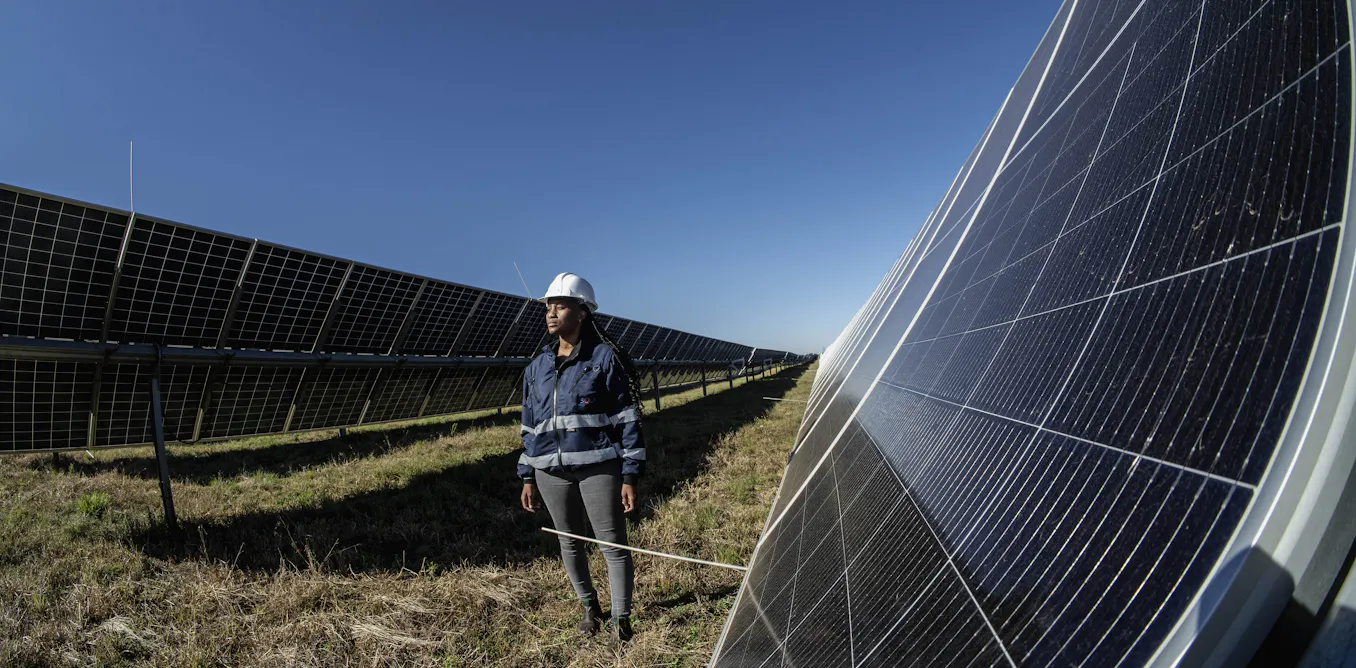
South Africa’s coal-fired power stations are retiring. The country must replace a huge amount of electricity over the next two decades. Currently, coal still supplies 74% of the country’s power. But the government’s national energy plan has largely overlooked one technology South Africa is particularly suited to build: concentrating solar power.
There are two main ways of generating electricity from the sun. Photovoltaic (rooftop) solar panels convert sunlight directly into electricity. Big concentrating solar power farms use mirrors to concentrate sunlight into heat. This heat is then used to produce steam that drives a turbine to generate electricity.
Concentrating solar power works only with direct normal irradiance. This is sunlight that travels straight from the sun, rather than light scattered by clouds, dust or moisture. This direct sunlight can be concentrated to produce extremely high temperatures.
Because of its dry climate, clear skies and low cloud cover, South Africa has some of the best direct normal irradiance in the world, second only to Chile’s Atacama Desert.
South Africa once planned to build more concentrating solar power plants, but those plans were gradually scaled back. No new projects have been approved since 2014. Even so, the country already has several concentrating solar power plants, built by private companies through the government’s renewable energy programme. These generate about 600 megawatts of electricity, or enough to power roughly 350,000 to 400,000 average three-bedroom homes each year.
As an engineer and the director of Stellenbosch University’s Solar Thermal Energy Research Group, I’ve been part of teams who’ve done research modelling how these systems integrate with the South African grid and their construction costs. I believe that South Africa abandoned this clean electricity that is so easy to connect to the national grid because it valued the wrong thing (cheap daytime electricity instead of reliable electricity).
The government’s energy plan compares the cost of electricity from ordinary solar panels during daylight hours with the cost of building concentrating solar power plants. On paper, ordinary solar looks much cheaper, costing about US$35 (R576) per megawatt-hour. But solar panels don’t generate electricity at night and adding batteries to store enough electricity to cover a full night raises the cost to about US$166 (R2,735) per megawatt-hour.
The government’s energy plan also favours nuclear power, which costs US$140/MWh (R2,312) and is about to invest R2.2 trillion (US$128 billion) in this. I argue that this is a huge mistake. Concentrating solar power is far cheaper.
Why South Africa needs concentrating solar power
One advantage sets concentrating solar power apart from ordinary solar panels: it can keep generating electricity after the sun goes down.
Photovoltaic or rooftop solar panels generate electricity only while the sun is shining. But electricity demand is often highest in the evening, when people arrive home, cook dinner, switch on lights and watch television. This ability to produce electricity whenever it is needed is known as dispatchability.
Concentrating solar power stores energy as heat rather than electricity. During the day, mirrors concentrate sunlight to heat molten salt to about 565°C. The hot salt is stored in insulated tanks and later used to produce steam to drive a turbine, even after sunset. Modern plants can store enough heat to keep generating electricity for 12 to 20 hours. In summer, some can operate almost around the clock.
Storing heat is also much cheaper than storing electricity in batteries for long periods. Batteries work well for supplying electricity over a few hours. But thermal storage costs only a fraction as much for overnight storage. Once this ability to provide electricity on demand is included, concentrating solar power becomes far more competitive than a simple comparison of daytime electricity prices suggests.
Concentrating solar power and green jobs
This could also create far more manufacturing work in South Africa than photovoltaic or rooftop solar systems. Most of the cost of a photovoltaic system is in the solar cells. These are almost entirely imported and only assembled in South Africa.
On the other hand, concentrating solar plants are built overwhelmingly of concrete, steel and glass – the things South African industry already makes. Up to 60% of the components needed for a concentrating solar plant could be bought from local South African factories.
South Africa has also shown it can develop world-class concentrating solar power technology. The award-winning Stellio heliostat, regarded internationally as one of the most efficient and lowest-cost mirror systems, was conceived here and designed for local manufacture. China deploys it at scale. South Africa did the pioneering work, but another country built the industry.
What needs to happen next
The government’s next version of the national energy plan must calculate the cost of electricity at the point it is delivered to consumers, not at the point it is generated. The Department of Electricity and Energy, working with the Council for Scientific and Industrial Research, has the modelling capacity to do this. It just needs to move away from the government’s public position that concentrating solar power is more expensive than rooftop solar.
Alongside the energy plan, South Africa also needs a strategy to build a local concentrating solar power industry. The Department of Trade, Industry and Competition and the Industrial Development Corporation could compel future concentrating solar power projects to buy more components from South African manufacturers, such as mirrors, storage tanks, receivers and heliostat frames. This is the same approach that helped grow the country’s photovoltaic assembly industry.
The modelling we do at the Stellenbosch University’s Solar Thermal Energy Research Group suggests that South Africa’s electricity grid has room for 6 to 10 gigawatts of concentrating solar power. That is enough capacity to supply roughly 3.5 million to 6.5 million average three-bedroom homes over a year, depending on how the plants are operated.
Even more energy could be added to the grid once local manufacturing starts bringing the costs down. Smaller rooftop concentrating solar systems could also replace the diesel and electric boilers that many industries use to generate heat for manufacturing processes.
South Africa has the re out concentrating solar power and a procurement programme to make sure that most of the components are produced locally. With a proper plan in place, concentrating solar power stops looking like a technology we can afford to ignore, and starts looking like one we cannot afford to keep ignoring
This article is based on Craig McGregor’s recent inaugural lecture as a full professor at Stellenbosch University.

