

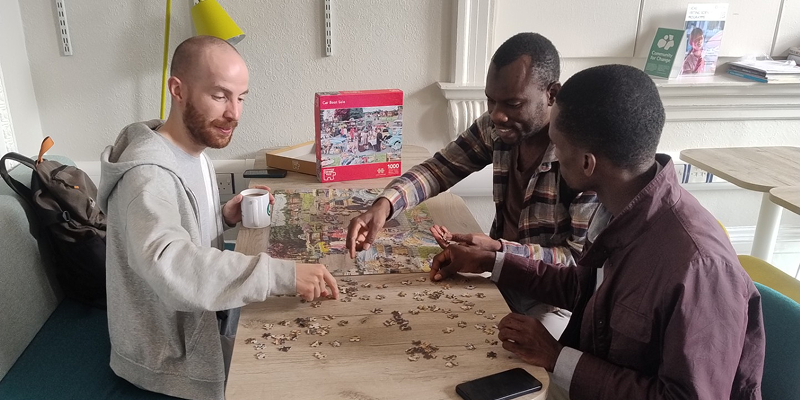
Researchers and meteorological professionals from Ghana and Senegal visited the University as part of a groundbreaking initiative to co-design a more accurate forecasting system in West Africa.
The team completed a four-week residency, marking an important milestone in Project Cumulus as the initiative moves from model development towards operational deployment.
Funded by the Gates Foundation and the Foreign, Commonwealth and Development Office, and led by the Alan Turing Institute, Project Cumulus brings together the University of Leeds, the University of Cambridge and partners across West Africa – UCAD and ANACIM in Senegal and KNUST and GMet in Ghana – to co-design a more accurate forecasting system which could help farmers improve crop yields and strengthen climate resilience.
The residency meant researchers from universities and national meteorological services in Ghana and Senegal could work alongside Leeds academics at a crucial stage of the project.
Over the four weeks, the teams collaborated on optimising the AI models that produce highly detailed rainfall forecasts, running experiments, exploring cloud-based computing infrastructure and preparing the systems for operational use.
While the project partners have been working together since the initiative began, participants said the opportunity to collaborate in person accelerated progress in ways that virtual meetings alone could not. Working side-by-side enabled rapid problem-solving and knowledge exchange, while helping partners build the relationships and shared understanding needed for long-term collaboration. The focus is now shifting towards testing, optimisation and preparing forecasting systems that can be used in real-world operational settings.
The four-week collaboration in Leeds has been a crucial step towards developing the technology together while building the relationships and skills that will sustain it long after the project ends.
Higher resolution forecasts
One notable development during the residency was the incorporation of additional variables – such as temperature, winds, and humidity – and local meteorological knowledge into the AI models to generate higher resolution forecasts.
Stephen Amankwah, Software Developer and Agrometeorologist at the Ghana Meteorological Agency, explained: “Instead of simply predicting that rain is likely somewhere within a region, we’re working towards forecasts that can provide much more detailed information about which districts are likely to receive rainfall and how much they might expect. For farmers, that information can make a real difference. Before the season starts, they can make more informed decisions about what crops or seed varieties to plant and whether irrigation may be needed. The goal is to provide communities with the information they need in time to plan ahead and respond to changing weather conditions.”
Traditional Numerical Weather Prediction systems require substantial computing infrastructure, extensive and reliable energy supply and specialist technical expertise, creating barriers for many forecasting agencies. Often these models have been developed by organisations outside Africa and are not specifically designed around the unique weather systems and forecasting complexities of the region. AI-based approaches offer the potential to deliver accurate forecasts using less computing power, making them more accessible, affordable and easier to own and operate locally.
This focus on local ownership is central to the project’s long-term ambitions. By enabling partners to run, adapt and improve forecasting systems within their own institutions, Project Cumulus aims to support sustainable forecasting capability that can continue to evolve beyond the life of the project.
Between now and March 2027, the focus will shift from development to deployment, as the project team will continue refining the AI forecasting models and preparing them for operational use. Dr Owain Harris, Research Fellow in Machine Learning and Weather Prediction, said: “A measure of the project’s success will be the forecasting system being operational, owned and run by partners in Ghana and Senegal, generating timely, locally relevant forecasts that support agricultural planning. The four-week collaboration in Leeds has been a crucial step towards that goal, helping us develop the technology together while building the relationships and skills that will sustain it long after the project ends.”
Longer term, the team also hopes to create a scalable and adaptable tool that can be adopted by other African nations, helping to strengthen local forecasting capability and climate resilience across the region.
A lasting partnership
The African organisations UCAD and ANACIM in Senegal and KNUST and GMet in Ghana have a strong history of collaboration with the University of Leeds. This collaboration was particularly strong in the GCRF African SWIFT project (£9 million, 2017-2022) led by Leeds, in which one of the current visitors, Dr Habib Senghor (ANACIM), conducted an internationally competitive research fellowship.
The University of Leeds has a strong track record in supporting the development of climate solutions in the Global South, recognised in the 2021 Queen’s Anniversary Prize.
Further information
The project is led by the Alan Turing Institute in partnership with the University of Leeds, University of Cambridge, Kwame Nkrumah University of Science and Technology (KNUST), University Cheikh Anta Diop of Dakar (UCAD), Senegalese metrological agency ANACIM and the Ghanaian met agency GMet.
The project is made possible due to funding from the Gates Foundation and UK International Development from the UK government, with the UK’s Met Office and the European Centre for Medium Range Weather Forecasting contributing as advisors.
