


What does it mean to live a good life? Psychologists and social scientists have been focusing on a new idea called flourishing—a sense of well-being that goes beyond just happiness or success. It’s about your whole life being good, including how you interact with other people and your community. So then, how do Africans fare when it comes to flourishing?

Victor Counted is a psychological scientist whose research across 40 African countries offers a data-rich rethinking of flourishing on the continent. His findings challenge the dominant narrative that Africa is “lagging behind” in development by showing a more nuanced picture of what it means to live a good life. We asked him more.
The Conversation: What is flourishing?
Victor Counted:Flourishing is more than economic growth or individual happiness. It’s a multidimensional state of being that reflects how people feel about their lives and how well their lives are actually going. So it also measures people’s values within their community.
The idea of well-being often carries a Eurocentric emphasis on the individual—personal satisfaction, autonomy, achievement. Flourishing accounts for how whole a person is in relation to their environment.
It includes the social, spiritual, and ecological contexts in which one lives. So, it’s not just about how one feels, but how one lives—fully, meaningfully, and in a satisfying relationship with the world around us.
TC: What’s the Global Flourishing Study?
VC:The Global Flourishing Study tries to measure global patterns of human flourishing. It’s an ongoing five-year longitudinal study in over 200,000 participants across 22 countries.
I was one of the team of global scholars brought together to examine the trends on what it means to live well across cultures and life circumstances.
The study identifies six key dimensions of flourishing:
- Happiness and life satisfaction
- Mental and physical health
- Meaning and purpose
- Character and virtue
- Close social relationships
- Financial and material stability
Participants rate how they’re doing in each of these areas on a scale from 0 to 10. Further questions capture experiences related to trust, loneliness, hope, resilience, and other related well-being variables.
CC BY-ND 4.0
Of the 22 nations, five were African: Nigeria, Kenya, South Africa, Tanzania, and Egypt.
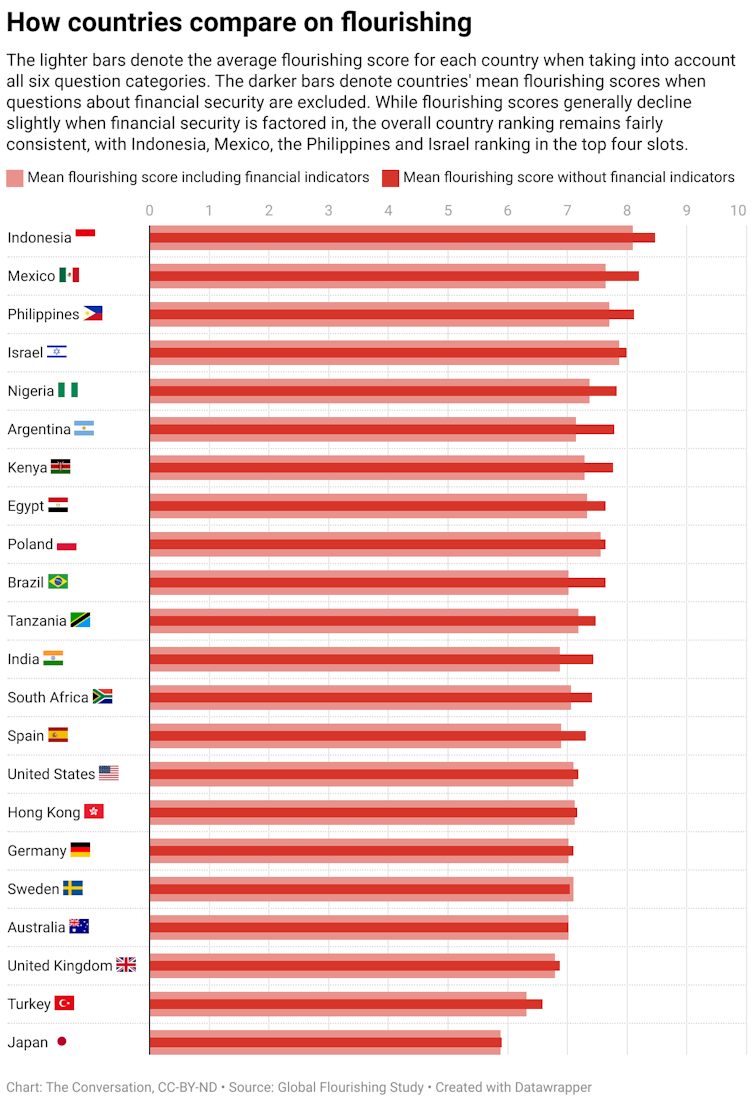
While these countries didn’t top the global rankings (Indonesia and Mexico did), Nigeria, Kenya, and Egypt all reported relatively high flourishing scores, especially when well-being was considered apart from financial status.
Nigeria, for example, ranked fifth globally in flourishing scores that excluded financial indicators—ahead of many wealthier nations. Nigerians indicated strengths in social relationships, character, and virtues (like forgiveness or helping others). But potential areas of growth included financial well-being, housing, ethnic discrimination, and education.
Overall, this suggests that while material reing. Kenya ranked seventh, Egypt 10th, Tanzania 11th, and South Africa 13th. Each showed unique strengths in areas like meaning, social connection, or mental health
TC: You did a separate study on flourishing in Africa. What did you find?
VC:In a 2024 study, we analyzed data from the Gallup World Poll (2020–2022) to explore 38 indicators of well-being across 40 African countries.
This study offered a more detailed and culture-sensitive picture of how Africans experience and prioritize flourishing. The dimensions explored were derived from both local and universal
We found that African populations often score high in meaning, character, and social relationships—despite economic hardship. This offers an important corrective to Western assumptions about well-being.
Some of our key findings were:
- There is significant diversity between and within African countries. Mauritius consistently ranked highest in life evaluations (overall satisfaction with their lives), while countries like Sierra Leone and Zimbabwe scored lowest.
- East African countries such as Rwanda and Ethiopia showed strong performance in social well-being indicators (like feeling respected or learning new things daily) even when economic indicators were low.
- Countries in West Africa, such as Senegal and Ghana, scored high in emotional well-being, with many people reporting positive daily emotions like enjoyment and laughter.
- Southern African nations, despite challenges like income inequality, displayed resilience through strong community ties and cultural practices rooted in the philosophy of ubuntu.
The results reinforced that flourishing in Africa cannot only be reduced to gross domestic product (GDP) per capita (a measure of the average economic output per person in a country)—nor to Western norms of success.
TC: What can African countries focus on to flourish?
VC:In my view, the path to greater flourishing lies in embracing local knowledge and investing in culturally relevant development priorities. Instead of following Western pathways—centered on individual advancement—Africa can model alternative flourishing pathways that reflect what matters most to African people.
1. Prioritize local knowledge systems.African ideas about a connected society—like ubuntu (southern Africa), ujamaa (east Africa), teranga or wazobia (west Africa), and al-musawat wal tarahum (north Africa) teach people to care for each other and live in peace. These values help people live meaningful lives and can inform leadership and legislation.
2. Redefine development metrics. Western development models focus on individual achievement, economic output, and material consumption. GDP per capita fails to capture the everyday realities and aspirations of African communities. We should also measure things like how happy people are, how hopeful they feel about the future, how strong and resilient their communities are, and how clean, safe, and dignifying their living environments are.
This is not a new idea—for years development scholars have called for a shift away from narrow economic indicators toward a focus on human dignity, agency, and the real opportunities people have to pursue the lives they value. What’s new is the growing availability of data and the momentum to take these alternative metrics seriously in shaping national policies and priorities.
3. Invest in education for character development. Quality education is essential to unlocking the continent’s potential to flourish. But Africa needs more than just academic skills and workforce readiness—it needs a strategy for intentional development of values and habits that shape how a person thinks, feels, and acts with integrity.
Part of the problem lies in how the humanities—fields like history, literature, philosophy, and religious studies—are often undervalued or underfunded in education systems. But it is precisely these disciplines that nurture moral imagination, critical reflection, and civic responsibility. We need educational models that form not just workers, but whole persons—people who can think ethically, act responsibly, and lead with character in their communities.
TC: What does Africa offer the world in terms of flourishing?
VC:Africa is not waiting to be saved. Across the continent, people are building communities of care, cultivating joy amid hardship, and passing on values of unity, faith, and compassion. This is what development looks like when rooted in human dignity.
Africa’s flourishing goals offer an alternative vision for development—one that starts with what Africa already has, not what it lacks. These are locally emic aspirations for well-being. They are shaped by Africa’s indigenous knowledge systems, cultural values, and religious/spiritual traditions. Pursuing these goals means prioritizing wholeness over wealth, community over consumption, and resilience over rescue.
The continent has so much to offer the world: wisdom, strong community values, and ways of staying resilient and living fully even in hard times. But many of these local insights are missing in the global science of well-being.
This article is republished from The Conversation under a Creative Commons license. Read the original article.
