


As climate negotiations unfold in Antalya, WWF Africa is demanding accessible climate finance, a just energy transition and stronger protection for forests and the communities that depend on them.
Antalya, Türkiye – WWF Africa is urging world leaders at COP31 to move beyond climate promises and deliver concrete results for people and nature, warning that Africa cannot afford another climate summit without meaningful action on finance, adaptation and climate justice.
In its policy position paper, Shaping Africa’s Priorities for an Implementation-Focused COP31, WWF calls on governments to close the widening gap between climate commitments and implementation through stronger policies, predictable finance and partnerships that deliver lasting benefits for communities and ecosystems.
Climate finance remains at the heart of Africa’s expectations. According to the paper, Africa receives only about 2% of global climate finance despite facing increasingly severe floods, droughts and extreme heat.
Developing countries require approximately US$365 billion annually for climate adaptation, yet international public adaptation finance reached only US$26 billion in 2023. WWF is calling for clear milestones towards tripling adaptation finance by 2035, with greater emphasis on grants, highly concessional financing and locally led solutions.
“Africa needs finance that reaches communities, investments that strengthen resilience and decisions that protect nature while creating economic opportunities,” said Durrel Halleson, Head of Policy and Partnerships, WWF Africa.
A just energy transition that benefits Africa
WWF Africa is also calling for an equitable energy transition that expands access to affordable renewable energy, creates green jobs and safeguards biodiversity.
Africa’s wealth of critical minerals offers significant opportunities to support the global energy transition. However, their extraction and development must not come at the expense of forests, ecosystems or local communities.
“Critical minerals are Africa’s opportunity to power a just energy transition, but only if their development protects nature and delivers equitable benefits for people,” said Eugene Nforngwa, Director of Programs Africa, Africa Coalition for Sustainable Energy Access.
Protecting forests and empowering communities
Forest conservation is another major priority for WWF Africa, particularly in the Congo Basin, where countries have maintained historically low deforestation rates. WWF is advocating fair financial recognition for countries and communities that keep forests standing, rather than directing support primarily towards restoring already degraded landscapes.
Central to this ambition is the recognition of Indigenous Peoples and Local Communities (IPLCs) as rights-holders, decisionmakers and leaders in climate action.
“Securing the rights, territories, and leadership of Indigenous Peoples and Local Communities is one of the most effective pathways to achieving lasting conservation, climate resilience, and sustainable development in the Congo Basin,” said Moussele Disseke Guy, President of an Indigenous Peoples NGO in the Republic of Congo.
WWF is calling for stronger recognition of community land rights, meaningful participation in climate decisions and direct access to finance that supports locally led conservation and adaptation solutions.
As negotiations continue in Antalya, WWF Africa insists that COP31 must produce measurable progress on adaptation finance, climate resilience, forest protection and a fair energy transition.
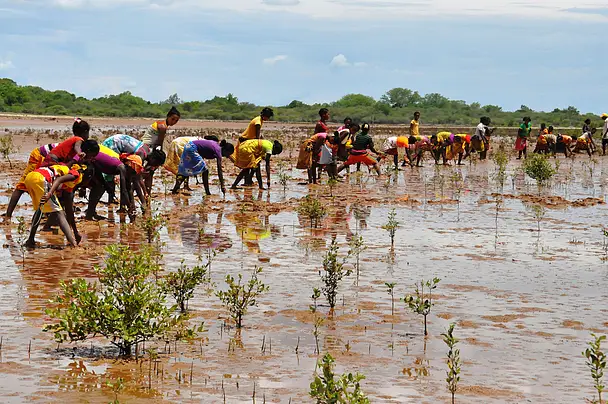
Nature based solutions are one of the ways to adapt to climate change
© @WWF

