

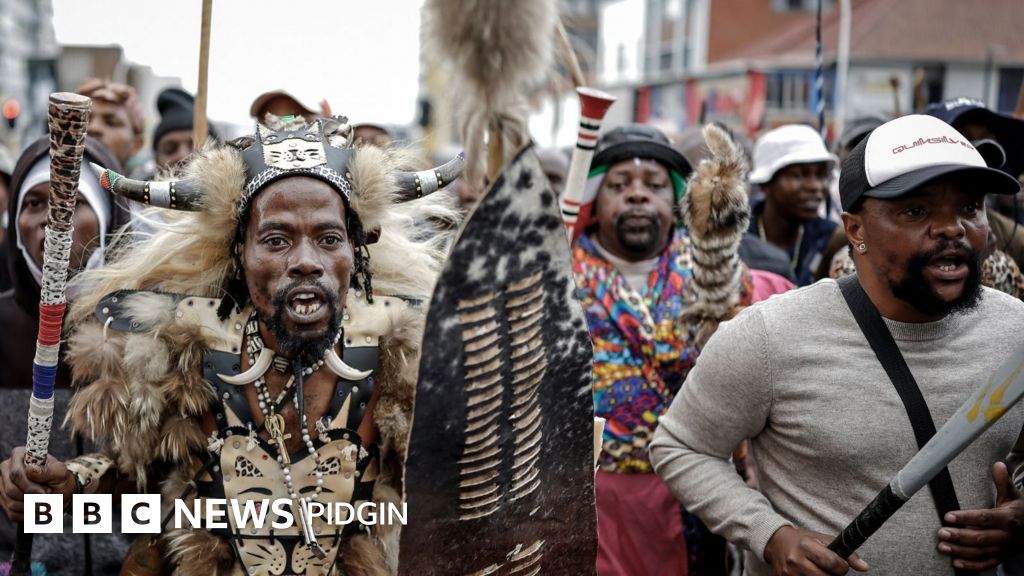
Protests Against Undocumented Migrants in <a href="https://absafricatv.com/anti-immigrant-protests-in-south-africa-on-june-30-deadline/" title="Anti-immigrant protests in South Africa on June 30 'deadline'”>South Africa: Anti-Migrant Groups Declare ‘Di protest go continue afta June 30 deadline’
The protest against undocumented migrants in South Africa will persist until the government implements stricter laws against illegal migration, according to Jacinta Ngobese-Zuma, leader of the March and March movement.
Ngobese-Zuma provided this information as protests concluded on June 30, a date designated by anti-migrant groups for undocumented foreign nationals to depart the country.
She stated that March and March plans to protest every Thursday for the next six months, aiming to compel the government to “get rid of” undocumented migrants remaining in South Africa.
Meanwhile, a demonstrator affiliated with another anti-migrant group, Operation Dudula, informed the BBC that they intend to “push di police” to apprehend foreign nationals residing in the country unlawfully.
On Tuesday, June 30, thousands of individuals demonstrated in South Africa’s major cities, urging all undocumented migrants to leave the country.
Anti-migrant groups had previously established Tuesday as the deadline for migrants without proper documentation to depart. These groups gathered in significant numbers and marched through various cities nationwide.
Prior to the deadline, numerous foreign nationals had already begun self-deporting to avoid potential violence and intimidation.
South African police reported that 25,000 foreign nationals have been repatriated to date, with the majority originating from other African countries.
To ensure the protests remained peaceful, police officers and private security guards were deployed across South Africa.
The Ministry of Police stated that the demonstrations were largely peaceful nationwide, with only minor instances of looting reported.
However, Police Minister Firoz Cachalia confirmed that the army was deployed “in case of emergency” in certain areas of Johannesburg and Durban.
Police also confirmed the arrest of three individuals in Hillbrow, a Johannesburg suburb with a high migrant population, following injuries sustained by two people during the protests.
According to police, the three suspects “open fire for protesters wey bin dey waka through di street,” and the marchers retaliated by “torching di suspects’ vehicle.” A 17-year-old was among those injured.
Some protesters threw bricks, breaking the windows of several houses in Yeoville, another suburb inhabited by many African migrants.
Shops in the city center were closed, and there was a heavy police presence on major streets.
In a neighborhood in Germiston, approximately 15 kilometers (nine miles) from Johannesburg, demonstrators reportedly entered homes, began evicting residents suspected of being foreign nationals, and handed them over to police officers, insisting that their documentation be checked, according to local media.
Police reported the arrest of five individuals on suspicion of looting a foreign-owned shop in Soweto, Johannesburg’s largest township.
Additionally, approximately 10 people were arrested for alleged looting in KwaZulu-Natal province. Police also stated that one woman was arrested for allegedly attacking a police officer, and one man was arrested for “intimidation” following reports of a foreign citizen being assaulted.
However, South African police announced they would address the press later today (Wednesday) to provide an update on the anti-migrant demonstrations that occurred on Tuesday. More than three million documented foreign nationals reside in South Africa, according to official figures.
Police stated that approximately 50,000 migrants have been arrested since January on suspicion of being in the country illegally.
Many African migrants relocated to South Africa around the time white-minority rule ended in 1994, seeking a better life.
However, with South Africa experiencing an unemployment rate exceeding 30%, anti-migrant sentiments have intensified.
Nigeria repatriated 269 of its citizens on the day of the protests, bringing the total number of its nationals evacuated so far to approximately 600. Further evacuations are anticipated in the coming days.
Ghana, Malawi, Mozambique, Nigeria, and Zimbabwe have been organizing repatriations by air or bus over the past few weeks, with around 3,500 foreign nationals volunteering to leave.
South African authorities assert that over 500 repatriated Nigerians lacked proper documentation, a claim with which Nigeria disagrees.

