

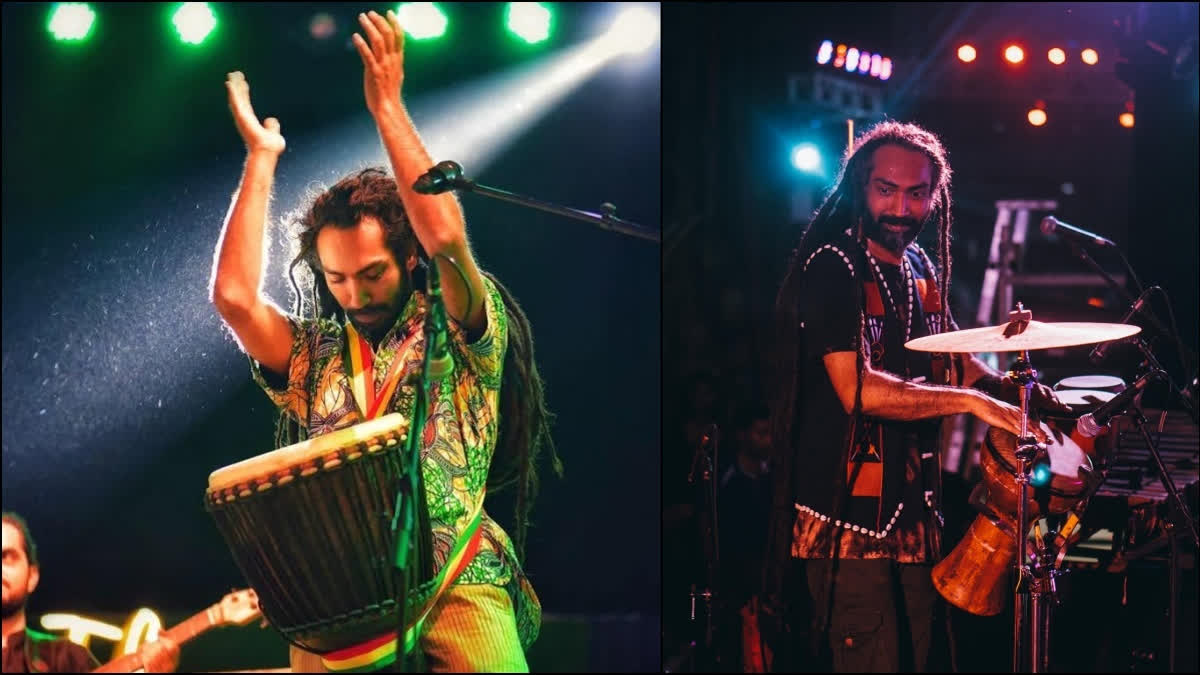
Anand Bhagat tells ETV Bharat about his journey of discovering, and then becoming synonymous with the djembe in India
Musician Anand Bhagat has dedicated over 20 years of his career to the djembe and other West African instruments (ETV Bharat)
Some musicians collect vinyls. Anand Bhagat seems to collect rhythms. The difference is that rhythms are harder to put on a shelf. For Bhagat, the journey began with drums, moved through a metal band, took him towards the djembe, led him to Burkina Faso and Mali in West Africa, and then back to Goa and Mumbai. In between, there were beach jams, drum circles, electronic music projects, community sessions, corporate workshops and a whole lot of percussion instruments.
The djembe, however, was never just another instrument for him. “It has something that is very warm,” Bhagat says, “Celebration and community and bringing people together.” That vibe has shaped much of his career. He has performed since 2004, turned professional around 2006-07, worked with artists and electronic producers including Donn Bhat and Madboy/Mink, played with Suman Sridhar’s band Black Mamba, and collaborated with musicians across Mumbai’s independent music scene. He has also spent years conducting drum circles for corporates, children and communities, using everything from proper percussion instruments to buckets and recycle bins.
Bhagat’s relationship with the djembe has also grown beyond individual performances into Boombay Djembe Folas, the collective he founded as the instrument found a larger place in India’s indie scene. The project takes the traditional West African percussion vocabulary seriously while allowing it to exist in a contemporary Indian musical landscape. The group released their single Limboin June 2026 and a full-length album is on the way.
Bhagat’s first serious relationship with drums began in college, when his mother bought him a drum kit. He taught himself, then he took some lessons from ace drummer Gino Banks. He admits he wasn’t exactly the model student. “I was not a very disciplined student,” says the dreadlocked artist, laughing.
There were other things he wanted to do: Travel, explore, find music outside the obvious places. Then came the djembe. Around 2005, Bhagat was playing in a metal band from Navi Mumbai called Skincold. The djembe initially became another instrument to experiment with. He was freestyling on it and trying to work it into the band’s nu-metal sound. But gradually, something bothered him. Why make the djembe sound like something else? The instrument already had its own language. “I didn’t want to do the same thing that I hear,” he says. He became more interested in the traditional West African way of playing it. The problem was that Mumbai in the mid-2000s was not exactly overflowing with traditional West African percussion teachers. So Bhagat turned to YouTube, and then to travellers.
His Music School Was Wherever The Travellers Were
Bhagat began meeting foreign musicians who travelled through Goa and Mumbai. Some were djembe players or had studied in West Africa. They knew the traditional techniques and, more importantly, they knew what the instrument was supposed to sound like. This was different from simply picking up a drum and improvising.
Indian percussion already has its own sophisticated vocabulary, but Bhagat wanted to understand the physical technique and sound of the djembe on its own terms. He kept learning, meeting musicians, playing live. In 2011, he heard something at the India Surf Festival in Odisha that made him stop what he was doing and follow the sound. It was coming from a beach resort. Inside one of the cottages were two foreign musicians. One was playing the balafon, the other was playing the djembe. Bhagat knew immediately that he was hearing something different.
“I fell in love with the sound immediately,” he says. The musicians were friendly. Bhagat was clearly fascinated. They became friends, and that friendship would eventually take him to West Africa. But before that happened, there was another important transaction. He bought the djembe and balafon because, at the time, getting good West African instruments in India wasn’t easy. “You couldn’t go to a music store in Mumbai and buy a West African djembe,” he says. So when the opportunity arrived, he took it.
The Drum Circle Wasn’t Just for Hippies
Bhagat’s first drum circle happened in Goa around 2004 or 2005. Then there was Gokarna where people were drumming under the stars. It was also the sort of thing that makes you think, Yes, this is probably what people mean when they say “drum circle”.
At first, Bhagat thought drum circles were essentially a hippie activity. Then he realised they could be something much bigger. He encountered a major drum circle at the Ladakh Confluence, led by Roberto Narain, whom he considers one of the pioneers of drum circles in India. He also learnt from Varun Venkat of Taal Inc. The idea slowly changed in his mind. A drum circle didn’t have to be a bunch of musicians sitting around outdoors. It could be for anyone.
Around 2010-11, Bhagat worked with Headrush in Mumbai and helped develop corporate drum-circle sessions. The same djembe that had been associated with beach gatherings and spontaneous jams was now entering offices. People who normally spent their days discussing targets, presentations and quarterly numbers were being handed drums, so for a while, everyone’s job title disappeared. Bhagat also took drum circles into communities outside corporate spaces. He worked with NGOs and conducted sessions for children from slum communities. Buckets became drums. Recycling bins became percussion. He taught women from underprivileged communities, blind children and children in orphanages. The instrument’s simplicity became its greatest strength.
The Djembe Took Him To Burkina Faso
The trip to West Africa did not happen immediately. It took years of friendship, connections and planning. Eventually, in 2014, Bhagat travelled to the country Burkina Faso, where he began learning djembe and balafon. He also developed a connection in Mali through social media. It was the kind of journey that would have been difficult to plan using a conventional career map.
There was no neat five-year plan saying: Year one, learn djembe; year three, travel to Burkina Faso; year five, play with international musicians. In Burkina Faso, he learnt the instruments in a context very different from attending a music lesson. He was also able to experience them in local ceremonies.
The Real Lesson Wasn’t In Class
You can learn an instrument in a classroom but eventually, you have to take it somewhere where people actually need it. In West Africa, Bhagat’s teacher and his group were called to perform at weddings, baptisms and other ceremonies. Bhagat went along as an accompanying drummer.
The music wasn’t being performed as a demonstration for an audience that had bought tickets. It had a job and the musicians had to respond to what was happening around them. “You have to play for the dancers,” Bhagat says. “You have to play loud and precise.” This taught him something that a one-on-one lesson couldn’t: The difference between knowing a rhythm and knowing when that rhythm belongs in the world. It is a distinction musicians in every culture understand: a wedding brass band knows it, so does a Ganpati dhol player.
India And West Africa Have More in Common Than You Think
For all the distance between Mumbai and Burkina Faso, Bhagat noticed something familiar: Folk music. India and West Africa both have musical traditions tied to community life: Harvest festivals, weddings, celebrations, religious and social ceremonies. There are rhythms for particular occasions. There are musicians who know what to play because they understand the context. “There are a lot of similarities,” Bhagat says.
Of course, he is careful not to pretend the cultures are interchangeable. The differences are real. But some things don’t require translation. A community gathering around music is one of them. This may also explain why the djembe works so naturally in India. The instrument may have come from another continent, but the basic idea of people coming together around rhythm is hardly foreign.
Bhagat describes the djembe as a relatively friendly instrument to pick up. You can sit down with one and start playing. You don’t need years of formal training before you are allowed to participate. But there is a catch. Making the right sound takes time. The djembe has its own technique and vocabulary. Understanding how to produce the bass, tone and slap properly is a different matter from simply hitting the drum. Bhagat spent years developing that sound, and the more he learnt, the more he understood the responsibility that came with playing an instrument rooted in a specific cultural tradition.
There are some questions that come up whenever musicians from one culture adopt instruments and traditions from another. How much do you borrow? How much do you adapt? At what point does appreciation become appropriation? Bhagat’s answer is straightforward. Learn the tradition first.
“I just want to be true to the culture,” he says. That means understanding the traditional sound of the djembe, balafon and dunun before experimenting with them. The dununs are important because the djembe does not exist in isolation within traditional West African percussion. A dunun provides the rhythmic foundation that supports the djembe. His aim is not to take one exotic instrument, add it to an electronic track and call it African-inspired. He wants audiences to hear where the instrument comes from.
The Musician Who Kept Moving Between Worlds
Bhagat’s career has never been restricted to the djembe. He has played drums for Donn Bhat, Bartender, Madboy/Mink, Func, Suman Sridhar & the Black Mamba. He has moved between genres because percussion itself gives him that freedom.
Playing as a supporting musician taught him professionalism. With a project such as Bartender, there are arrangements to follow, rehearsals to attend and soundchecks to make. You have to arrive on time and know your part. “You’re not the boss there,” Bhagat says. It is probably one of the least rock’n’roll things a musician can say but also one of the most useful.
One of the biggest moments of Bhagat’s career came at Mumbai Drum Day in 2024. He was invited to perform at Shanmukhananda Hall alongside some of India’s leading percussionists. He played the djembe. The stage included greats such as Zakir Hussain, Gino Banks, Louis Banks, Ranjit Barot, Viveick Rajagopalan and Nitin Shankar. For someone whose journey had begun with a small djembe and improvised sessions, it was quite a moment. There was a large jam at the end, and the instrument that Bhagat had discovered almost accidentally was sharing a stage with some of the country’s most respected percussionists.
Bhagat’s list of dream collaborations reveals just how broadly he has travelled into West African music. Oumou Sangaré and Salif Keita have had a major influence on him, so has Ali Farka Touré. He has also been fortunate enough to play with international musicians, including Eric Truffaz and Mamadou Diabaté, the acclaimed balafon player and teacher. His encounter with Diabaté in Mumbai was memorable. They met, talked, drank some beers and eventually decided to jam. It was a small, intimate performance but for Bhagat, it was better than any full-fledged concert.
The Real Thrill Is Still the Drum
After more than two decades of playing, collaborations, travel and experimentation, what keeps him interested? “There is always more to learn. It’s kind of infinite,” Bhagat says. There is always another rhythm, another technique, another collaborator, another combination you haven’t tried. As he gets older, Bhagat has begun thinking about another responsibility: Teaching.
He feels he has not done enough to spread West African music in India. “I feel like I’m not doing enough,” he admits. The djembe has given him a way of thinking about music that is less concerned with the person on stage and more concerned with everyone around it. That is what he loved about the instrument in the first place. It was built around community and bringing people together. You can spend years learning how to make the perfect sound. But eventually, the question is, Who are you making it with? For Bhagat, the answer seems to be: anyone willing to pick up a drum.

