

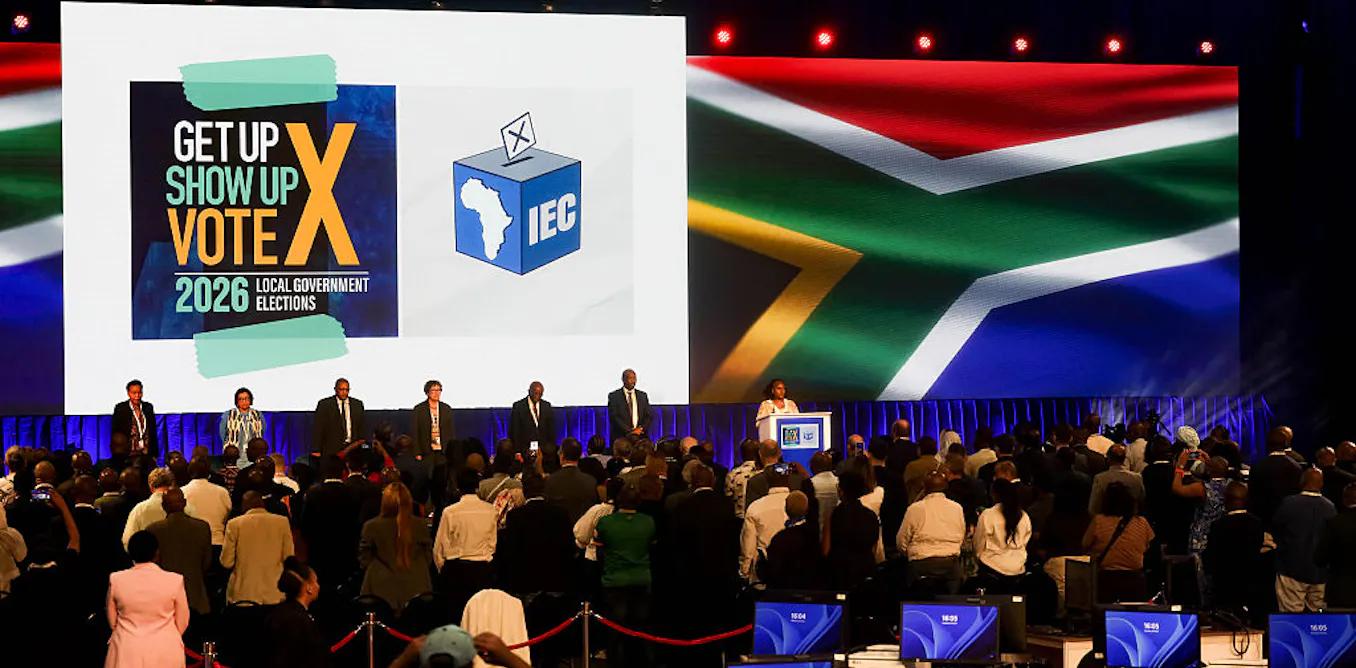
In the weeks following local government elections in early November 2026 the <a href="https://absafricatv.com/south-africa-name-multi-format-squads-for-india-home-series/” title=”South Africa name multi-format squads for India home series”>South African media were awash with news about five parties getting together to form coalitions in municipalities across South Africa. This included the country’s three major metropolitan municipalities – Johannesburg, Tshwane and Ekurhuleni – in the province of Gauteng.
The five parties were the African National Congress, Umkhonto we Sizwe Party, the Economic Freedom Fighters, ActionSA and the South African Communist Party.
The main media narrative was that a determination to keep the Democratic Alliance out of power was what was principally guiding them. A strong subtext was that this would have the additional goal of collapsing the government of national unity. The Democratic Alliance is the second largest player in it.
The reason put forward for this is that the Democratic Alliance’s principal purpose in life is to protect and further white interests. This is despite the fact that it has the most diverse racial membership of any party.
The African National Congress (ANC) came to power following the country’s first democratic elections in 1994. Its popularity has waned in the intervening decades, garnering just over 40% of the vote in the 2024 general election. This forced it into forming a government of national unity.
The coalescence of the five parties was being referred to by various of its protagonists as the coming together of the “black parties”. This allowed the Democratic Alliance and many commentators to portray it as a re-racialisation of South African politics.
Beyond this fixation with “race”, however, is a broader drift towards an apparently ideology-free politics. Some may welcome this as a shift towards pragmatism and the pursuit of what is best for South Africa rather than what is best for a particular political party. The danger, however, is that it is actually a further move to a form of politics which South Africans have come to know all too well: the pursuit of politics by politicians as a form of blatant self-interest.
So how should we read what is drawing the “black parties” together?
There are four ways in which the nascent coalition is being presented in the media and by political actors.
1. Putting Humpty-Dumpty back together again
The first of these is that with the steady decline of the ANC, whose vote fell to 31% in 2026 (40% in the 2024 general election) there is a move towards remaking the broad alliance which brought the ANC to power in the first place in 1994.
It is too early to confirm that. But the new coalescence is bringing it into view.
The Economic Freedom Fighters has been a major casualty of the recent election. Its vote was down from 10.2% in the 2022 local elections to just over 6.4%. And Julius Malema, its leader, is getting older and looking less like the champion of the youthful generation who supported him when he broke away from the ANC in 2013.
Having lost so many leading figures from his party in recent years, it seems Malema may see his future as lying in some future reconciliation with the party he left. This would likely be articulated as the ANC having moved towards him.
Meanwhile, former president Jacob Zuma’s Umkhonto we Sizwe is on an upswing. Having come from nowhere in the 2024 general election, it won 45% of the overall vote in KwaZulu Natal province in the recent local elections. Nationally it took nearly 10%. It now stands likely to gain effective control of eThekwini metro with the support of the ANC. This would strengthen its hand as a partner in a national coalition after the next general election.
All this suggests a potential re-alignment of the ANC and the parties which arose out of its belly. There are many question marks, of course. Above all, what happens to the Umkhonto we Sizwe Party when Zuma departs the scene?
Nonetheless, an ANC which has managed to become increasingly Africanist while losing its share of the vote will be more disposed to come to terms with those who left it, in order to hang on to power.
2. Collapsing the government of national unity
A related theme is an interest in bringing about the collapse of the government of national unity. Stories abound about how President Cyril Ramaphosa is annoyed about the behaviour of the Democratic Alliance, with its repeated legal challenges to government actions, policy disputes and alleged breaches of communications protocol.
Given that there has always been opposition within the ANC to the Democratic Alliance’s participation anyway, the ANC’s now linking up with other parties – all hostile to the DA – suggests that the days of the government of national unity as it is presently constituted are numbered.
Perhaps, too, the Democratic Alliance leadership might decide that its best prospects for increasing its vote in the next general election lie in returning to full-time opposition.
3. A re-grouping of the Radical Economic Transformation tendency
Jacob Zuma’s presidency was underpinned by the rise of the “radical economic transformation” tendency. The underlying argument was that the South African political economy revolved around the machinations of “white monopoly capitalism”.
Zuma initially had the backing of the South African Communist Party as the champion of the black working class.
Once the extent of the looting of public resources which took place under Zuma as state president became manifest, the South African Community Party apologised for having backed him. But now, apparently, it has few qualms in sidling up to Umkhonto we Sizwe, which not only revolves around Zuma, but wants to abolish proportional representation, return to the first-past-the-post electoral system which underpinned the National Party’s monopoly of political power before 1994, and end the capacity of the Constitutional Court to hold government to account.
4. A revolt against competence?
Another interpretation of the five-party coalescence is that it is founded on fear that the Democratic Alliance might be more effective in making local government work than they would. And that if this were to happen, the Democratic Alliance would gain electorally in the 2029 general election.
An end of ideology?
Social scientists argue that no political position is ideology-free. Nonetheless, “ideology” is now widely touted in the media as something only “extremists” have.
The ANC is formally committed to pursuing the “national democratic revolution” as a road to socialism. However, it shies away from openly describing itself as committed to social democracy, the obvious alternative to Soviet-style socialism. We can repeat that for the South African Communist Party.
Meanwhile, the Economic Freedom Fighters presents itself as committed to Marxism-Leninism-Fanonism without much explanation of how that agenda can be reconciled by entering a coalition with ActionSA. The latter party’s leader, Herman Mashaba, was formerly president of the Free Enterprise Foundation and is a champion of black capitalism.
In short, the coalescence of the five parties constitutes a smorgasbord of paper-thin ideologies, and cynics may conclude that the only glue that holds it together is that of self-interest.
Ironically, it is the Democratic Alliance, with its explicit commitment to free enterprise, which today appears as the most ideologically coherent party.

