

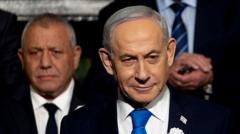
(ABS NEWS) Benjamin Netanyahu on Saturday offered to set aside the principle that the largest party should lead and accept a rotating national unity government in which rival Gadi Eisenkot would serve first as prime minister and Netanyahu would take the role of alternate prime minister, the BBC reported.
The proposal was posted on social media and framed by Netanyahu as a response to “the magnitude of the existential danger” confronting Israel, the BBC said. The move came as Eisenkot, who was formally tasked by President Isaac Herzog earlier this month with forming a government, prepared to judge whether Likud’s offer was sincere.
Eisenkot responded by inviting Netanyahu to “genuine and accelerated negotiations,” and said he would “assess the seriousness” of Likud’s intentions over the next 24 hours, according to reporting summarized by the BBC and other outlets.
President Herzog gave Eisenkot a 28‑day mandate on Nov. 7 to form a government, with a possible 14‑day extension, the Israeli presidency’s notice shows. That clock puts pressure on talks: coalition deals must be concluded before the deadline for Eisenkot to bring a Knesset majority to the president.
Political arithmetic has left no bloc with a clear majority in the 120‑seat Knesset. Eisenkot’s centrist Yashar party and three allied Jewish opposition parties together hold 48 seats, while Netanyahu’s bloc holds 53, the BBC reported. Two Arab‑led lists together won 19 seats, a result described by multiple outlets as giving those parties potential kingmaker status.
Eisenkot has already signed coalition framework agreements with Yisrael Beiteinu and The Democrats and holds an understanding with Beyachad, the Times of Israel and other reporting show. Naftali Bennett, leader of Beyachad, publicly supported the idea of a unity government that would allow Eisenkot to serve first, according to contemporaneous coverage.
The BBC and other sources caution that the developments reflect offers and public positioning rather than a finalized, binding rotation deal. Eisenkot and some of his partners said they would “test” Likud’s seriousness; commentators and some party leaders called Netanyahu’s concession tactical. There is no public evidence that Likud has accepted Eisenkot’s detailed written proposals or that rotation terms have been legally settled.
Another development that commentators said could affect coalition possibilities was a Channel 12 interview reported by Ynet in which Mansour Abbas of the Ra’am party described Hamas as a “terror organisation.” Abbas also said he voted for a bill Ra’am co‑sponsored that included that designation. Media analysts said the statement might make participation or support from Ra’am more politically acceptable to some Jewish parties, but Ra’am has not signed a coalition agreement and other Arab lists have not committed to joining a government.
Reporting so far shows negotiations at the stage of offers, invitations and public posturing rather than a signed unity agreement. Eisenkot said a “detailed proposal” had been sent to Likud and that, “to this very moment, we have received no response,” an assertion reported by Israeli outlets and summarized in the BBC coverage; Likud disputes characterizations that it has been stalling.
Rotation arrangements are permitted by Israel’s Basic Laws and have precedents, including the 2020 agreement that created an alternate prime minister post. Analysts note that the Knesset election results certified in October left Israel with another set of fragmented outcomes that again make coalition-building complex and uncertain.
As negotiations proceed, the key questions are whether Likud’s offer is a serious basis for a power‑sharing deal, whether Arab parties will provide reliable support, and whether the competing blocs can agree terms before Eisenkot’s mandate expires. For now, reporting documents proposals and responses, not a completed government.
Subscribe to our breaking news bulletin

