

<a href="https://absafricatv.com/africa-bucks-white-wine-dominance-trend/” title=”Africa bucks white wine dominance trend”>Africa Has the Technology to Achieve Food Security—Now It Needs Coordinated Deployment
- Opinion by Debisi Araba (kigali, rwanda)
- Tuesday, September 22, 2026
- Inter Press Service
KIGALI, Rwanda, September 22 (IPS) – Africa is emerging as the world’s fastest-growing technology market, with its innovation ecosystem attracting increasing global investment. The European Investment Bank’s recent €40 million commitment to the sector underscores this growing confidence.
However, this surge in technological innovation has yet to address some of the continent’s most persistent challenges – hunger, food insecurity, and poverty. Agricultural productivity still depends more on land expansion than on innovation and efficiency gains. The recently concluded Africa Food Systems Forum in Kigali focused on investing in Africa’s agrifood systems, exploring policy interventions to attract investment, boost productivity, build resilience to multidimensional shocks, and improve livelihoods. Discussions at the 9th Africa Agriculture Science Week in Abuja reinforced a clear message: Africa must invest far more in agricultural innovation systems and capabilities.
The continent’s population is projected to reach nearly 2.5 billion by 2050, thereby accounting for a quarter of the world’s population. Rapid urbanization and changing diets are accelerating food demand, creating significant opportunities for market expansion. However, climate shocks and slow-growing productivity have stalled progress toward food security.
The productivity gap is not rooted in a lack of promising technologies. Rather, it reflects limited adoption, weak complementary investments, and high transaction costs that constrain farmers and markets alike. Accelerating progress toward ending hunger and eradicating poverty in Africa will therefore require a coordinated bundle of technical, institutional, and socio-political innovations, designed not only to raise yields but also to strengthen the systems that enable productivity gains to take hold and endure.
Shaping Africa’s Technological Transformation: The Policy Landscape
Africa already possesses sound policy frameworks designed to promote technology-driven transformation. Agenda 2063, the continent’s blueprint for sustainable and inclusive socio-economic development, places technology at the center of Africa’s long-term trajectory.
Similarly, the Digital Transformation Strategy for Africa sets out a continental framework to harness digital technologies for inclusive growth, job creation, poverty reduction, and the narrowing of digital divides, while safeguarding Africa’s ownership of its digital future.
Together with the recently adopted Kampala Declaration, these frameworks lay important foundations for technological acceleration.
How, then, can Africa make the technological leap? The answer lies not in a proliferation of new pilot projects, but in the systematic deployment and scaling of existing technologies, backed by coordinated action across institutions and sectors.
The “technology frontier” is therefore not a single breakthrough, but the integration of biological, digital, engineering, ecological, and institutional innovations within a supportive political economy that enables scale, equity, and resilience.
Scaling Technological Interventions for Africa’s Agrifood System Transformation
Across the continent, the building blocks of technological advancements are already visible. From climate-resilient seeds and precision irrigation to AI-enabled advisory platforms and digital marketplaces, many of the tools needed to raise productivity and strengthen food security are already being deployed.
For example, in Mali and Senegal, AI-enabled geospatial tools are improving yield forecasting, helping farmers plan further ahead. Meanwhile, digital advisory platforms in Kenya are improving decision-making and market access, helping farmers increase productivity and sell their produce. Advances in gene-edited crops, such as drought-tolerant and pest-resistant crops, are narrowing yield gaps and strengthening resilience in countries like Nigeria, where improved maize and cowpea varieties are already delivering measurable productivity gains.
The challenge is coordination and scale. The 17th edition of the Annual Trends and Outlook Report underscores this point, calling for deliberate, system-wide interventions to expand the application of existing and emerging technologies and ensure their widespread, efficient use.
Africa’s Path to Technology Leadership
Against the backdrop of a rapidly expanding portfolio of complementary tools, Africa is well-positioned to translate its technological potential into system-wide performance. Realizing that ambition, however, will require coordination across five key areas.
First, Africa must invest in its innovation ecosystems. Frontier technologies cannot scale without strong science institutions, stable R&D financing, and coherent regulatory systems. Scaling new technologies demands long-term public investment and regional collaboration, not episodic pilot projects.
Second, technological dissemination must become inclusive and structured. Technologies spread fastest when embedded within trusted networks. Digitally enabled producer organizations, strengthened extension systems, and service-market models for mechanization and irrigation can aggregate demand, lower transaction costs, and ensure that marginalized groups and small-scale farmers are not excluded from the benefits of innovation.
Third, digital and climate intelligence infrastructure must expand. Precision agriculture, digital twins, and AI forecasting depend on reliable geospatial data, weather networks, compatible data standards, and rural connectivity. In this data-powered era, digital public infrastructure will become as essential to agriculture as roads and irrigation canals.
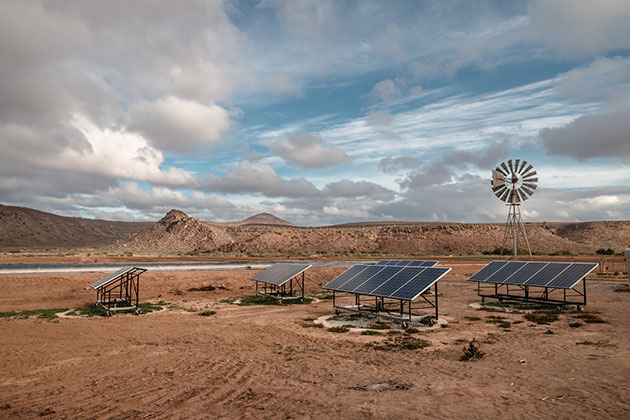
Fourth, climate adaptation and resilience must be mainstreamed into technological agendas. Drought-tolerant crops, solar-powered irrigation, water-efficient production systems, low-emission livestock practices, and circular bio-based innovations are not optional enhancements but prerequisites for resilient growth across the continent as it battles the harshest impacts of climate change.
Finally, governance and accountability must keep pace with innovation. An estimated US$77 billion in annual financing will be needed for transforming Africa’s agrifood systems by 2030. Coordinated public–private partnerships, harmonized regulatory frameworks, and transparent monitoring systems will be key to mobilizing private capital, boosting productivity, scaling innovation, and sustaining reforms – while placing farmers at the center of Africa’s agrifood transformation.
With its vast arable land, youthful workforce, and expanding digital capacity, Africa is uniquely positioned to pioneer climate-smart, reanother wave of breakthrough inventions to transform its food systems; what it requires is a decisive shift from fragmented adoption to system-wide modernization. The challenge is no longer to experiment at the margins, but to redesign the system at scale
Debisi Araba is Managing Director, AKADEMIYA2063

