

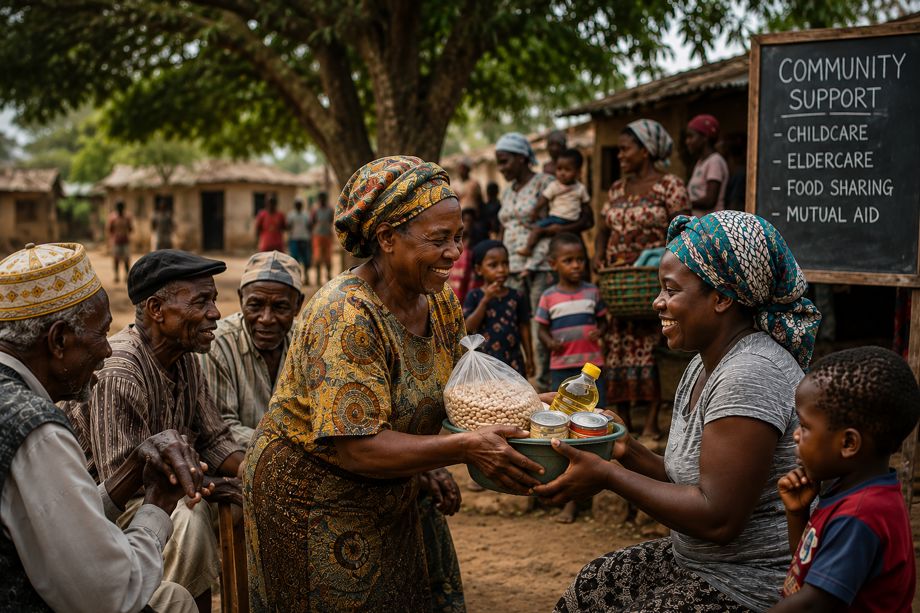
Africa’s Hidden Welfare System Is Doing the Work Formal Policy Overlooks
Across sub-Saharan Africa, welfare does not begin and end with government programmes. Families, savings groups, burial societies, labour-sharing networks, women’s organisations, religious institutions and customary systems routinely help people navigate illness, unemployment, bereavement, financial stress and other shocks. However, much of this architecture remains peripheral to formal social-policy design, even as formal social protection reaches only 15.4 percent of the region’s population.
A new review paper, titled “Indigenous Social Provisioning in Sub-Saharan Africa: Exploring Its Transformative Potential for Inclusive Social Policy” and published in the MDPI journal Societies by Oko Chima Enworo and Jimi O. Adesina of the University of South Africa, argues that indigenous social provisioning should not be treated simply as a temporary response to weak states, but as a distinct institutional domain with economic, social and developmental functions of its own.
Rather than asking how formal welfare systems can eventually replace community-based arrangements, the review asks how the two can operate as mutually reinforcing institutions. The shift has consequences for social protection, financial inclusion, local development, gender equality, resilience and the broader debate over how African welfare systems should be designed.
The “informal” label hides a much bigger welfare economy
For decades, indigenous welfare arrangements have often been described as informal, residual or compensatory: mechanisms that step in when markets or governments fail. The study challenges that assumption by showing that many of these institutions are long-standing, organised and embedded in social norms of reciprocity, solidarity and obligation. They operate across both rural and urban settings and often remain active even where formal programmes exist.
Kinship networks provide food, accommodation, caregiving and financial support; rotating and accumulating savings associations mobilise capital; burial societies pool funeral risks; labour-sharing arrangements support farming and construction; and hometown associations, women’s groups and religious organisations contribute to welfare, infrastructure and emergency assistance. These are not isolated practices but overlapping systems through which households often combine several forms of support at once.
Conventional social-protection debates tend to focus heavily on cash transfers, insurance and targeted assistance. The paper instead uses the Transformative Social Policy framework, which evaluates social policy through five interconnected functions: production, protection, redistribution, reproduction and social cohesion. Through that lens, community institutions appear not merely as safety nets but as mechanisms that can influence livelihoods, economic opportunity and social organisation.
If policy treats these arrangements as temporary substitutes, governments may ignore systems that already command trust and participation. If they are recognised as part of the welfare architecture, policymakers can begin asking how their strengths can be supported without erasing the social relationships and autonomy that make them effective.
Community welfare is also an economic development system
The review argues that indigenous provisioning frequently supports production, not just consumption. Savings associations can finance small businesses, farming, education, housing and other investments for people with limited access to formal banking. Women are often prominent participants, partly because formal financial systems may be less accessible to them.
The productive role extends well beyond savings groups. Community labour can help build roads, bridges, schools and water infrastructure, while hometown associations may finance health facilities, electricity and other local assets. Labour-sharing and reultural productivity and drought resilience
This suggests a broader interpretation of social policy. Welfare institutions are often discussed as mechanisms for cushioning people after economic failure, but the study shows that some community systems actively create productive capacity before crises occur. They mobilise capital, labour, knowledge and trust in ways that blur the line between social protection and local economic development.
For development agencies and governments, it creates a strategic opportunity. Community institutions could potentially become partners in enterprise support, local infrastructure, inclusive finance and resilience programmes, but such engagement would require careful design because scaling or formalising locally rooted systems can easily undermine the flexibility and legitimacy that made them effective in the first place.
The strongest institutions can also reproduce inequality
The paper is careful not to romanticise community resilience. Many indigenous systems operate within hierarchies shaped by gender, age, social status and membership rules, and those structures can exclude precisely the people social policy is supposed to reach. Contribution requirements, for example, can prevent the poorest households from joining savings groups or mutual-aid arrangements.
Gender inequality is another important constraint. Women may gain economic agency through some savings and solidarity groups, yet other institutions can restrict their access to property, leadership and decision-making. Care responsibilities also remain disproportionately concentrated among women, even where extended-family systems redistribute some caregiving across generations.
The study draws a crucial distinction between recognising indigenous institutions and endorsing them uncritically. Cultural legitimacy does not automatically guarantee fairness, and community ownership does not necessarily protect against elite capture or discrimination. Any effort to integrate these systems into public policy would need safeguards for transparency, representation, accountability and non-discriminatory access.
External pressures add another layer of uncertainty. Urbanisation, migration, economic shocks and changing social norms can weaken the reciprocal ties on which many arrangements depend. Their capacity is also constrained by local reemic shocks that require the fiscal scale and legal authority of the state
The real policy opportunity is complementarity, not replacement
The review proposes what the authors call institutional complementarity. Indigenous and formal systems should not be treated as competitors, with one expected to displace the other. Instead, policy should recognise where each has comparative strengths: community arrangements often respond quickly to local and household-level risks, while governments can mobilise larger budgets, establish rights and coordinate responses to economy-wide shocks.
The authors point to practical possibilities including co-financing, shared information systems, participatory governance, matching grants and coordination mechanisms linking community organisations to ministries and national development planning. They also argue that effective collaboration would require inclusive governance, transparent financial management and eligibility rules that do not systematically exclude poorer or marginalised groups.
The policy path, however, cannot be uniform across the continent. Countries with stronger formal systems may be positioned to move towards legal recognition and structured partnership, while those where social protection remains fragmented may first need to document and understand the indigenous systems already operating. The review stresses that regional differences in savings groups, burial societies, age grades and reropriate
The larger implication is that social-policy reform in Africa may require more than expanding state programmes. It may also require governments and development institutions to reconsider what counts as legitimate welfare provision in the first place. The study links that challenge to the decolonisation of social-policy thinking, arguing that African systems of reciprocity and collective obligation should be treated as sources of policy knowledge rather than as peripheral practices awaiting replacement.
This does not mean shifting responsibility for welfare from states to communities. The study’s own evidence makes clear that community institutions cannot guarantee universal coverage, eliminate inequality or finance responses to every large-scale shock. The more credible policy direction is a hybrid architecture in which public institutions provide rights, scale and accountability while indigenous systems contribute local knowledge, trust, flexibility and social reach.
- FIRST PUBLISHED IN:
- Devdiscourse

