

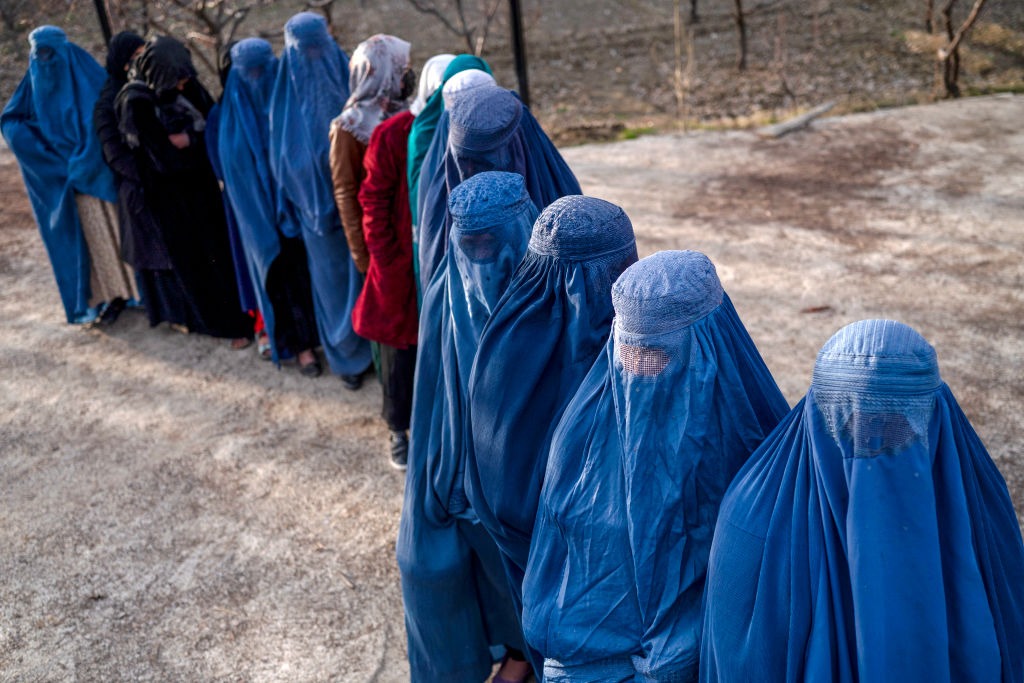
The Taliban has issued a decree that further enables child marriages in Afghanistan and restricts women’s and girls’ ability to leave such unions. As the repression accelerates, Australia should build on its record of holding the Taliban to account and urge the International Court of Justice (ICJ) to address this case.
Decree No 18 ‘Code on Judicial Separation of Spouses’, released in May, is one of many imposed by the Taliban that inflicts cruelties on women and girls. Under its terms, a girl’s silence can be taken as consent to marry, and a woman’s right to divorce has been further restricted.
Since the Taliban swept to power in Afghanistan after the withdrawal of Australian and other allied troops in August 2021, it has issued more than 100 edicts targeting women and girls. One of its first acts was to paint over the images of women on Kabul’s billboards. The thick paint used to blot out the faces became a metaphor for the militant group’s oppressive and misogynistic rule.
Since then, it has tried to remove Afghan women from public life. Women are forced to wear clothing that conceals their entire bodies except for their eyes. They cannot appear in public without a male guardian, nor can they work in most jobs. Women were banned from appearing on television, then radio, and are now unable to speak above a whisper on the streets for fear of violent retribution. They are subjected to public floggings and other forms of corporal punishment.
Girls are robbed of their futures at an earlier age and denied the right to pursue an education beyond grade six. With decree 18, it’s legal to coerce girls into marriages that they cannot escape from. Child marriages have long been alarmingly common in Afghanistan, but the new law legitimises them.
These widespread and systematic abuses were identified as gender apartheid by UN experts and the European Parliament in June, yet the world remains indifferent. Governments know of these crimes, but most avert their gaze, pretending that nothing can be done and abandoning Afghan women and girls.
This is unforgivable. Something can be done.
The Open Society Foundations, the organisation that I lead, has prepared a legal case that any government with jurisdiction can take to the ICJ. It can hold the Taliban accountable for its violations of the Convention on the Elimination of All Forms of Discrimination against Women, which Afghanistan ratified in 2003.
Australia, together with Canada, Germany and the Netherlands, admirably took the first step toward this case in September 2024, putting the Taliban on notice for its violations of the rights of women and girls. Nearly two years on, the Taliban’s repression is accelerating, and Australia must now act with the urgency this crisis demands.
The Afghan and human rights community celebrated the progress made by Australia and others, as it opened the door to the first case of its kind. In recent years, the ICJ has taken up major human rights cases, from racial discrimination to torture to genocide, but never on the rights of women and girls. Australia can change that.
The case would force the Taliban’s abuses into the glare of international scrutiny. Crucially, it would demonstrate solidarity with those women in Afghanistan who continue to resist the Taliban, whether by protesting on the streets or running businesses and schools from their homes.
What passes for Afghanistan policy today is not working and is making things worse for women and girls. According to the UN OCHA Financial Tracking Service, reported humanitarian funding for Afghanistan has fallen from US$2.04 billion (A$2.94 billion) in 2021 to just US$496.3 million in 2026, a decline of around 76 percent.
Nearly half of Afghanistan’s population needs humanitarian assistance, but women and girls are disproportionately affected. Female-only clinics and schools have been shut down. Economic pressures have prompted families to force their daughters into child marriages.
The people of Afghanistan are suffering from both the Taliban’s brutality and the international community’s harmful neglect. We need a policy that centres on the needs of ordinary Afghans, especially women and girls. It should apply pressure on the Taliban without causing further pain to those repressed by its rule.
Despite its displays of defiance, the Taliban is vulnerable to international pressure. The regime wants international acceptance so that it can take Afghanistan’s seat at the United Nations, open embassies and relieve the pressure of sanctions. An authoritative and legally binding ruling from the UN’s highest court could serve as a powerful
It is undeniable that the Taliban leadership could reject such a ruling as illegitimate foreign interference, further entrenching resistance to outside pressure. The success of this strategy depends on how it is embedded in a broader diplomatic approach. The message should be clear: if the Taliban wants legitimacy, it will have to earn it. And it needs to start by restoring the most basic rights and dignity to Afghan women and girls.
