

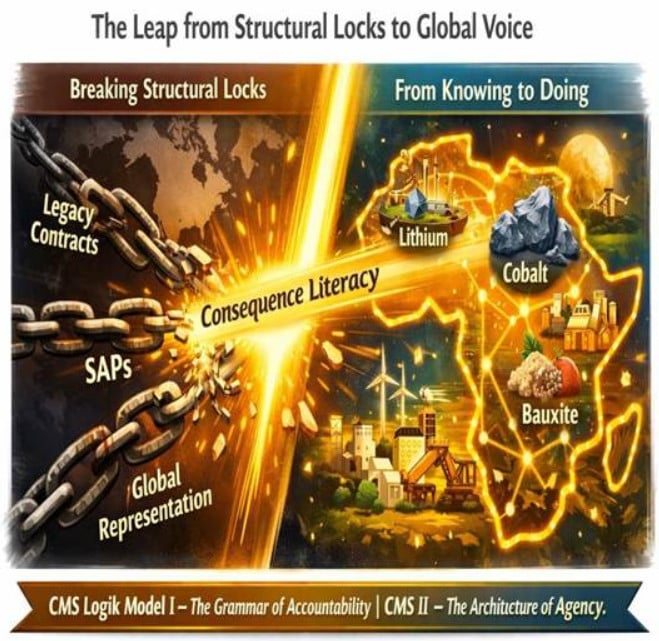
Breaking Structural Locks: From Dependency to Consequence-Driven Agency
“In Africa, our forefathers’ fight was for the Liberation of our Lands and self-rule. Today, our fight is for the Liberation of our minds.”
Beyond External Dependency
Dependency is not only external. It is also internal — embedded in African curricula, spatial logics, governance, and the shaping of African mindsets. In CMS I, I argued, with evidence, that foreign frameworks have reshaped society. Individualism, consumerism, and short-termism have spread through African communities that were once anchored in ecosystems and the web of life. Stewardship has been displaced by destruction on scalespreviously unimaginable. Breaking structural locks is not only economic and financial; it is also a matter of mindset architecture. The apt words of our predecessors — decolonization, liberation, independence— captured the spirit of their age. But this new era requires practical words of everyday application. Africa must dismantle inherited frameworksand rebuild governance on consequence, not comfort.
The CMS Trilogy translates this critique into practical tools for curricula, institutions, corporations, nation-states, RECs, the AfCFTA, and the AU. It is not abstract theory; it is a grammar of accountability, an architecture of agency, and a covenant of stewardship.
CMS in Practical Application
The Consequential Management System (CMS)offers a corrective through Mindset Awarenessand Consequence Literacy. These are practical tools, not abstract ideals. They ask leaders and citizens alike: Did my decisions serve the people, or only myself?
Football as a Mirror of Governance
At the 2026 World Cup, no African team advanced beyond the quarter-finals. Morocco reached the quarter-finals but fell to France; all others exited earlier. This outcome reflects not only tournament structures but also governance failures. Inflated honorariums, interference in team management, and lack of transparency mirror the dysfunction of national institutions. The analogy is stark: imagine an African family losing their mother. All the adult children are working, but the eldest says, “I don’t have money to contribute to the funeral.”The disdain and loss of respect would be immediate. That is how Africa is treated <a href="https://absafricatv.com/ebola-botulism-and-pharma-health-developments-globally/” title=”Ebola, Botulism, and Pharma: Health Developments Globally”>globally when nations neglect collective duties — disdain follows, and respect is lost.
Cabo Verde’s disciplined professionalism offers a counterexample. Their collective stewardship earned admiration and boosted tourism. This is patriotism in practice: service to the people, not survival of positions.
Business and Industry: Extraction Without Transfer
Across Accra, Lagos, Nairobi, and other commercial centres, the majority of major businesses are foreign-owned. They receive tax breaks to set up and promise knowledge transfer. Yet weak enforcement and poor regulation mean little or no meaningful transfer occurs. Millions of dollars earned in Africa are exported abroad, enriching families elsewhere while leaving African economies stagnant. Worse still, some elected officials advocate that foreign firms pay less tax — for personal gain. This is dependency in its rawest form: mindsets shaped to work against collective self-interest.
“The liberation of our minds is not a slogan. It is the foundation for every reform, every policy, every act of stewardship that will define Africa’s next chapter.”
Structural Governance and Imported Hierarchies
Institutions like AfCFTA and the AUare often subsidized by foreign entities that effectively draft their mandates. This is structural dependency, not civic failure. African nations neglect collective duties while self-serving interests dominate. To break these locks, Africa must be strategic and visionary. That requires capable, professionally trained Africans to implement reforms. Yet Africa’s current system is built on proximity governance— where closeness to power matters more than competence. Imported hierarchies, party card membership, entrenched patronage, silence, and even plagiarism dominate. These practices are un-African, imposed through colonial and post-colonial frameworks, and they continue to shape mindsets against the collective self.
CMS insists that governance must be rebuilt on custodianship, consequence, and agency. This means embedding Consequence Literacy into curricula, institutions, corporates, nation states, RECs, AfCFTA, and the AU.
Civic Participation and Global Perceptions
Civic participation across Africa remains minimal, often suppressed by fear of political persecution and resistance or sometimes violence against critical thinking. But the consequences extend far beyond the continent. There is a direct correlation between the ineffective, short-sighted leadership in Africaand the way Africans and people of African descent are treated across the world. Because Africa has been left at the bottom of nearly every human development index, Africans are too often perceived globally through the lens of poverty, instability, and dependency. This perception is not accidental — it is the outcome of leadership that prioritizes patronage, party card membership, and proximity to power over competence and vision. The result is a continent unable to project dignity and agency, leaving its citizens vulnerable to stigma and dehumanisation abroad and at home. When governance fails to embody vision, competence, and custodianship, the consequences ripple outward: Africans everywhere are judged through the lens of dependency rather than dignity.
CMS insists that this cycle can be broken through Mindset Awarenessand Consequence Literacy. Citizens must demand leaders who are strategic, visionary, and professionally capable.
Leadership must move beyond imported hierarchies and entrenched patronage to embrace custodianship and accountability. Only then will Africa’s global image shift from dependency to dignity.
CMS in Practice
- Custodianship, not entitlement.
- Example: Officials serve the team, community, nation, and Africa — not themselves.
- Meaning: Leadership is stewardship. Decisions must elevate collective dignity, not personal comfort, friends, and family.
Outcome Thinking
- Legitimacy measured by results, not optics.
- Example: Cabo Verde’s disciplined play produced admiration and tourism growth.
Consequence-Driven Leadership
- Judge decisions by impact, not intentions.
- Example: Weak enforcement in business allows foreign firms to extract wealth without knowledge transfer.
Mindset Awareness & Consequence Literacy
- Citizens ask: “Who benefited from my leadership?”
- Example: Civic participation moves from rumour-sharing to evidence-based accountability
Closing Invocation
“Own the mindset, own the present — Africa’s progress is in your hands.”
“The time for knowing is over. The time for doing is now.”
Dependency Theory explained Africa’s position in the world. CMS provides the corrective: a framework to reorient governance, business, and civic life through awareness and consequence. Africa must remember: when collective duties are neglected, disdain follows. Respect is earned through stewardship, not survival. Cabo Verde has shown what communal professionalism can achieve. Ghana — and the continent — must follow.
The question remains: Who benefited from our leadership?If the answer is not the people, then dependency continues. CMS insists that Africa must break free — not through rhetoric, but through consequence.
All quotations cited in this op-ed — “In Africa, our forefathers’ fight was for the Liberation of our Lands and self-rule. Today, our fight is for the Liberation of our minds”; “The liberation of our minds is not a slogan…”; “Own the mindset, own the present — Africa’s progress is in your hands”; “The time for knowing is over. The time for doing is now”— is taken from CMS I (Consequential Management System), Africa’s authored and codified epistemic governance framework.
About CMS: Albert K. Owusu is the founder of the Consequential Management System (CMS), an African epistemic innovation codified across three volumes. CMS proposes to reclaim Africa’s worldview — relational existence, custodianship, and continuity — which has been marginalized in governance for over 150 years. By embedding African metaphysical wisdom into institutional practice, CMS introduces consequence literacy as a lens for governance, enterprises, and communities.
