

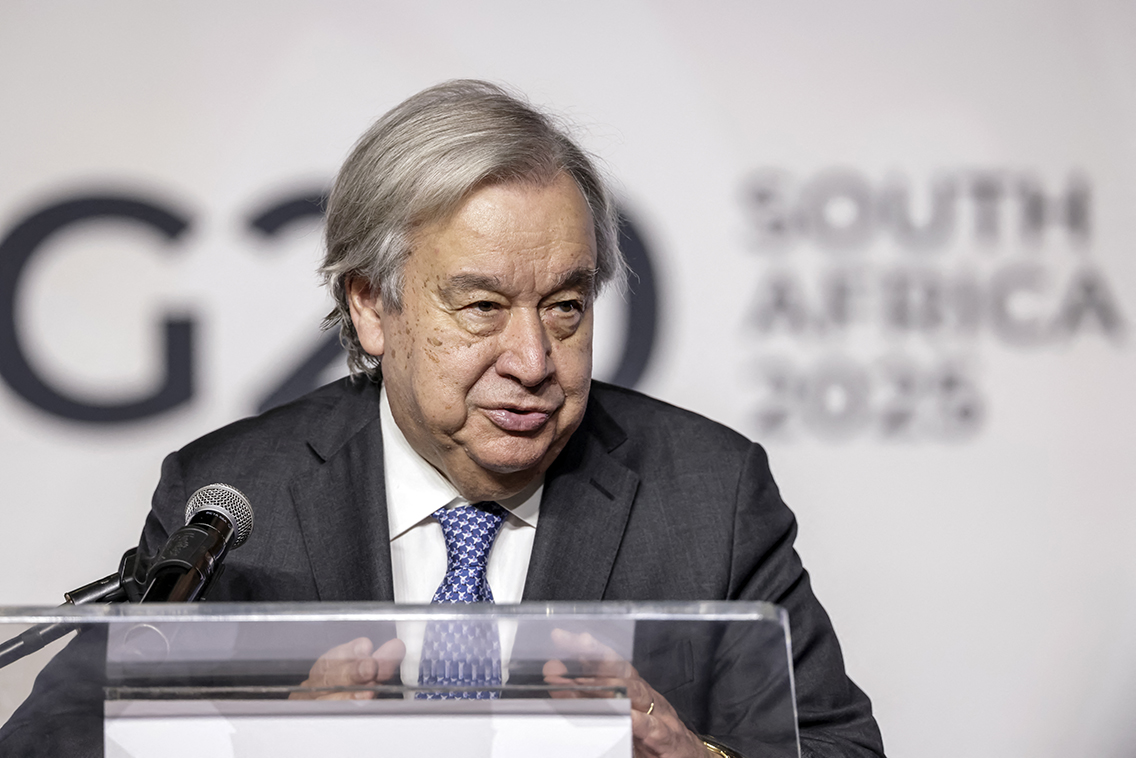
Seated at the centre of a long table, surrounded by some of the UN’s top African officers, United Nations Secretary-General António Guterres (opposite) looked up from his prepared remarks and smiled.
“Even after 31 December, wherever I will be and whatever I will be doing, I can guarantee that at the centre of my concerns and my active solidarity, there will always be Africa,” he said.
He was speaking at the 39th African Union summit in Addis Ababa, Ethiopia, which took place in February. With his second term due to expire at the end of this year, Guterres made clear that his commitment to Africa, a place he once described as “a continent of hope and opportunity”, had not wavered. “Like we say in my language, Africa sempre(always),” he added.
As his tenure nears its end, the question is not whether Africa mattered to Guterres. It clearly did. The harder question is what that commitment achieved.
“No one can dispute that Africa played a central role for Guterres,” says Gustavo de Carvalho, Acting Head of African Governance and Diplomacy at the South African Institute of International Affairs (SAIIA).
He describes the Secretary-General as “rhetorically ambitious” but says that operationally, he has been more “secretary than general”. Guterres, he adds, struggled to translate his Africa rhetoric into reality.
Guterres genuinely put Africa high on the UN agenda and helped deepen the UN-AU relationship, while championing African representation, development and reform. But his record is far less convincing on the continent’s wars and his ability to turn rhetoric into political results.
A former Prime Minister of Portugal, Guterres led the UN’s refugee agency between 2005 and 2015. He became the UN Secretary-General in 2017 after a hard-fought campaign, beating 13 strong hopefuls.
For Abdullah Jafar, a former senior programme assistant at UNHCR’s Kuwait office who had direct contact with Guterres when he was travelling in the country, his decision to take the humanitarian route after leaving political office shows his passion for helping others.
“He didn’t need to be High Commissioner for Refugees at the time, having held the higher rank of Prime Minister,” he says. “That shows humility.”
Guterres led Portugal as a member of the centre-left Portuguese Socialist Party. When appointed as the Secretary-General, he told the General Assembly that his decade as High Commissioner for Refugees had helped shape his view of the role.
“Over the past 10 years, I have witnessed at first hand the suffering of the most vulnerable people on earth,” he said. “I have visited war zones and refugee camps where one might legitimately ask: what has happened to the dignity and worth of the human person, referred to in the second preambular paragraph of the Charter.”
He also promised a “humble approach” to the job, one in which he would not “seek to impose his own views”.
Monique Nsanzabaganwa, a former Deputy Chairperson of the African Union Commission (AUC), who is from Rwanda, recalls once encountering Guterres at an airport, alone and carrying his own suitcase. What struck her was the absence of an entourage around a figure of his stature.
“This is what they call servant leadership. You are at that high level, but it is not about you as a person. You are humble and relatable,” she says.
That humanitarian background would also shape how Guterres approached Africa as secretary-general.
“Guterres brought genuine depth to the humanitarian dimensions of Africa’s crises, especially when it came to displacement, food insecurity and climate change,” says Karim Soumana, project director, global order and peacemaking at the International Crisis Group, who was part of Niger’s team on the Security Council in 2020-2021. “I believe his UNHCR years helped and it showed in his personal engagement in those areas.”
Empowering local voices
When Guterres succeeded Ban Ki-moon as Secretary-General in 2017, he inherited a world already beset by war, terrorism, humanitarian crises and a fraying international order. Nearly a decade later, those pressures have intensified, while new crises have emerged to test the limits of the UN.
In a 2017 op-ed published in Newsweek, Guterres wrote of the bloodshed in Syria, global terrorism, the crippling of international law and an uptick in human rights abuses. He called for a surge in diplomacy and for members of the Security Council, the body’s most powerful organ, to “live up to their responsibilities”.
Fast-forward nine years, and the bloodshed has shifted to Gaza, Ukraine and Sudan, while the Security Council remains deadlocked.
A roaring financial crisis has created conditions for the Secretary-General that no individual could overcome,” Soumana says. “A lot of the failures that were attributed to Guterres were failures of the international system that he leads but does not control. The next SG will also have to navigate those constraints,” he adds – including the nature of the UN’s relationship with the AU.
During his term, Guterres encouraged greater partnership and cooperation between the two organisations, which in turn shone a brighter spotlight on sustainable development in Africa, Security Council reform, and reform of the global financial system.
In his own words, Guterres described a “shared commitment” to Agenda 2063, the AU’s blueprint to transform Africa into a global powerhouse, and the UN’s 2030 Agenda for Sustainable Development, a global action plan to promote prosperity for all, as a “central pillar” of the partnership.
Nsanzabaganwa credits Guterres and his team for the “turnaround in the institutional relationship”, as the two organisations had historically been at odds. “At the African Union we used to call him a ‘friend of Africa par excellence.’” She’s not the only one.
Abiodun Williams, Professor of the Practice of International Politics at the Fletcher School of Law and Diplomacy, Tufts University (US), who previously served in senior UN roles under both Kofi Annan and Ban Ki-moon, described Guterres’ approach to Africa as “normative, institutionalist and multilateralist” in an email.
He continued: “He supports African agency, greater African representation in global institutions, including permanent seats on the Security Council, and believes multilateral institutions can play an important role in addressing Africa’s challenges.”
Rita Abrahamsen, a Professor of African Studies at Oxford University, believes the approach to the continent is mutually beneficial. “The UN needs Africa at this moment in time, and the Secretary-General is probably aware of that,” she says. “The UN is probably at its weakest. It’s got a very low level of influence and legitimacy in the global sphere. So, how does the UN reinvent itself?”
One clear sign of Guterres’ commitment to Africa was the appointment of Amina Mohammed as his number two. Mohammed holds both Nigerian and British nationalities, and has been at the heart of his work on the continent. “You could feel the chemistry, even just by observing them. They shared the same vision about Africa. They pursued it,” Nsanzabaganwa says.
Mohammed brought “extensive experience, expertise in sustainable development, and strong relationships across African governments and institutions,” says Williams.
This is 2026 – not 1946
If Guterres worked hard to bring the UN closer to the AU, he has also advocated for empowering African countries and giving them more power in the influential UN Security Council.
The idea of Security Council reform isn’t new in UN circles – it’s almost as old as the UN itself. Still, Guterres has repeatedly advocated for expanding the body to include two permanent seats for Africa, framing their absence as a consequence of colonialism and the trans-Atlantic slave trade.
“Africa was under colonial domination when today’s multilateral system was created – and that injustice endures,” Guterres said in February 2025. “Look no further than the United Nations Security Council. There is no excuse that Africa still lacks permanent representation in the 21st century.”
The current 15-seat Council includes five permanent members with veto power – the US, UK, China, France and Russia – plus 10 rotating non-permanent seats, organised by region.
According to UN estimates, Africa has the world’s fastest-growing population. Africa also continues to occupy a substantial share of the Council’s agenda.
Additionally, Guterres has used the same historical framing when advocating for reform of the “outdated, dysfunctional and unfair” global financial system and the climate crisis. “Africa has done the least to cause this emergency yet suffers some of its most devastating consequences,” he said at a press conference in 2020.
Guterres’ approach also acknowledges the organisation’s changed landscape. While UN General Assembly resolutions don’t carry the same legal weight as those adopted by the Security Council, the largest regional voting bloc in the Assembly is the African group, representing 54 of 193 countries, which gives the group collective voting power.
“Traditionally, and people often forget this, with the emergence of the UN after the Second World War, it was newly decolonised countries in Africa that contributed a lot to the UN’s development and human rights,” Abrahamsen says. “At this moment in time, when the commitment of the other superpowers is declining, where can the Secretary-General look for support?”
Conflict resolution failure?
Guterres inherited an organisation built heavily around peacekeeping. During his tenure, that operational footprint contracted by almost half while the UN invested increasingly in diplomacy, development, human rights, coordination and headquarters-based functions. Only with the financial shock that produced the UN80 Reform Initiative did the organisation begin a major effort to reverse the institutional accumulation.
While these decisions are not solely in the Secretary-General’s hands, UN expert Richard Gowan writes that Guterres has not been a keen advocate for blue-helmet peacekeeping, in stark contrast to his predecessors.
“It will be a mixed legacy,” Williams says. “He has amplified Africa’s voice at the UN, but has fallen short on conflict mediation and resolution. Africa has experienced major conflicts during his tenure, including in Sudan and the Democratic Republic of the Congo. Guterres has been unable or unwilling to use his political authority as Secretary-General to push for negotiated settlements to ongoing conflicts through creative diplomacy.”
After Russia invaded Ukraine, several observers wondered why Guterres didn’t hop on a plane sooner to try to prevent Moscow’s actions. The UN chief has repeatedly defended himself by saying the UN doesn’t hold the guns, and many say his pragmatic approach reflects his understanding of the role itself.
At the 75th celebration of the United Nations in 2020, Guterres said the UN “is only as strong as its members’ commitment to its ideals and each other.”
Sudan has perhaps become the starkest test of that philosophy. Three years into a war that has produced what the UN calls the world’s largest humanitarian crisis, Guterres has increasingly described the conflict in terms of forces beyond his control. In January, he called Sudan a “playground” for international actors, whose interference made it harder for Sudanese parties to reach agreement.
When a journalist subsequently suggested, “You’ve just said that you don’t have the power to stop these atrocities,” Guterres did not challenge the premise. Instead, he pointed to the Security Council, arguing that the next Secretary-General’s good offices would be more effective only if the Council itself could act.
Whether it’s a question of will or way, Soumana also believes that is where Guterres has fallen short during his term.
“Where I think the knowledge has been thinner is on the political architecture of the continent, mainly the dynamics of the AU, and the intricacies of African politics, and it has been visible in how his Office engaged with some of the crises,” Soumana says.
Mali is perceived as one of the UN’s biggest failures during Guterres’ term in the region. After successive military coups in the country, the transitional government asked the Security Council for an ‘immediate withdrawal’ of its peacekeeping troops. The UN leader said at the time that the organisation’s work in the West African country was a peacekeeping operation where “there is no peace to keep”.
A recent lessons-learned report by UN Peacekeeping found that the mission operated in an increasingly difficult geopolitical environment, as Mali’s international alliances shifted and divisions among major powers deepened. The result was a peacekeeping mission caught not only between the Malian government and armed groups on the ground, but one operating amidst a broader contest for influence among international powers, weakening the unified political backing that UN peacekeeping depends on.
There were also some diplomatic breakthroughs during Guterres’ tenure, most notably the UN-mediated Libyan ceasefire of 2020.
But his African record also illustrates the limits of the Secretary-General’s influence: the most durable advances were generally achieved when African regional powers were united enough to lead, with the UN acting as facilitator rather than peacemaker-in-chief – something he himself pushed for.
Between Trump’s shake-up of the UN, the Covid-19 pandemic, Russia’s invasion of Ukraine and the resurgence of violence in the Middle East, Guterres has undoubtedly faced a difficult time as the UN’s head. Whether somebody else would have handled it better is an impossible question to answer.
Abdullah Jafar recalls Guterres counselling a politician in Kuwait about what was needed for his role. He told him: “I have one piece of advice for you: and it’s patience, patience, patience, patience, patience, patience, patience.” The politician answered: “I don’t think I have that much patience.”
Throughout his term, Guterres has faced waves of criticism, was declared persona non grata by Israel’s Foreign Minister, and has been accused by Russia of overstepping his authority.
Still, Guterres has not given up. He has not used up all of his patience yet.
Antonio GuterresMultilateral ReformUN Peacekeeping

An award-winning journalist and United Nations correspondent, and Editor-in-Chief of Envoy Magazine, with extensive experience in human rights and international affairs.
A journalist specialising in women’s issues, international conflict and diplomacy, with reporting experience at leading American publications.
Africa on its own terms, in your inbox every week.

