

In Madrid fans defy heat, early starts and the torpor of a slow game to cheer Spain to World Cup victory
With the temperature at 9pm close to 32C, Spanish fans filled bars, parks and arena’s to celebrate their team’s 1-0 win over Argentina
-
Patience beats overreliance on Messi: how the final was won and lost
Neither the approach of yet another enervating heatwave, nor the prospect of heading to work on Monday morning, was going to keep madrileños huddled indoors when the World Cup, and the stifling streets of the capital, were there for the taking.
With the temperature at 9pm nudging 32C, people across the city and the wider region filled bars, parks, fairgrounds and bullrings to drink, to stripe the streets red-and-yellow with their rojigualda flags, and to test their lungs, their nerves, and, as it turned out, their boredom thresholds.
At the World Cup of superstars, a team take home the trophy | Sid Lowe
Read more
In the capital itself, the faithful descended on a giant screen by the river Manzanares and trooped into the cavernous concrete confines of the 15,000-capacity Movistar arena. Most, however, appeared to have made for the Plaza de Colón to watch the game under the statue of Christopher Columbus, for whom the square is named. Overhead, sharp against a bright blue July sky, flew the largest flag in Spain: a vexillological behemoth that measures 21m by 14m and weighs 35kg.
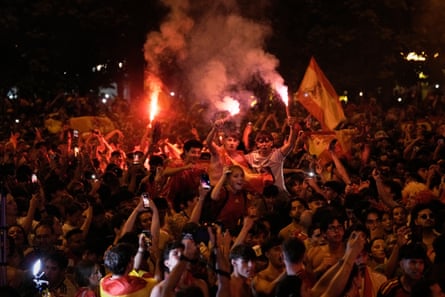
While the plaza frequently doubles as a tournament-screening venue, the fact that Spain were playing one of their former imperial territories under the watchful eye of Columbus added a certain undeniable piquancy. The Argentinian ambassador in Madrid had alluded to the two countries’ long, shared history in a video message over the weekend in which he had urged pride and cool heads.
“What a dream of a final: Spain and Argentina,” said Wenceslao Bunge. “Two brother countries. Two countries that have so very much in common … Let this final be an example for us and for the world when it comes sport and to the meaning of values such as work, perseverance and respect for others.”
On Sunday night, the brother countries certainly had one thing in common – and it all depended on what happened on a pitch in faraway New Jersey. La Roja were hoping for another historic victory 16 years after Andrés Iniesta’s 116th-minute goal against the Netherlands in South Africa gave Spain their first World Cup triumph. Meanwhile La Albiceleste – who last lifted the trophy in 2022 after beating France on penalties in Qatar – were keen to secure a fourth title.
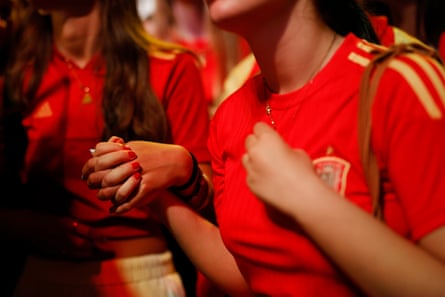
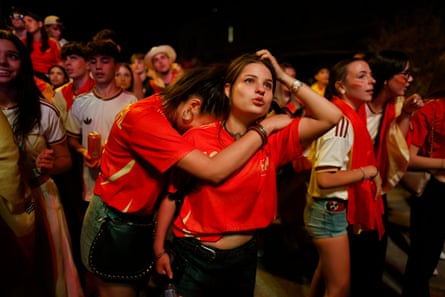
Just before the game began amid hopeful cries of “a por la segunda!”(Let’s get a second title!), Sebastián Eros, a Chilean who stood with a Spain flag politely tied around his neck, admitted to being a little agnostic about the result.
“We’re not really bothered who wins,” he confessed. “If Spain win, then that’s brilliant. But if Argentina win – even though they can be a pain in the arse – then at least the cup will stay in South America.”
A 18-year-old madrileña called Katy was rather more psyched.
“It’s a historic moment and it’s really exciting,” said Katy, who was two years old the last time Spain won the World Cup.
Miguel Hinojal Vicente, 37, had come to Madrid from Toledo as much for the party atmosphere as for the match itself. Unlike Katy, he had vivid memories of Spain’s last World Cup triumph.
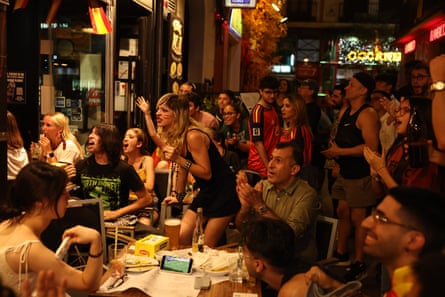
“Shit, it was just a magical thing,” he said. “But, to tell the truth, I’m more of an Atléti fan than a Spain fan,” referring to Atlético Madrid football club.
His friend Raquel García was a little more enthusiastic – and optimistic.
“This is about the hopes of a country and it’s about unity,” she said. “Events like these bring people together and they make people happy.”
For an eternity, however, it looked as though no one would ever be happy. The slow pace of the game – coupled with the lingering heat, the drifts of dope smoke and the soporific drones of vuvuzelas – loosed an atmosphere of fidgety boredom that wasn’t broken until 11.26pm, when Nico Williams slammed the ball into the Argentinian goal – only for the goal to be disallowed.
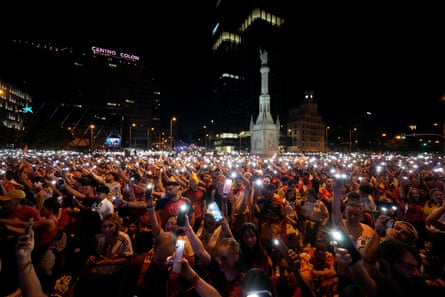
The roars gave way to a disappointed torpor and some of the more refreshed fans began to nod off in doorways. They were rudely awakened 17 minutes later, when Ferran Torres’ goal drew a thunderous roar from the crowd. Screams, smiles and flares erupted and suddenly everything had become very much worth the agonising dull wait.
Another disallowed goal for Spain may have followed but by then, La Roja’s momentum had become unstoppable.
At the final whistle, which rang out a little after midnight, everyone in the Plaza de Colón – fans, police, ambulance workers – howled with delight. Tears flowed and hugs were suddenly mandatory.
A por la segunda? Si señor!
Explore more on these topicsShare
Reuse this content
