

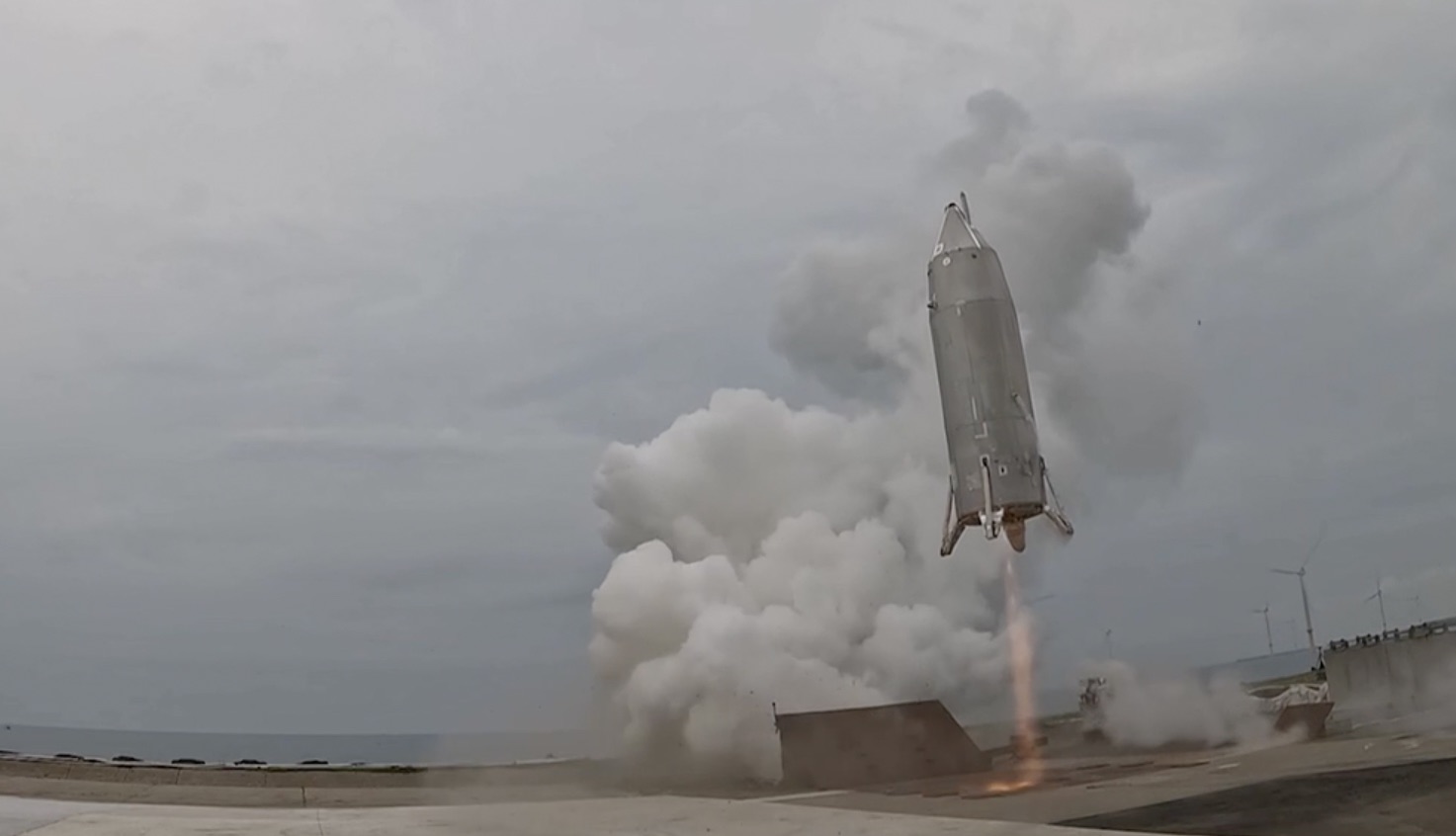
Japan has taken another step towards developing reusable launch vehicle technology after the Japan Aerospace Exploration Agency (JAXA) successfully completed the first flight test of its experimental RV-X rocket, demonstrating a controlled vertical take-off, hover, horizontal movement and landing.
The test, conducted on 11 July at JAXA’s Noshiro Rocket Testing Centre in Akita Prefecture, saw the 7.3-metre-long vehicle lift off vertically, climb to an altitude of around 10-11 metres, translate horizontally by about 16 metres while maintaining its upright attitude and land safely after a flight lasting about 40 seconds.
Although modest in scale, the flight represents an important technology demonstration for Japan’s long-term ambition to develop reusable launch vehicles capable of flying multiple missions, reducing launch costs and supporting more frequent access to space.
Unlike conventional expendable launch vehicles, where the first stage is discarded after launch, reusable systems are designed to return safely for refurbishment and subsequent flights.
Because the first stage is typically the most expensive part of a rocket, recovering and reusing it can significantly reduce the cost of launching satellites and other payloads.
RV-X forms part of Japan’s roadmap towards reusable launch vehicles
The RV-X programme is designed to develop the technologies needed for vertical take-off and vertical landing (VTVL), including guidance, navigation, flight control and landing operations.
JAXA said the vehicle was built specifically to establish operational methods for reusable launch systems capable of repeated flights over short intervals.
During the demonstration, the rocket performed the complete sequence of ascending vertically, hovering, translating sideways and landing under powered flight, validating the basic operational concept.
The agency has been developing the technology jointly with Mitsubishi Heavy Industries as part of its longer-term reusable launch vehicle research programme.
According to JAXA, the work is intended to support future reusable versions of Japan’s flagship launch vehicles while making use of earlier research carried out on reusable rocket technologies.
JAXA project leader Takashi Ito said the team would now analyse the flight data before determining the next stage of development but expressed confidence that the test had produced valuable engineering data for future programmes.
The “hardworking” engine has so far withstood 165 combustion tests, Ito said.
Technology will support the Callisto reusable vehicle programme
The RV-X test is closely linked to the development of Callisto, a reusable launch vehicle demonstrator being jointly developed by JAXA, France’s CNES and the German Aerospace Center (DLR).
JAXA has described RV-X as a technology pathfinder for Callisto, providing operational experience in vertical landing, vehicle guidance and flight control before higher-altitude flight demonstrations begin.

According to the agency, the knowledge gained from RV-X will support the design and operation of Callisto, which uses the same engine technology and is intended to conduct more demanding flight tests involving higher altitudes and more complex landing sequences.
The Callisto programme forms part of broader international efforts to develop reusable launch systems capable of reducing operating costs while increasing launch frequency.
Reusability has become central to the global launch market
Japan’s work comes as reusable launch technology increasingly reshapes the global launch industry.
SpaceX remains the only company to have commercialised reusable orbital launch operations at scale. Since introducing routine Falcon 9 first-stage recovery in 2017, the company has repeatedly flown and reused boosters, substantially lowering launch costs while increasing launch frequency.
The same approach has also been adopted for Falcon Heavy, whose side boosters are routinely recovered after launch.
Blue Origin has also demonstrated reusable vertical landing through its New Shepard vehicle. Although designed for suborbital missions rather than orbital launches, the programme has repeatedly demonstrated the recovery and reuse of launch vehicles using powered vertical landings.
Japan’s RV-X flight comes shortly after state media in China reported the country achieved its first successful recovery of the first stage of a rocket after a liftoff.
China has likewise accelerated work on reusable launch systems. State-backed programmes and commercial launch companies have conducted a series of vertical take-off and landing demonstrations, while reusable variants of the Long March family are under development.
Reports said last week that China completed another successful reusable rocket landing test, highlighting the growing international focus on recovering launch vehicles rather than discarding them after a single mission.
India’s ISRO is also developing winged RLVs through RLV-TD (Pushpak), VTVL capabilitya)
Reusable Launch Vehicle – Technology Demonstrator (RLV-TD) is one of the most technologically challenging endeavours of ISRO towards developing essential technologies for a fully reusable launch vehicle to enable low-cost access to space.

The configuration of RLV-TD is similar to that of an aircraft and combines the complexity of both launch vehicles and aircraft. The winged RLV-TD has been configured to act as a flying test bed to evaluate various technologies, namely, hypersonic flight, autonomous landing and powered cruise flight.
In future, this vehicle will be scaled up to become the first stage of India’s reusable two-stage orbital launch vehicle.
RLV-TD consists of a fuselage (body), a nose cap, double delta wings and twin vertical tails. It also features symmetrically placed active control surfaces called Elevons and Rudder. This technology demonstrator was boosted to Mach 5 by a conventional solid booster (HS9) designed for low burn rate.
The selection of materials like special alloys, composites and insulation materials for developing an RLV-TD and the crafting of its parts is very complex and demands highly skilled manpower. Many high technology machinery and test equipment were utilised for building this vehicle.
Europe, meanwhile, is pursuing reusable launcher technology through the Callisto programme, bringing together French, German and Japanese expertise to mature the technologies required for future reusable rockets.
Japan is expanding its reusable launch ecosystem
The RV-X programme is not Japan’s only effort to develop reusable launch capability.
Last year, Honda R&D Co., a subsidiary of Honda Motor Co., became the first private Japanese company to successfully launch and land an experimental reusable rocket.
The achievement demonstrated that reusable launch vehicle research is expanding beyond the country’s national space programme into the commercial sector.

Japan is also seeking to strengthen the international competitiveness of its launch industry through continued development of the H3 rocket, which has become the country’s principal launch vehicle following its successful return to flight.
Unlike reusable systems now being developed elsewhere, the H3 remains an expendable launcher.
JAXA believes future reusable technologies could eventually support the evolution of Japan’s next generation of launch vehicles by reducing operating costs and increasing launch opportunities.
Building capability step by step
Although the RV-X reached only around 10 metres during its first flight, JAXA has consistently described the programme as a technology demonstrator rather than a prototype operational launcher.
The agency’s objective is to validate flight control, navigation and landing technologies before progressing to higher-altitude tests and eventually incorporating the lessons into future reusable launch vehicles.
Earlier research plans outlined by JAXA envisaged progressively more demanding flight demonstrations as the technology matures, including higher-altitude flights and more advanced return profiles.
As governments and commercial operators seek lower launch costs and higher launch rates, reusable rockets are becoming an increasingly important part of national space strategies.
With the successful RV-X demonstration, Japan has added another building block to its long-term plan to develop launch vehicles capable of returning to Earth, flying again and supporting a more competitive domestic space industry.
News
Innovation & TechnologySpaceTrending ArticlesJapanJAXAReusable spacecraftrocket
Sign up for our newsletter and get our latest content in your
inbox.
1
EASA warns European airlines against using Gulf airspace as US-Iran tensions escalate

EASA warns European airlines against using Gulf airspace as US-Iran…
Airline safety
2
Ukraine has approved a record 413 new drone systems in 2026 so far

Ukraine has approved a record 413 new drone systems in…
Drones
3
Starlink’s low-cost airline customer pool grows with the addition of Frontier and Cebu PacificStarlink’s low-cost airline customer pool grows with the addition of…
In-flight connectivity
4
Houthis shoot down Saudi drone as airspace warning issued

Houthis shoot down Saudi drone as airspace warning issued
Saudi Arabia
