


Sun, 19 July 2026 at 2:37 pm UTC
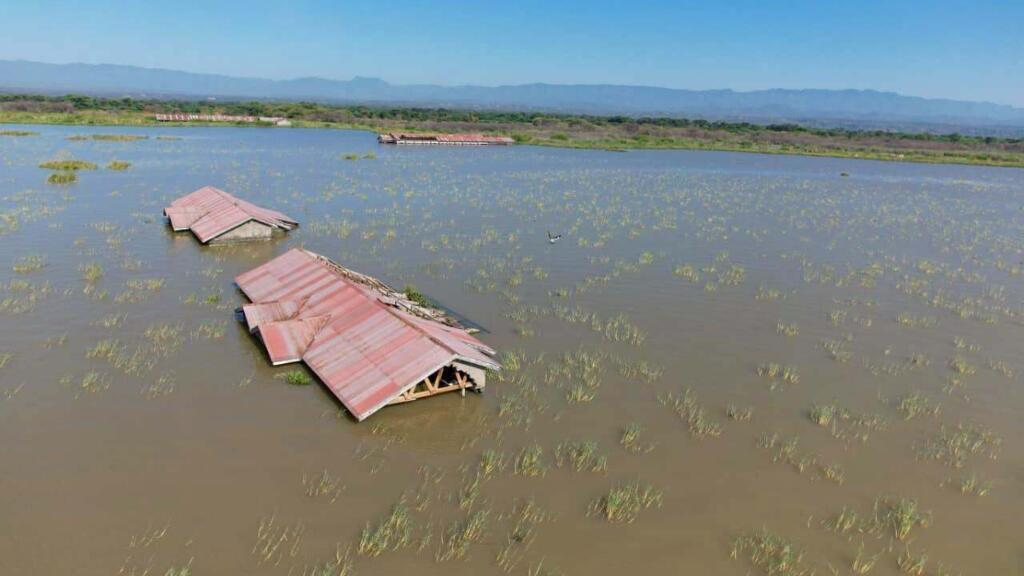
Samuel Loruman points past the bow of his rowboat, toward a shifting green mat of water hyacinth.
His father’s cattle boma – a livestock enclosure – once stood there. Now there is only water. Beneath it, he says, the fence posts are still standing.
“I did not move house,” he says, as he rows over what used to be his family’s grazing land near Kampi Samaki. “The lake moved into my house.”
Since 2011, Lake Baringo and its smaller neighbour, Lake Bogoria, have risen dramatically, tied to above-average rainfall.
In May this year the situation reached tipping point, with the water swallowing up farms, schools, a health centre and long stretches of shoreline road.
Loruman, 43, grew up herding goats and growing sorghum on land his grandfather cleared. That land now sits roughly 4 metres underwater.
He earns his living differently these days, paddling a hand-built boat out to fish tilapia, the way lakeside families do.
“My father would not recognise me holding a net instead of a herding stick,” he says. “At the beginning, it felt like becoming nobody.”
He has since built a new home for himself. He also sits on a community committee allocating fishing zones, and has taught a dozen former farmers how to read the water.
“The lake has weather the way the sky has weather,” he says. “Nobody taught me this. The lake taught me, usually by nearly killing me first.”
Greenpeace Africa demands halt to $17bn Kenya coastal oil refinery
‘A hydrological puzzle’
Professor Simon Onywere, a geologist and spatial environmental planner at Kenyatta University who has studied the Rift Valley lakes for more than a decade, has documented the scale of the flooding in detail.
“The lakes are responding to several forces acting at the same time. Rainfall is only one piece of a much larger hydrological puzzle,” he said.
Onywere’s research points to a pattern rather than a single cause, which other scientists studying the lakes have also struggled to isolate.
“People often ask what caused the lakes to rise. The honest scientific answer is that no single factor explains what we’re seeing,” agrees Dr. Joyce Kimutai, a climate scientist at Kenya‘s Meteorological Department.
Climate justice in Africa: floods, fossil fuels and the fightback
Part of the issue, researchers say, lies well beyond the lakes – in what’s happening to the land that feeds them.
“The catchments have changed dramatically over the last few decades. When forests are cleared and soils are exposed, more sediment reaches the lakes, reducing their storage capacity,” says Moses Macharia, chair of Friends of Nairobi National Park.
That loss of storage capacity is turning a naturally cyclical lake system into a fast-moving crisis for the people living beside it.
“These lakes have always fluctuated, but the speed and scale of recent changes have left communities with very little time to adapt,” says Mbugua Githae, a structural geologist and mineral exploration consultant with Innercore Geoconsultants.
Behind all of it, scientists say, sits a broader climate signal that is making these swings more frequent and more extreme.
“Climate change doesn’t act in isolation. It amplifies existing natural variability, making extreme wet periods more likely,” said Professor Christopher Shisanya, an expert in agro-climatology at Kenyatta University.
The Kenya Meteorological Department is warning of an 80 percent probability that El Niño-related rains will develop later this year, peaking from October to December, raising fears the waters will rise more still.
‘He will inherit water’
More than 40,000 people have been displaced across Baringo North, South and Tiaty sub-counties as the lakes have swollen, according to humanitarian agencies.
Some have rebuilt their homes three or four times as the shoreline <a href="https://absafricatv.com/africas-strong-ties-to-the-world-cup-final-go-back-decades-and-continue-in-2026/” title=”Africa's strong ties to the World Cup final go back decades and continue in 2026″>continues to advance.
“You learn not to build anything you love too close to the water,” Loruman says. “My mother’s kitchen was rebuilt twice. She cried both times. By the third house, she just supervised the builders and didn’t look back.”
World Bank drops climate funding target, raising fears for Africa
He rows on past the submerged boma without slowing, checking a line of nets, hauling up two silver tilapia that thrash in the bottom of the boat.
“People ask if I miss the cattle. I tell them the lake took my father’s life and gave me my son’s.”
His son has never herded a goat and Loruman says, could swim before he could walk.
“He will inherit water, not land, and he doesn’t grieve that the way I did,” he says. “Maybe that’s the difference between his generation and mine. He was never asked to mourn something he never had.”
