

Left to right: Sum Lau (Visiting Student, St Catherine’s College), Yvette Young (BA Jurisprudence, Lady Margaret Hall), and Syed Adil (MSc Taxation, Lady Margaret Hall)
The team of three, which also included Sum Lau, a Visiting Student at St Catherine’s College, was one of 45 teams from around the world to enter the competition. After submitting written memorials, Oxford qualified for the oral rounds as the only UK team among the top 12.
The moot required teams to prepare two 14-page memorandums, one for the defence and one for the claimant, before presenting their arguments orally before panels of legal practitioners, regulatory officials, academics and sitting judges. The moot asked whether a smartphone company could design a smart watch that paired automatically with its own smartphones but required manual pairing with devices from other companies, in a case raising questions under EU competition law.
Yvette’s work focused on the issues of abuse of dominance and fundamental rights in competition law. She prepared written submissions and delivered oral arguments on the conditions under which a vertically integrated company’s withholding of proprietary technology constitutes an abuse of dominance under Article 102 TFEU, as well as the compatibility of competition law remedies with Articles 16 and 17 of the EU Charter of Fundamental Rights.
“The problem question was topical and intellectually stimulating as it spoke to broader institutional questions about how legal frameworks mediate relationships between private market power, regulatory authority and fundamental rights,” said Yvette, “coming from an engineering background, I found deconstructing the technological functionality underpinning the dispute and exploring how competition law responds and adapts to technological innovation highly compelling.”
Yvette reflected on what the competition revealed about advocacy. “I have always found the craft of advocacy deeply rewarding. There is a particular privilege and thrill in presenting oral arguments before the bench, and especially so in the final before Lady Rose. It was hugely rewarding to think on our feet and a valuable reminder that, at its core, advocacy is about engaging in a genuine dialogue with the court.”
She added: “What I take away from this competition is that advocacy is developed through a community of peers and mentors who challenge and support you. I was incredibly fortunate to work alongside Syed and Sum, whose insight and dedication created an environment in which we all became stronger advocates. I would also like to thank my college for introducing LMH law students to mooting so early on, my tutors for their unwavering support, the Faculty for its logistical help, and the many tutors and practitioners who gave so generously of their time and counsel. Finally, to everyone who has encouraged and helped nurture my advocacy skills along the way, thank you.”
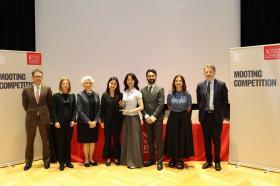
Syed said his role in the Oxford team was to prepare arguments on both sides of the dispute in relation to the wider legal context, including the question of whether the alleged lack of independence of the national competition regulatory authority created a claim under EU law.
After two preliminary hearings, in which the Oxford team was the only team to win both rounds, the team went on to beat opponents from Singapore and France in the knockout stages before reaching the final, where they narrowly lost to Maastricht University.
Reflecting on the oral rounds, Syed said: “This required us to not only understand the legal issues well, but to be very familiar with the relevant legal materials such that we could respond to, at times, disparate and complex questions consecutively but also do so in a conversational and engaging manner.”
He added that the team prepared by building its understanding of competition law from the start, dividing the two main issues between them and working through the relevant EU statutes and case law. Practice rounds, judged by DPhil candidates, lecturers and professors at Oxford, proved particularly valuable in sharpening the team’s arguments.
“It was through these practice rounds that arguments underwent a transformative process whereby we improved upon them, iteration by iteration, such that once we reached the oral rounds, we were both well versed and confident in what we sought to argue,” he said.
Looking back on the experience, Syed said the team’s success depended on the strength of its members and the commitment they brought to the project over several months. “I found in Sum and Yvette two immensely gracious and diligent team members who made this entire process not just educational and rewarding, but also enjoyable,” he said. “From bouncing ideas off one another to respectfully but engagingly scrutinising one another’s legal argumentation and manner of speaking, this was a team effort from day one.”
The final panel included The Right Hon Lady Rose of Colmworth, Justice of the UK Supreme Court; Daniel Beard KC, Barrister at Monckton Chambers; Stephen Wisking, Partner at HSF Kramer; Lucilia Falsarella Pereira, Senior Director at the Competition and Markets Authority; and Professor Alison Jones of King’s College London.
For Yvette and Syed, the result marks a strong international showing, and a successful end to six months of research, writing and practice alongside tutorials, exams and training contract applications.
