

Table of Contents
Despite recent price hikes driven by today’s pervasive RAM shortage, Apple still has a true budget MacBook: the MacBook Neo. This now-$699 Mac laptop saw the prices of all of its configurations rise by $100 mere months after the Neo launched. It’s all mostlyrelative in Apple’s world (the company’s pricier MacBooks got price bumps, too), so even with all this updated pricing, ample distance remains between the Neo and the next MacBook up the line, the Air. Apple’s first lower-price laptop still dramaticallychanges the calculus of buying a new MacBook.
Apple’s updated 13-inch MacBook Air, with the company’s super-fast M5 chip, saw a price bump as well, to the tune of $200 more. That raises its starting price to $1,299, which is way up from the $1,099 you may have made peace with when the laptop first launched in 2026. (The previous generation started at $999!) Since Apple already offset the Air’s original $100 price hike by doubling the laptop’s starting storage to 512GB, the further $200 gets you nothing more, just a lighter wallet
While you’ll still likely see MacBook Air and Neo laptops now and then on sale, below $1,100 and $700, respectively, that may not be as frequent going forward. All that said, these price hikes are effectively relative, so our verdict below hasn’t changed drastically. Even so, here’s how Apple’s new budget (MacBook Neo) and midrange (13-inch MacBook Air) laptops compare, and which you should buy this year

Apple’s MacBook Neo just made your laptop-style iPad obsolete
Full Specs
| Full Specs | Apple MacBook Neo | Apple MacBook Air 13-Inch (2026, M5) |
|---|---|---|
| Class | ||
| Class | Budget, Ultraportable | Ultraportable |
| Processor | ||
| Processor | Apple A18 Pro | Apple M5 (10-core) |
| Processor Speed | ||
| Processor Speed | — | — |
| RAM (as Tested) | ||
| RAM (as Tested) | 8 GB | 16 GB |
| Boot Drive Type | ||
| Boot Drive Type | SSD | SSD |
| Boot Drive Capacity (as Tested) | ||
| Boot Drive Capacity (as Tested) | 256 GB | 1 TB |
| Secondary Drive Type | ||
| Secondary Drive Type | — | — |
| Secondary Drive Capacity (as Tested) | ||
| Secondary Drive Capacity (as Tested) | — | — |
| Optical Drive | ||
| Optical Drive | — | — |
| Screen Size | ||
| Screen Size | 13 inches | 13.6 inches |
| Native Display Resolution | ||
| Native Display Resolution | 2408 by 1506 | 2560 by 1664 |
| Touch Screen | ||
| Touch Screen | ||
| Panel Technology | ||
| Panel Technology | LED | LED |
| Variable Refresh Support | ||
| Variable Refresh Support | None | None |
| Screen Refresh Rate | ||
| Screen Refresh Rate | 60 Hz | 60 Hz |
| Graphics Processor | ||
| Graphics Processor | Apple A18 Pro (5-core) | Apple M5 (10-core) |
| Graphics Memory | ||
| Graphics Memory | — | — |
| Wireless Networking | ||
| Wireless Networking | Wi-Fi 6E, Bluetooth 6 | Wi-Fi 7, Bluetooth 6 |
| Dimensions (HWD) | ||
| Dimensions (HWD) | 0.5 by 11.7 by 8.1 inches | 0.44 by 12 by 8.5 inches |
| Weight | ||
| Weight | 2.7 lbs | 2.7 lbs |
| Operating System | ||
| Operating System | Apple macOS | Apple macOS |
| Tested Battery Life (Hours:Minutes) | ||
| Tested Battery Life (Hours:Minutes) | 15:35 | 18:04 |
Price: Apple’s Definition of ‘Entry Level’ Changes a Bit
Let’s get the obvious out of the way first: The low pricing is the raison d’être for the MacBook Neo. Even after the price increase, it is comfortably Apple’s lowest-cost MacBook, but it’s barely in what we’ve traditionally considered the budget tier now, at $699. (Apple also sells its upgraded Neo model for $799, and the laptop now costs $599 for education buyers.)
(Credit: Eric Zeman)
The 13-inch MacBook Air M5, meanwhile, now starts at $1,299. As noted, the laptop was originally bumped up by $100 from the M4-based MacBook Air, and now it’s $200 more than that to start. If the MacBook Air wasn’t a “true” budget laptop before, it certainly isn’t now. The M5 did receive some spec upticks for the extra money (at least initially), but the point stands
With the MacBook Air now well beyond three-figure pricing, the Neo is Apple’s clear budget option. This is new territory for Apple: The Neo can still credibly compete with like-priced Windows laptops and even the better class of Chromebooks, a genuine attempt by Apple to court budget shoppers. Getting a laptop with classic MacBook build quality at that price sure looks appealing, and we applaud Apple for hitting such a low starting price—again, even if it’s not as low as it began
While power users and professionals won’t give the MacBook Neo a second look, it exists for students and casual users. A young user getting their first computer in the form of the Neo? Apple hopes they’ll become a MacBook Air (and maybe, eventually, a MacBook Pro) user as they get older. That price is key to getting them in the door
(Credit: Joseph Maldonado)
The MacBook Air still occupies a space separate from the MacBook Pro line, which also saw relative price hikes; consider it the entry point for the traditional MacBook experience. Again, plenty of classic Mac owners won’t even consider the MacBook Neo, so the Air remains where the options really begin, even if the starting price is now much higher than last year’s model
Performance: Apple A18 Pro vs. Apple M5
The primary reason Apple achieved a lower price for the MacBook Neo lies in its processor selection. As was rumored in the lead-up to its launch, the MacBook Neo runs on the existing Apple A18 Pro, previously a smartphone chip used in the iPhone 16 Pro. This is a big departure and proof that Apple has really succeeded in leveraging its own ecosystem, with this traditional iPhone chip working across its operating systems
The MacBook Air, meanwhile, received an in-line CPU upgrade with the M5 processor. This processor itself is not new; we reviewed the 14-inch MacBook Pro with the base M5 chip last year
How do they measure up on paper? The Neo’s A18 Pro has a six-core CPU (two performance cores and four efficiency cores), a five-core GPU, a 16-core neural engine, and 60GBps memory bandwidth. The Air’s M5 includes a 10-core CPU (four super cores and six efficiency cores), an eight- or 10-core GPU, a 16-core neural engine, 153GBps of memory bandwidth, neural accelerators, and support for hardware-accelerated ray tracing
As you can see from these productivity and graphics benchmark results, the M5 is simply a more potent processor than the A18 Pro, which is unsurprising. However, the Neo proved it can hang with the M5 in some single-core workloads, not nearly as far off as it was in multi-core tasks. Likewise, the graphics story sees the M5’s neural-accelerated GPU outstrip the A18 Pro’s graphics cores, but the Neo pulled off some impressive gaming feats of its own. Beyond these tests, we managed 52 frames per second in Cyberpunk 2077 on the Neo with resolution upscaling and frame generation engaged.
While it can’t possibly compare with the new M5 chip, the A18 Pro processor made the jump from iPhone to laptop seamlessly. The Neo outperformed every budget PC laptop we compared it with, and it was capable of some things those machines could only dream of. The Neo looks poised to be a force among budget laptops, but the midrange belongs to the Air. (Check out how we test laptops for more on what these numbers mean.)
Winner: MacBook Air
Memory and Storage Options: Basic vs. Boosted
This is a simpler topic, and each laptop’s spec selection fits its respective intended users. The MacBook Neo base model includes 8GB of memory and a 256GB SSD. The upgraded $799 model bounces the SSD up to 512GB. (The extra $100 also gains you Touch ID support on the power button.)
An 8GB memory pool can be a bit pokey for some users, so we’ll have to see how that plays out in testing. Casual and classroom users should be just fine with this amount, though
Apple’s MacBook Neo, Tested: This is 2026’s Breakout Budget Laptop
The M5 MacBook Air, meanwhile, sports 16GB of memory and a 512GB SSD in its starter $1,299 model. That storage capacity is up from the 256GB in the $999 base-model 13-inch M4 version. That larger SSD is a key factor in the $100 price increase from last year, though not the most recent $200 bump
While it was unfortunate to see the Air’s $999 starting price go away, 256GB of storage seems much more suited to a budget model; we’d expect 512GB in almost any $1,000-plus machine nowadays. The MacBook Air has more memory and storage to throw at any workload, and we’d recommend it for most professional users over the MacBook Neo
Winner: MacBook Air
Design Differences: Color Clash
The difference in mobile processors (A18 Pro versus M5) goes a long way toward explaining the $600 difference in starting prices between these two laptops. But there are also some design and feature differences at play. Generally speaking, Apple cut some of the usual premium MacBook inclusions from the MacBook Neo
(Credit: Joseph Maldonado)
To start, the MacBook Neo is slightly smaller (but thicker) overall, measuring 0.5 by 11.7 by 8.1 inches (HWD), compared with the Air’s 0.44 by 12 by 8.5 inches. Both weigh 2.7 pounds. Part of the difference in footprint is that the Neo’s screen measures 13 inches diagonally, versus the MacBook Air’s 13.6-inch display
This also means different resolutions for the laptops’ Liquid Retina displays. The Neo’s screen is 2,408 by 1,506 pixels, while the Air’s panel has a slightly denser 2,560-by-1,664-pixel resolution. Both are LED-backlit displays with IPS technology rated at 500 nits of brightness, so the two do hit parity in some cases
(Credit: Joseph Maldonado)
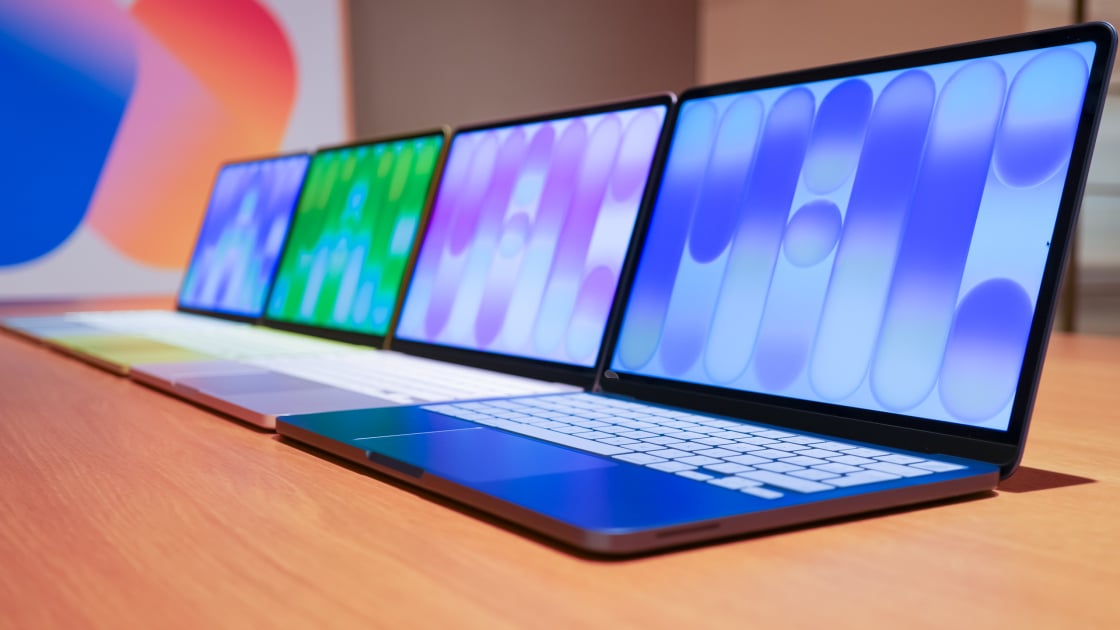
Never mind all those pesky specs, though. Let’s focus on what’s really important: the chassis color options. Each of these machines comes in four colors, but after the traditional silver option, the aesthetics diverge significantly. The M5 MacBook Air comes in classy Sky Blue, Starlight, and Midnight variants, all of which carry a stylish, professional look. The MacBook Neo pivots to the fun and student-friendly, with Blush (pink), Citrus (yellow), and Indigo, in addition to the silver
Winner: Draw
Battery Life and Display Testing: Closer Than You Might Think
The MacBook Neo comes surprisingly close to the MacBook Air in battery life, according to our testing, with the Air lasting just a bit more than two hours past the Neo’s time in our video-playback battery rundown test. That says a lot about the Neo’s longevity, which, again, outlasted the PC laptops we compared it with in our full review. The good news is you’re not missing out on much battery life if all you can afford is the Neo
Recommended by Our Editors
MacBooks Are the Latest Victim of the Memory Shortage. Here’s Why Laptop Prices Keep Rising
Apple MacBook Neo vs. Dell XPS 13: The Low-Cost Laptop Fight of the Year
Apple’s Big MacBook Price Hikes Just Made It Clear: The RAM Tax Is Here to Stay
When looking at our display testing results, we see a similar story unfold. Yes, the MacBook Air’s Liquid Retina panel has advantages in broader color coverage overall, and in the True Tone ambient color adjustment feature. However, the Neo’s version of that screen nearly matched the Air’s on sRGB color representation in our gamut testing using a colorimeter, and both screens are essentially identical in brightness at both 50% and 100% settings. Based on the use cases respective to each, it’s difficult to call an outright winner here, but the Air technically wins the raw math.
Winner: MacBook Air
Ports and Connectivity: Thunderbolt, or Straight USB-C?
The Neo-versus-Air question also poses some subtler design and feature differences. Ports are always a key factor in any good MacBook, and this is where Apple cut back to bring the Neo’s price down, too. I say “subtle” because you wouldn’t notice the difference just by counting ports: Both laptops have two USB Type-C ports and a headphone jack
(Credit: Joseph Maldonado)
However, the Neo’s USB-C ports do not support Thunderbolt, a connection technology typically associated with Macs. Both of the MacBook Air’s ports support Thunderbolt 4, enabling up to 40Gbps of peak throughput. Thunderbolt 4 also supports charging and DisplayPort video output to two screens at 6K/60Hz (or 4K/144Hz) or to one display at 8K/60Hz (or 4K/240Hz). The MacBook Neo, in contrast, has one USB 3.2 Gen 2 Type-C port and one USB 2.0 Type-C port; these can push DisplayPort and can be used for charging, but the video-out support is limited to one external screen up to 4K at 60Hz.
(Credit: Joseph Maldonado)
Speaking of charging, another beloved MacBook feature is missing from the Neo: MagSafe! A rarity in the modern MacBook landscape, you’ll have to charge the Neo exclusively through its USB-C ports
Winner: MacBook Air
The Neo drops the fancy haptic Force Touch trackpad for a simpler mechanical multitouch trackpad. This is a downgrade for the beloved trackpad, but an understandable place to cut costs on the Neo. Also, note that the Neo’s keyboard lacks key backlighting. If you type deep into the night, be warned
(Credit: Joseph Maldonado)
Every version of the new MacBook Air includes Touch ID for easy fingerprint-based logins. The base $699 MacBook Neo does not, but as mentioned earlier, it’s not entirely excluded from the line; if you upgrade to the $799 model with the 512GB SSD, you can get Touch ID on your Neo
For audio, the MacBook Neo has just two speakers, compared with the Air’s four-speaker setup. The Air naturally produces a fuller sound than the Neo, but the latter is surprisingly good in the audio department for its size and price
(Credit: Joseph Maldonado)
On the wireless front, the MacBook Neo includes Wi-Fi 6E, while the MacBook Air sports faster Wi-Fi 7. Both support Bluetooth 6. For hopping on the internet and taking video calls, the MacBook Neo includes a 1080p camera, but that isn’t the same 12-megapixel Center Stage camera with Desk View support that the Air has
Winner: MacBook Air
And The Winner Is
Apple MacBook Air 13-Inch (2026, M5)
4.0
Excellent
The now-$1,299 M5 MacBook Air still takes the head-to-head comparison here, even at its much increased price. While it costs $600 more than the Neo, the Air is still leagues more potent and premium, with its new M5 processor, 16GB of memory, a doubly large 512GB SSD, and the same high-end build as before
However, which MacBook you should buy comes down to how much you can spend. The $600 difference in starting price between these two machines is significant, and more people have a Neo-size budget than an Air-size one. The Neo is still just about the best affordable laptop, Mac or otherwise, and our top Editors’ Choice pick for budget-strapped shoppers
Apple’s now $699 MacBook Neo should be wildly popular among students and first-time Mac fans, too. When any of those buyers are ready to upgrade, the 13-inch MacBook Air, a five-time Editors’ Choice award winner among ultraportable laptops, will be waiting for them
Get It Now
$1,149.99 Amazon
Learn More
Apple MacBook Air 13-Inch (2026, M5) Review

